
You walk past your kid's room and hear them laughing hysterically, talking rapid-fire into a headset, using words you don't recognize. "Let's go! GG! He's one-shot! Rotate!" They're clearly having the time of their life, with people you've never met, in a world you've never seen.
And you feel something you didn't expect: left out.
Not angry. Not worried (well, maybe a little worried). Just... left out. Like your kid found a whole universe that doesn't include you, and you don't even know how to knock on the door.
I know that feeling. I lived in it for years. I was the dad who said "get off the screen" because I didn't know what else to say. The dad who figured gaming was just noise and flashing lights. The dad who was slowly becoming irrelevant in his own kid's life, and didn't understand why.
Then I did something radical. I got curious.
This guide is everything I wish someone had handed me back then. Not a list of parental controls. Not a warning about screen time. A real, honest translation of the world your kid lives in, written by a dad who finally stopped fighting it and started understanding it.
Why Gaming Culture Feels Like a Foreign Country (And Why That's OK)
The deeper pattern is in our pillar piece on turn screen time into connection time.
Here's something nobody tells you: the disorientation you feel around your kid's gaming life is completely normal. It's culture shock. Real, legitimate culture shock.
Gaming in 2026 isn't what it was when we were kids. It's not sitting alone in a basement with a Nintendo. It has its own language, its own social norms, its own hierarchies and values and inside jokes. It has fashion (skins), gathering places (Discord servers), celebrities (streamers), and an economy that moves billions of dollars a year.
Your kid didn't just pick up a hobby. They joined a culture.
And that can feel threatening when you're on the outside. I get it. When my son started spending hours in a game I couldn't name, talking to friends I'd never met, I felt like I was losing him. Like he'd moved to a country I couldn't find on a map.
But here's the reframe that changed everything for me: your kid hasn't left your world. They've expanded into a new one. The only question is whether you'll visit.
You don't need to become a gamer. You don't need to learn every game or master every skill. You just need to become a curious tourist. Someone who asks questions, tries the local food, learns a few phrases. That's it.
The first time I sat down and asked my kid to explain what he was actually doing in a game, not to check on him, not to set a time limit, but because I genuinely wanted to know, his face changed. He lit up. He pulled his chair over so I could see better. He talked for thirty minutes straight.
That was the moment I realized: he'd been waiting for me to ask.
 For your first visitPause, Play, Connect: Core Deck172 prompts that give a curious tourist somewhere to start, no gaming knowledge required.$49 CAD • 90 cards • 18 reviewsShop the deck
Gaming Culture 101 - A Quick Translation Guide
Think of this section as your phrasebook. You wouldn't visit Japan without learning "hello" and "thank you." Same principle here.
The Language
Gaming has its own vocabulary, and your kid uses it constantly, probably even outside of games. Here's a starter kit:
- GG - "Good game." Said at the end of a match. Good sportsmanship.
- Noob - A new or unskilled player. Can be affectionate or insulting depending on tone.
- Nerf/Buff - When game developers make something weaker (nerf) or stronger (buff). Kids use these words about real life too.
- Meta - The most effective strategy at any given time. "What's the meta?" means "what works best right now?"
- AFK - "Away from keyboard." Gone temporarily.
- Sweaty/Tryhard - Someone playing intensely competitively. Sometimes a compliment, sometimes not.
- Clutch - Pulling off something incredible under pressure. "He clutched that!" is high praise.
- Goated - The greatest. "She's goated at this game" means she's the best.
- Mid - Mediocre. Average. The ultimate Gen Z dismissal.
- Salty - Upset about losing or something unfair.
For a complete translation guide with dozens more terms, check out our gaming slang guide for parents. But even knowing five of these will change how your kid looks at you when you use one correctly.
The Games
You don't need to know every game. You need to know why different types of games appeal to different kids:
Battle Royale games (Fortnite, Apex Legends, Warzone) are about adrenaline and social play. Drop in, survive, be the last one standing. The appeal is the same as pickup basketball, just digital. If your kid is deep into Fortnite, our guide to connecting with Fortnite-playing kids has conversation starters that actually work.
Sandbox games (Minecraft, Roblox) are about creativity and autonomy. Your kid is building, designing, creating entire worlds. This is digital Lego on steroids. If your kid plays Minecraft specifically, our deep dive on what Minecraft teaches breaks down the real skills they're developing.
RPGs (Zelda, Final Fantasy, Genshin Impact) are about story and identity. Your kid is living through an epic narrative, making choices that shape the outcome. Interactive novels.
Competitive/Sports games (Rocket League, FIFA, NBA 2K) are pure competition. Same drive as organized sports, different arena.
Understanding which genre your kid gravitates toward tells you something real about what they value. Creativity? Competition? Story? Social connection? The game is a window. If you're looking for age-appropriate recommendations, our guide to the best games to play with kids breaks down options by age and skill level.
The Platforms
Gaming doesn't just happen on the TV in your living room anymore. Here's where your kid actually spends their time:
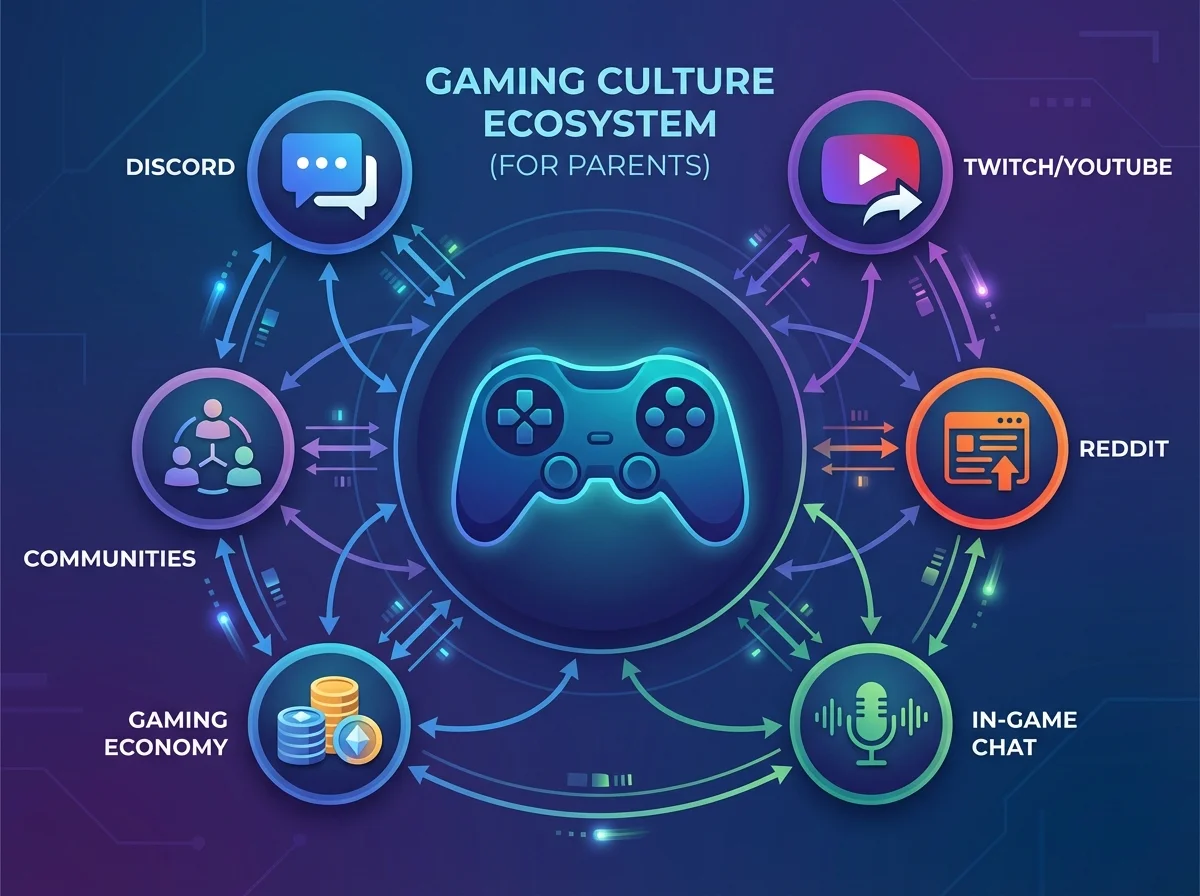
- Discord - Think of it as the group chat on steroids. Servers organized by interest, voice channels for hanging out, text channels for sharing. This is the social hub. Our Discord safety guide for parents covers privacy settings and moderation in detail.
- Twitch/YouTube - Where they watch other people play (more on this in Section 4).
- Reddit - Where they discuss strategy, share clips, argue about updates.
- In-game chat - Voice and text communication built directly into games.
The Economy
This is where a lot of parents hit a wall. "You want me to spend $20 on a SKIN? It doesn't even do anything!"
I said the same thing. Then I realized something.
When your kid asks for V-Bucks or Robux, they're not wasting money. They're buying social participation. Skins, cosmetics, battle passes... these are identity expression in a digital space. It's how your kid shows up in their world. It's fashion.
Think about it this way: did you ever want a specific pair of shoes in middle school? Not because they made you run faster, but because they mattered socially? Same thing. The shoes didn't "do anything" either. They meant something.
That doesn't mean you hand over unlimited money. But understanding WHY it matters to them changes the conversation from "that's a waste" to "let's figure out a budget for this." For a complete breakdown of V-Bucks, loot boxes, and battle passes, check out our gaming monetization guide.
The Social World Inside the Screen (What Parents Can't See)
This might be the most important section in this entire article, because it addresses the biggest misconception parents have about gaming: that it's isolating.
It's the opposite.
Gaming Is Hanging Out
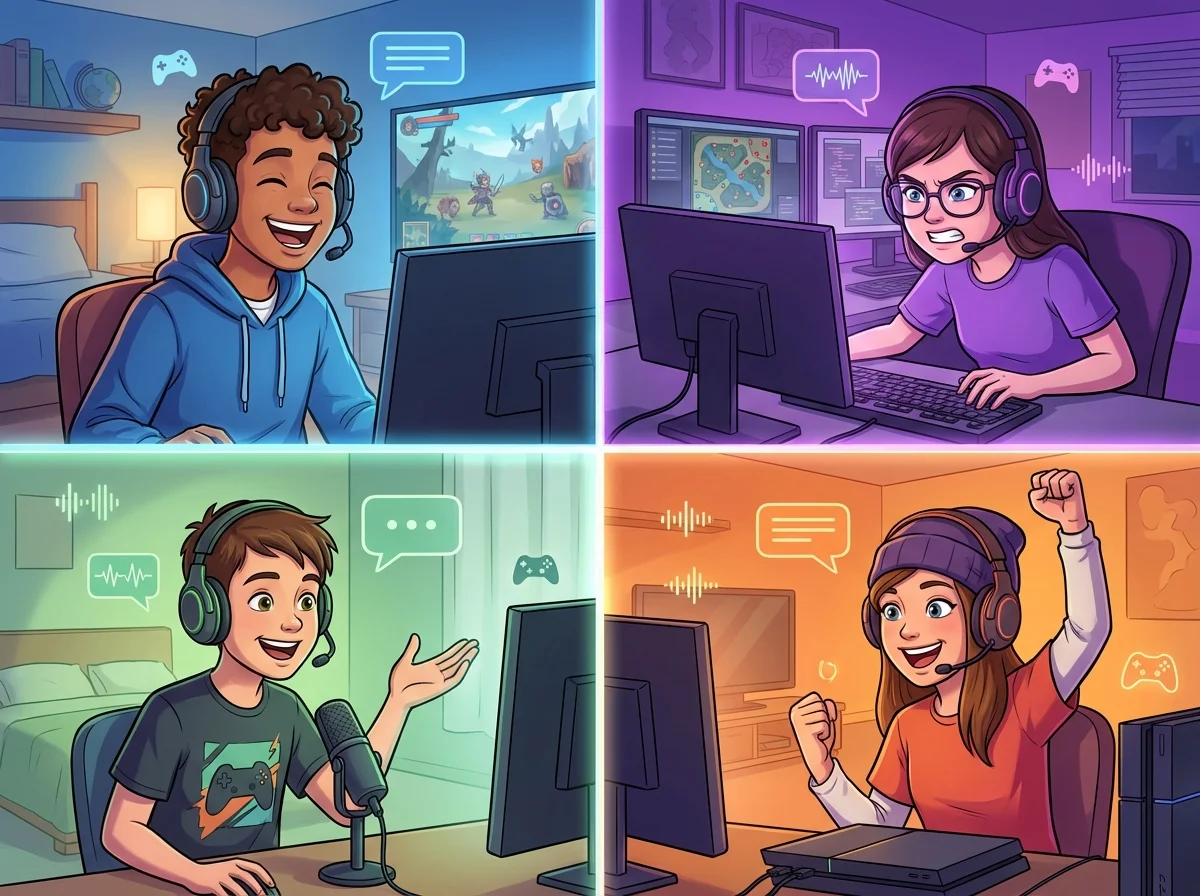
For Gen Alpha and Gen Z, "playing games together" IS socializing. When your kid says they're "hanging out with friends," they might mean they're in a Discord call playing Minecraft together. And that's real. That's genuine social interaction, complete with jokes, arguments, inside references, and all the messy beautiful stuff that comes with friendship.
I know it doesn't look like socializing. It doesn't look like what we did. We rode bikes to each other's houses. We hung out at the mall. But the function is identical. The medium changed. The human need didn't.
When you dismiss online friendships with "those aren't real friends," you're dismissing your child's entire social life. I made that mistake once. My son's face told me everything I needed to know about how that landed. I never said it again.
Discord and Gaming Communities
Your kid has probably found communities organized around their specific interests. A Discord server for fans of a particular game. A group that builds together in Minecraft. A competitive team that practices regularly.
These communities give kids something powerful: belonging based on shared passion, not just geography. Your kid might not click with anyone at school but have a tight-knit group of friends who share their exact interests online. That matters enormously.
Teamwork and Leadership
Here's where it gets really interesting.
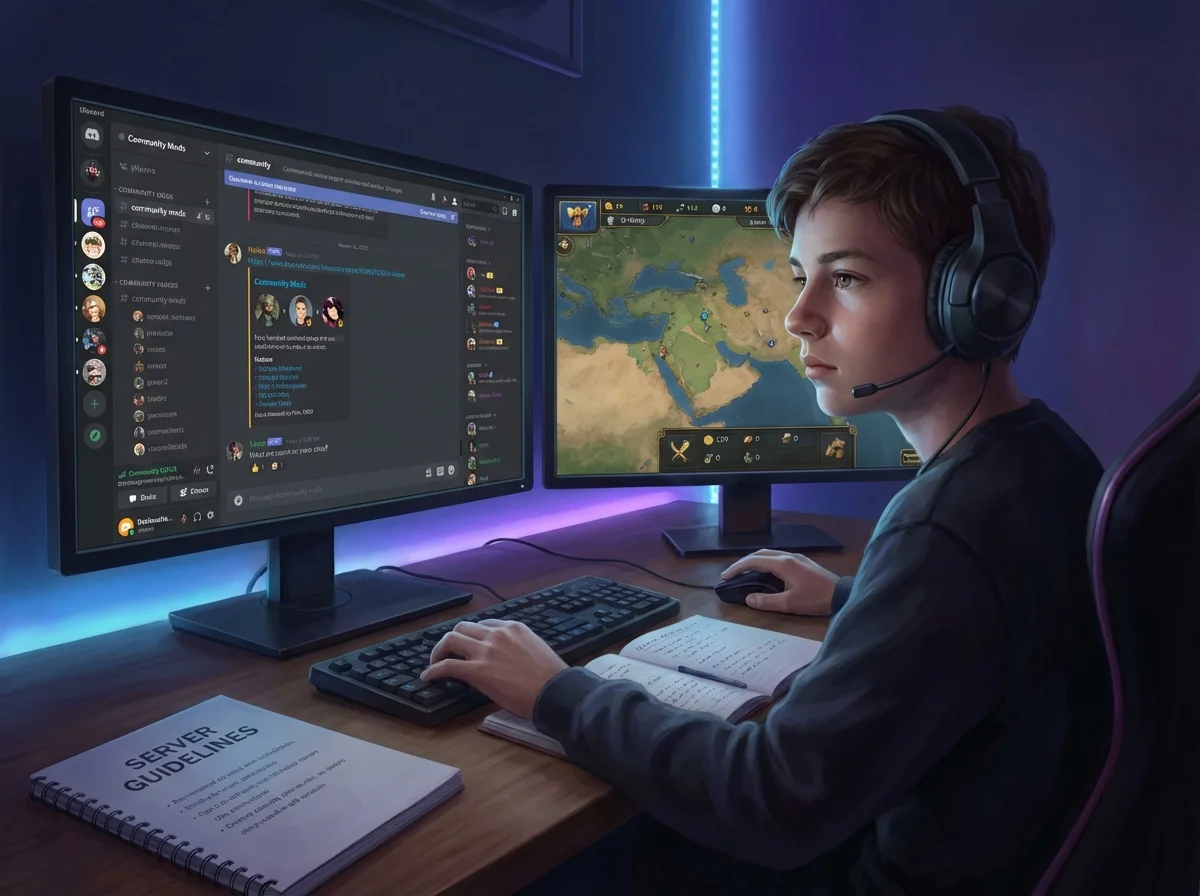
I discovered my son had become a moderator in a Discord server when he was 13. I had no idea. When I found out, I asked him about it. He explained that he was managing conflicts between members, setting rules, holding people accountable when they broke those rules, and making decisions about who to let in and who to remove.
He was 13. Running a community of a few hundred people. Developing leadership, conflict resolution, and governance skills that no summer camp or classroom project could replicate. And I almost missed it entirely because I was too busy worrying about his screen time.
Look, I'm not saying every kid who games is secretly learning to be a CEO. But the skills are real. Strategic thinking, communication under pressure, teamwork, planning, adapting on the fly. Raid groups in online games require genuine coordination. Competitive teams require practice, analysis, and working through disagreements. This stuff transfers. For a deep dive into the specific skills video games teach, check out our complete guide to what games actually teach kids.
The Emotional Stakes
"Why does my kid freak out over a game?"
Because it's not just a game to them. When your kid rages after losing, they're not having a meltdown over pixels. They're feeling the sting of failing in front of friends. The frustration of hours of effort not paying off. The pressure of wanting to perform for people they care about.
Sound familiar? It should. It's the same thing you felt when you struck out in Little League or bombed a presentation at work.
The emotions are real even if the arena is digital. Responding with "it's just a game" is like someone telling you "it's just a job" when you're stressed about work. Technically true. Completely unhelpful.
 Watch one video togetherPause, Play, Connect: Core Deck$49 CAD • 172 promptsSee the deck
Why Kids Watch Other People Play Games (And Why It Makes Total Sense)
If there's one thing that truly baffles parents, it's this: "Why are you watching someone ELSE play a video game? Why don't you just... play it yourself?"
Fair question. Here's your answer.
Do you watch cooking shows? You could just cook. Do you watch football? You could just go play in the backyard. Do you watch home renovation shows? You could just renovate your house.
We watch people do things we enjoy because watching skilled, entertaining people perform is fun. It's that simple.
Streamers on Twitch and YouTube aren't just playing games. They're entertainers. They're storytellers, comedians, community builders. The best ones create a feeling of hanging out with a funny friend. Kids tune in for the personality as much as the gameplay.
There's also a learning component. Kids watch to get better. They study strategies, learn new techniques, discover things they didn't know about a game. It's like watching game film in sports.
And yes, there's a parasocial element. Streamers can feel like friends, especially for kids who might struggle socially in other environments. That's worth keeping an eye on, just like you'd want to make sure any media relationship stays in a healthy range. But it's not automatically a problem.
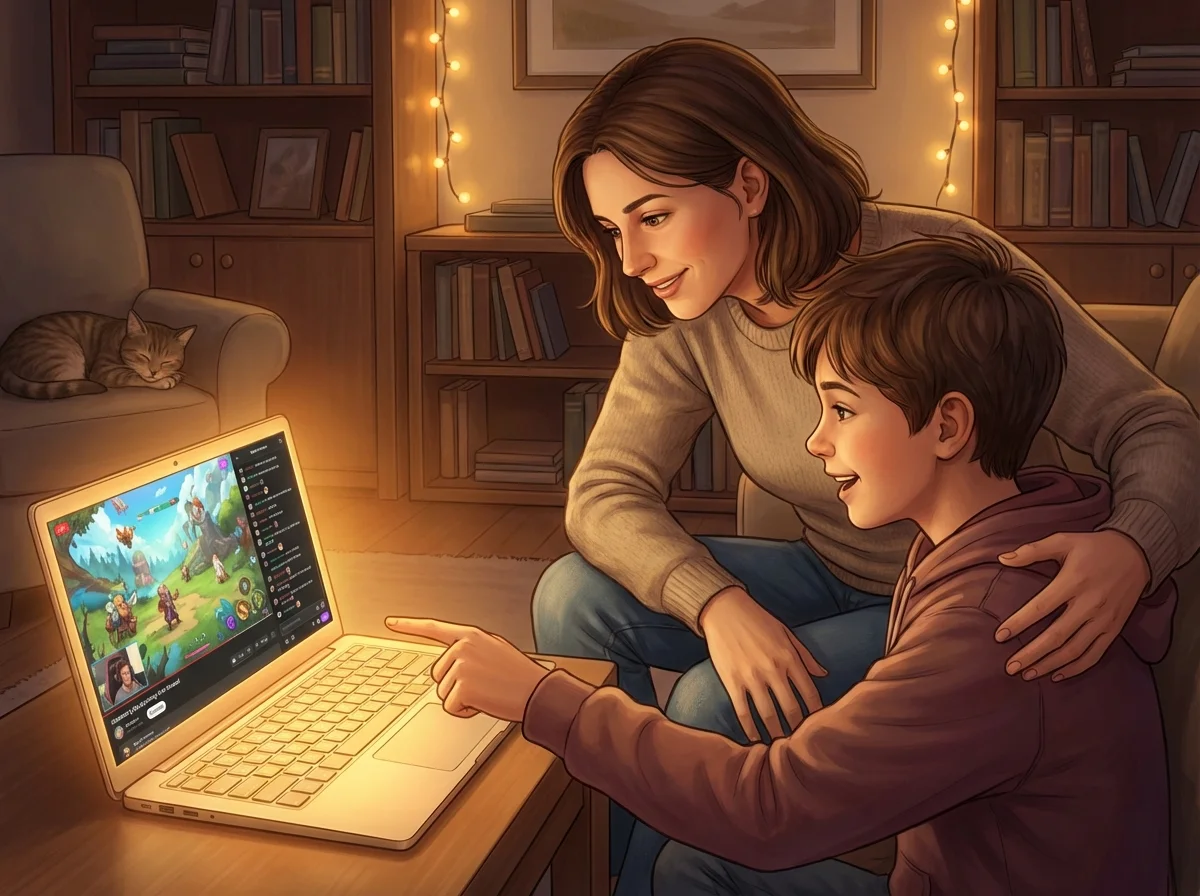
Here's a practical way to use this: ask your kid who their favorite streamer or YouTuber is. Then sit down and watch one video together. Just one. You'll learn more about what your kid values, what makes them laugh, and how they see the world in that fifteen minutes than in a week of "how was school?" For more on why kids watch Twitch and YouTube gaming, our complete guide breaks down the appeal and what to watch for.
The Stuff Worth Worrying About (Honest, Not Alarmist)
I promised you honesty, not just cheerleading. So let's talk about the real concerns.
Real Risks, Honestly Assessed
Predatory monetization. Some games are designed to extract money from players, especially younger ones. Loot boxes that function like slot machines. Limited-time offers creating artificial urgency. "Free-to-play" models that pressure spending. This is worth understanding and setting clear boundaries around.
Toxic voice chat. Online gaming can expose kids to racist, sexist, and generally awful behavior from strangers. This is real, it's common, and it's something to talk about openly with your kid. Not to scare them, but to prepare them. Our complete guide to handling toxic behavior covers reporting tools, conversations to have, and when to escalate.
Sleep displacement. The most common actual health impact of gaming isn't violence or addiction. It's kids staying up too late because "one more game" turned into three more hours. This one matters.
Gambling mechanics. Loot boxes and certain in-game systems mimic gambling patterns. Some countries have started regulating these. Worth knowing about, especially for younger kids.
What's Overblown
"Video games cause violence." This has been studied extensively for decades. The research doesn't support it. Violent crime has decreased as gaming has increased. The moral panic around game violence is a repeat of the same panic around rock music, comic books, and Dungeons & Dragons.
"Gaming is antisocial." As we covered above, modern gaming is deeply social for most kids. The antisocial gamer stereotype is about 20 years out of date.
"All screen time is equal." Passively scrolling TikTok for two hours and actively problem-solving in a cooperative game for two hours are fundamentally different activities. Lumping them together as "screen time" makes no more sense than lumping reading a novel and staring at a wall together as "sitting."
The Addiction Question
This is the big one. Let me be straight with you.
Problematic gaming is real. About 3-5% of gamers develop patterns that genuinely interfere with their lives. That's a real number and it's worth taking seriously.
But here's what that number also tells you: 95-97% of kids who game are fine. Passionate, enthusiastic, maybe a little obsessive about it, but fine. The same way a kid who plays travel soccer six days a week is passionate, not addicted.
How do you tell the difference? Ask yourself these questions:
- Are they still meeting their obligations (school, chores, basic responsibilities)?
- Do they have relationships outside of gaming (even if those relationships happen online)?
- Can they stop when genuinely needed, even if they complain about it?
- Are they still eating, sleeping, and functioning?
- Do they enjoy gaming, or does it seem more like they can't NOT do it?
If the answers are mostly yes to the first four and "they enjoy it" for the last one, you're probably looking at a passionate kid, not an addicted one.
If you're seeing real warning signs, like declining grades, loss of all non-gaming interests, inability to stop even when they want to, aggressive behavior when access is removed, or withdrawal from all relationships, that's worth professional attention. Talk to your pediatrician.
Red Flags vs. Green Flags
Green flags:
- Talking excitedly about what happened in a game
- Playing with friends (online or in person)
- Learning new skills (building, strategy, problem-solving)
- Able to pause or stop for meals, school, family time
- Gaming alongside other interests and activities
Red flags:
- Hiding gaming or lying about how much they play
- Loss of interest in everything except gaming
- Significant mood changes when they can't play
- Declining performance in school or other areas
- Complete withdrawal from family and in-person friends
On Restrictions
Here's a counter-intuitive truth: restricting gaming harshly often backfires. Kids hide it. They play at friends' houses. They lie about it. They resent you for it. And the resentment damages the relationship you're trying to protect.
Setting boundaries together, with their input, works better than top-down rules. "How do we make sure gaming fits into your life without crowding out sleep and school?" is a better conversation than "You get one hour and that's final."
For Co-Play Windows: A prompt during the in-between beat is how gamer kids open up. Set the Pause, Play, Connect deck beside the console so a card is within arm's reach during your co-play session.
How to Actually Connect With Your Kid Through Gaming
A deck of conversation cards for families with gamer kids turns these chats into a nightly habit.
OK. You understand the culture now. You see why it matters to your kid. Here's the practical part: how do you actually use this knowledge to connect?
I think of it as levels, like in a game (see what I did there).
Level 1 - Show Curiosity
This costs you nothing and it's the most powerful move you can make. Sit down next to your kid while they're playing. Don't say "how long have you been on?" Say "what's happening right now?" or "who are you playing with?"
Ask real questions. "What's the goal here?" "Why did you do that?" "What's your favorite part about this game?"
And here's the key: actually listen to the answer. Don't use it as a segue into a lecture. Just listen. Be interested. If you don't understand something, say so. "I have no idea what that means, but it sounds cool" goes a long way.
Level 2 - Learn the Language
Pick up a few gaming terms from the glossary below. Then, when the moment is right, drop one naturally in conversation.
"So did your team clutch it?"
Watch what happens. Your kid will probably stop, stare at you, and either laugh or be genuinely impressed. Either reaction is a win. You just showed them you're paying attention. That you care enough to learn their language.
Level 3 - Try It Yourself
Ask your kid to teach you their game. This is the big one.
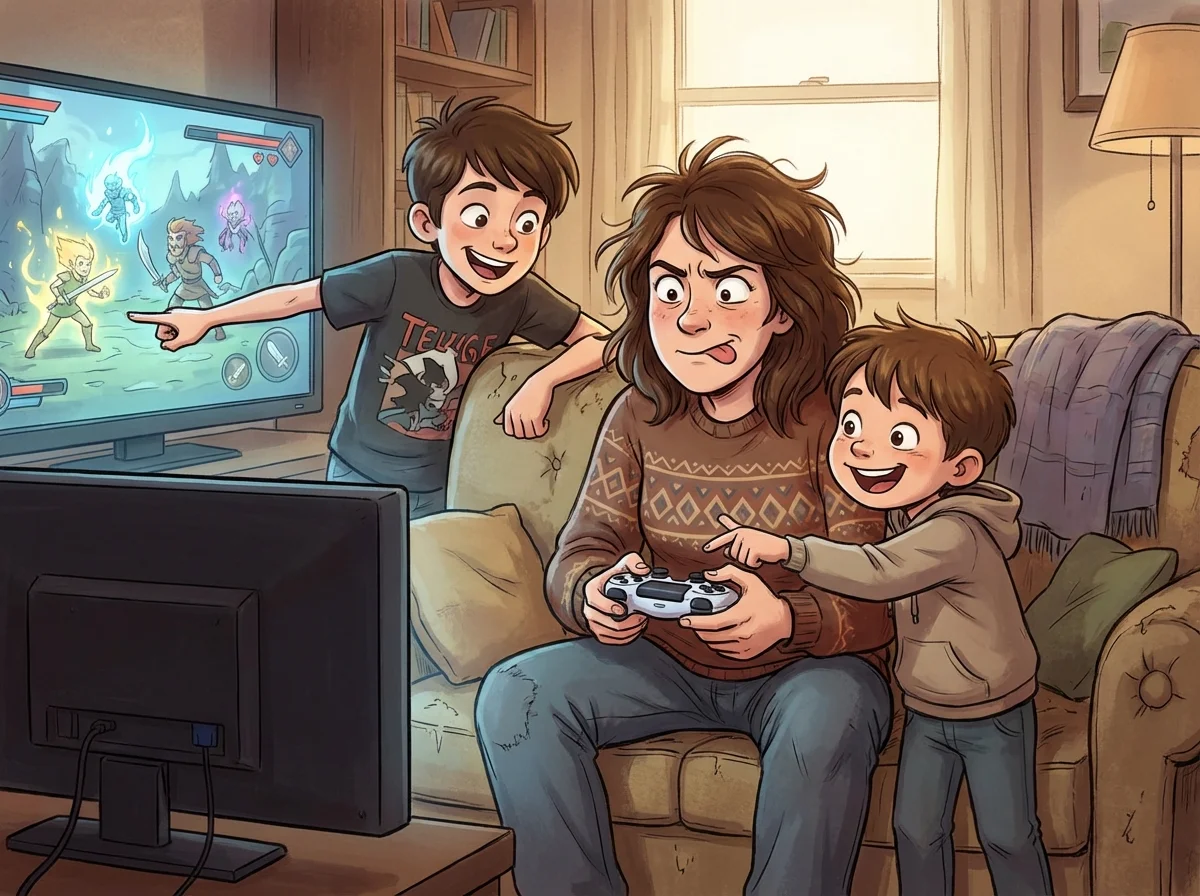
The first time I played Fortnite with my kids, I was hilariously bad. I couldn't figure out the controls. I kept looking at the ground. I died within thirty seconds of every round.
And my kids were patient with me. They gave me tips. They showed me where to go. They laughed, sure, but they were laughing WITH me. We laughed harder together that evening than we had in months.
Here's why this works: you're letting your kid be the expert. In almost every other area of their life, adults are the authorities. School, sports, rules, life decisions. But in gaming, they know more than you. Letting them teach you flips the script. It builds their confidence and it builds trust between you.
You don't need to be good. You just need to be there and be willing to try. For more on making this a regular thing, our parent's guide to playing video games with your kids has practical tips and game recommendations.
Level 4 - Play Together Regularly
Once you've found a game you both enjoy, make it a thing. Schedule it like you'd schedule family dinner. Tuesday night is gaming night. Saturday morning co-op sessions.
Great games to start with:
- It Takes Two - literally designed for two players, parent and kid
- Overcooked - chaotic fun, guaranteed laughter
- Mario Kart - the universal equalizer
- Minecraft - build a world together
- Stardew Valley - relaxing, cooperative farming
Level 5 - Bridge Digital and Physical
This is where gaming culture becomes a launchpad for connection beyond the screen. When you understand what your kid loves about gaming, you can bring that energy into other shared experiences.
Talk about game strategy over dinner. Debate which game character would win in a fight. Use gaming references they'll actually get. Take the conversation topics that light them up digitally and find ways to explore them face-to-face.
This is actually why we created Yakety Pack. We realized that some of the best conversations happen when you take the energy of gaming culture and bring it to the table, literally. Our conversation card games are designed to bridge exactly this gap between your world and theirs. Questions like "What game character would you want as a friend?" aren't about getting kids off screens. They're about understanding what kids love and giving the whole family a way to talk about it together.
The point isn't to replace gaming. It's to extend the connection that gaming creates into every part of your family's life.
Gaming Slang Your Kid Wishes You Knew
Bookmark this section. Come back to it. Use it as your cheat sheet.
Gameplay Terms
| Term | What It Means | Example |
|---|---|---|
| GG | "Good game" - said after a match | "GG, that was close" |
| Noob/Newb | New or unskilled player | "Don't worry, everyone's a noob at first" |
| Nerf | When developers make something weaker | "They nerfed my favorite weapon" |
| Buff | When developers make something stronger | "That character got a huge buff" |
| Meta | The current best strategy | "Playing the meta is boring but effective" |
| AFK | Away from keyboard (stepped away) | "I'm going AFK for a sec" |
| Clutch | Winning against the odds under pressure | "That clutch saved the whole match" |
| Carry | One player dragging the whole team to victory | "She carried us so hard" |
| Camp | Hiding in one spot waiting for enemies | "Stop camping, that's so cheap" |
| Spawn | Where/when a player or item appears | "I got spawn-killed" |
| Lag/Ping | Slow connection causing delay | "I'm lagging so bad right now" |
| Main | Your go-to character | "Who's your main?" |
| Griefing | Intentionally ruining others' fun | "That guy is just griefing everyone" |
Social Terms
| Term | What It Means | Example |
|---|---|---|
| Sweaty/Tryhard | Playing intensely competitive | "This lobby is so sweaty" |
| Bot | Playing so badly you seem computer-controlled (insult) | "That guy's a total bot" |
| Goated | The greatest, the best | "He's goated at this game" |
| Cracked | Incredibly skilled | "That player is cracked" |
| Mid | Mediocre, nothing special | "That game is mid" |
| NPC | Someone acting robotic or scripted (real-life insult) | "Don't be an NPC, think for yourself" |
| Sus | Suspicious (popularized by Among Us) | "That play was kinda sus" |
| Touch grass | Go outside (insult suggesting someone plays too much) | "You need to touch grass" |
Emotional Expressions
| Term | What It Means | Example |
|---|---|---|
| Salty | Upset, bitter about losing | "Don't be so salty" |
| Tilt/Tilted | Frustrated to the point it's affecting your play | "I'm so tilted right now" |
| W | A win, something good | "That's a W move" |
| L | A loss, something bad | "That's an L" |
| Ratio | Getting more engagement on a reply than the original (being shown up) | "L + ratio" |
Pro tip: you don't need to memorize all of these. Pick three that feel natural and try using them. "Was that a W or an L?" is an easy one to start with. Your kid will be shocked, and probably delighted, that you're speaking their language.
For the Long Build: Becoming an ally happens through many small low-pressure conversations. A deck of Yakety Pack conversation cards on the dinner table is the easiest one to keep.
Your Next Move - From Outsider to Ally
Let's bring this home.
The single biggest shift in understanding gaming culture for parents is this: move from cautious to curious. Stop worrying about screen time. Start worrying about connection time. The hours your kid spends gaming matter far less than whether you're part of their world or locked out of it.
Your kid's gaming friends are real friends. The skills they're developing are real skills. The emotions they feel are real emotions. The culture they belong to is a real culture.
You don't have to love it. You don't have to understand all of it. You just have to respect it enough to take it seriously.
Here are three things to do this week:
1. Ask your kid to show you their favorite game for 10 minutes. Not to evaluate it. Not to set limits. Just to see what they see. Ask questions. Be curious.
2. Learn 3 gaming slang terms and use one naturally. Check the glossary above. Pick something that fits. Drop it in casually. See what happens.
3. Watch one video of their favorite streamer or YouTuber together. Let them pick. Sit down, watch it, and ask them what they like about this person. You'll learn something.
That's it. Three small actions. No big dramatic intervention. No family meeting about screen time. Just three quiet steps toward your kid's world.
If you need more conversation starters that actually work with gaming kids, check out How to Talk to Kids About Fortnite. It's full of specific questions that get real answers, not grunts.
Here's what I've learned after years of figuring this out: every parent feels lost in their kid's world at some point. That's not failure. That's just the natural result of raising someone who's becoming their own person.
The parents who stay connected aren't the ones who understand everything. They're the ones who keep asking.
So ask. Listen. Try. Be bad at their game and laugh about it. Use the wrong slang and let them correct you. Show up in their world even when it feels foreign.
Because that door to your kid's room? It's not locked. You just have to knock.
Three small steps this weekPause, Play, Connect: Core Deck172 prompts that turn being curious into an actual question you can ask at dinner tonight.$49 CAD • 90 cards • 18 reviewsShop the deck
Related Articles
Looking for more ways to connect with your kids in the digital age? Check out these guides:

