
For two years, I treated my son's strategy game time like junk food. Necessary evil, tolerated in small doses, lectured about regularly. Then one rainy Saturday I sat down next to him during a Clash Royale match. Three minutes later, I realized he'd made more complex decisions in that match than I'd made all morning at work.
That was the moment the question changed for me. I'd been asking "are strategy games good for kids?" like the answer was yes or no. Turns out the real answer is: "yes, if you're paying attention to what your kid is actually doing in there."
Let me explain what I mean.
The Short Answer to "Are Strategy Games Good for Kids?"
Yes. Strategy games are generally good for kids. Better than most parents realize. But the type of game, your kid's age, and whether you ever engage with what they're playing matters more than the games themselves.
Here's the thing nobody tells you. When parents Google "are strategy games good for kids," they're not usually asking an academic question. They're asking, "Am I being a bad parent for letting this continue?" That's the real question under the question. I know because I asked it for years.
The honest answer is: you're not a bad parent for letting your kid play strategy games. You might be a checked-out parent if you've never asked them to walk you through a single match. That's a different problem, and it's fixable.
 Ten minutes on the couchPause, Play, Connect: Core Deck172 prompts that turn a match you watched into an actual conversation.$49 CAD • 90 cards • 18 reviewsShop the deck
What Counts as a Strategy Game Anyway?
This is where most articles get lazy. They say "strategy games" like Chess and Clash of Clans are the same activity. They're not.
Rough breakdown of what your kid is probably playing:
- Turn-based: Chess, Civilization, Pokemon TCG Live. Slow thinking, long-horizon planning.
- Real-time strategy (RTS): StarCraft, Age of Empires. Fast decisions, resource juggling, reading opponents.
- Tower defense: Bloons TD, Roblox tower defense games. Pattern recognition, planning ahead, optimizing.
- Card-based: Clash Royale, Hearthstone, Marvel Snap. Probability, deck-building, bluffing.
- Building/survival with strategic layers: Minecraft, Terraria. Resource management, long-term planning, problem-solving.
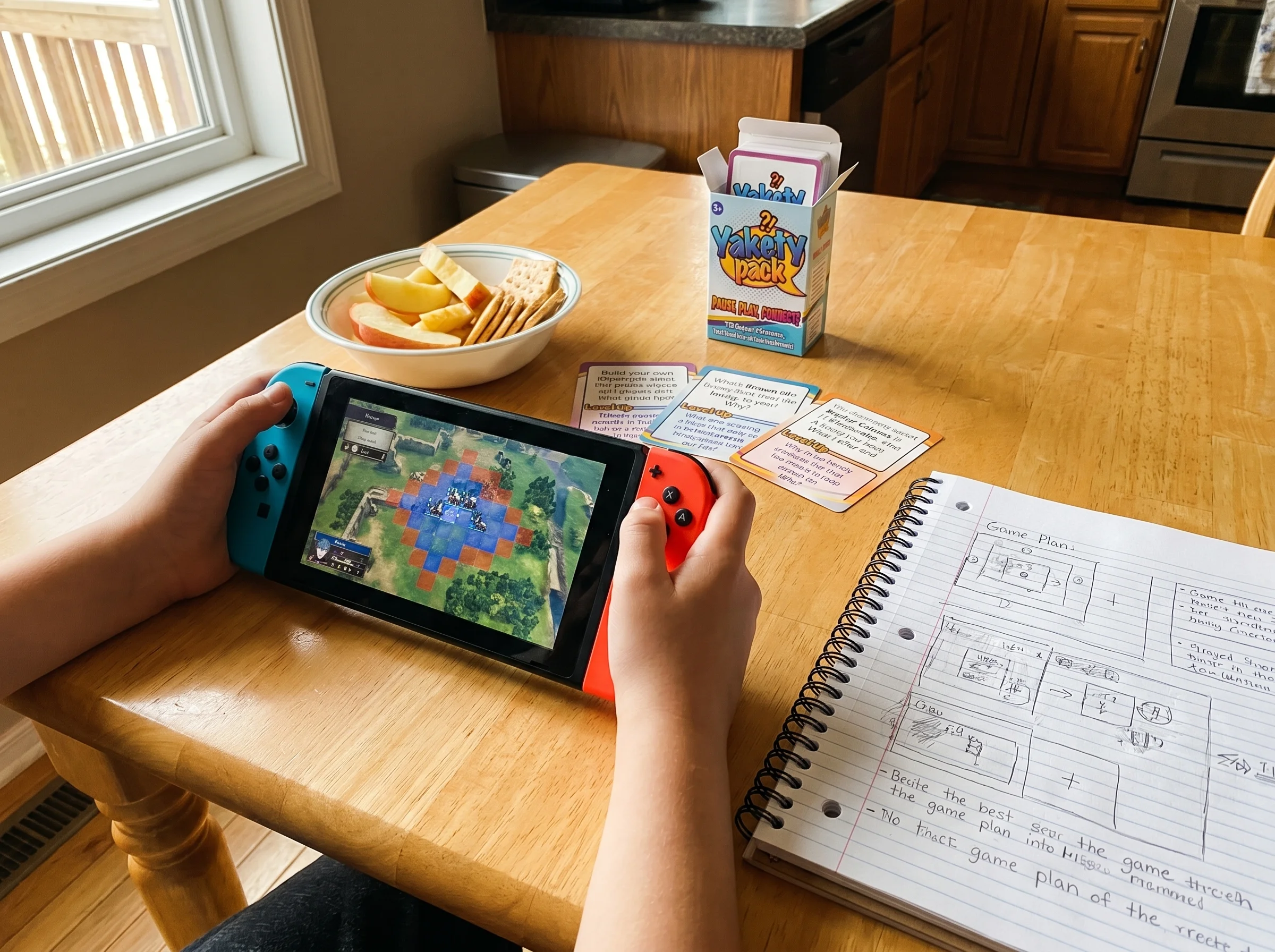
And yes, Minecraft counts. So does Roblox, depending on what they're playing inside it. A kid running a Roblox tycoon game is doing real resource optimization. A kid running through an obby is doing reflex training. Same platform, totally different skills.
Knowing what category your kid's game falls into tells you what skills they're actually practicing.
The Real Benefits of Strategy Games for Kids (With Specific Examples)
Forget vague "improves cognition" claims. Here's what's actually happening:
Decision-making under pressure. A single Clash Royale match has roughly 40 micro-decisions packed into 3 minutes. When to drop a card, what to drop, where, what to hold, what's coming next. That's a rep. Your kid is getting 40 reps every 3 minutes.
Long-horizon planning. A Civilization game requires thinking 20 turns ahead. Most adults I know can't plan 20 minutes ahead.
Resource management. Every strategy game forces tradeoffs. Time vs. gold. Offense vs. defense. Short-term win vs. long-term position. Your kid is doing executive function workouts.
Emotional regulation. This is the most underrated one. Losing a match, getting up, and trying again is a skill. A massive one. Strategy games hand kids the opportunity to fail repeatedly in low-stakes settings. That's gold if they learn to process the loss instead of throwing the controller.
Reading other people. Multiplayer strategy is essentially "predict what this human will do next." That's social cognition.
Real story: my son explained to me why he sacrificed his best unit in StarCraft to bait his friend into overcommitting. He used the word "leverage." He's 12. He didn't get that word from school.
When Strategy Games AREN'T Good (Being Honest)
I'm not going to pretend everything's roses. Strategy games can absolutely be a problem, just not always for the reasons parents fear.
Watch for:
- Grind disguised as strategy. A lot of "freemium" mobile games look strategic but are actually just patience tests with a paywall. If the path to winning is "wait or pay," it's not building strategic thinking. It's building Pavlovian patience.
- Losses that trigger meltdowns nobody processes. If your kid rage-quits and then never talks about it, the loss isn't teaching anything. It's just generating shame.
- Toxic social layers. Some Discord servers and voice chats are brutal. If your kid is in a community where losing means getting flamed, the game stops being good for them.
- Total replacement of other problem-solving. If strategy games are the only place your kid solves problems, that's a flag. They should be one outlet, not the only one.
Honest red flags: rage that doesn't fade after 10 minutes, secrecy about who they're playing with, total abandonment of stuff they used to love. The American Academy of Pediatrics has good frameworks for spotting when gaming has crossed from hobby into something else.

Age-by-Age: Which Strategy Games Are Good for Kids at Each Stage
Quick guide based on what I've seen work in my house and with friends' kids:
Ages 5-7: Simple tower defense (Bloons TD 6 is fine with supervision), basic chess apps like ChessKid, Pokemon-style turn-based games. Keep it short and play alongside them.
Ages 8-11: Minecraft survival mode is huge here. Clash Royale, Roblox tower defense games, intro Civilization-style games like Polytopia. This is the sweet spot for getting into real strategic thinking.
Ages 12-15: Full RTS games like StarCraft and Age of Empires, complex 4X games like Civilization VI, competitive multiplayer. They can handle the complexity. The question is whether they can handle the losses.
Ages 16+: Pretty much anything. But this is when conversation matters more than ever, because they're about to leave your house and you want them processing decisions with you while they still will.
 The talk after, not duringPause, Play, Connect: Core Deck$49 CAD • 172 promptsSee the deck
How to Actually Engage Without Being Weird About It
This is where most parents lose. We mean well, but our questions land like surveys.
Stop asking "how was your game?" You'll get "good." Forever.
Try these instead:
- "What's the smartest move you made today?"
- "Did you do anything that surprised you?"
- "What would you do differently next match?"
- "Who's the best player you ran into? What made them good?"
Sit down and watch a match. Don't comment. Don't coach. Just watch. Ask questions after.
And the big one: play WITH them. Even if you're bad. Especially if you're bad.
I asked my son to teach me Clash Royale once. I lost every match for a solid week. He coached me through it. Told me what cards to use, when to drop them, how to bait a counter. That week shifted our relationship more than any "family dinner" rule ever did. He was the expert. I was the student. He loved it.
When I was trying to find better questions to ask my kids about gaming and basically everything else, I realized I didn't have any in my back pocket. "How was your day" wasn't cutting it. That's actually why we built Yakety Pack, because I needed conversation prompts that met my kids where they actually lived, which for mine was inside a video game half the time. Turns out the right question changes everything.
The Counterintuitive Truth
The best parents I know don't limit strategy games as much as they engage with them.
Limits matter. Of course they do. You don't want your kid playing 8 hours a day. But limits are table stakes. They're the easy part. Any parent can set a timer.
The harder part, the part that determines whether strategy games are actually "good" for your kid, is whether you've ever asked them to walk you through a single decision they made in a match.
Most parents will never know if a game is helping or hurting their kid because they've never asked. They counted hours instead. Hours are the wrong metric. Quality of engagement is the right one.
Here's my actual rule of thumb: if your kid can explain why they made a decision in a game, the game is probably good for them. If they just shrug and say "I dunno, I just played," the game might be running on autopilot mode in their brain. That's the difference between strategy and time-killing, and only you, sitting next to them, can tell which one is happening.
One Thing to Do This Week
Pick a night. Sit down next to your kid while they play. Don't bring your phone. Watch one match. Ask one question after: "What were you thinking right there when you did X?"
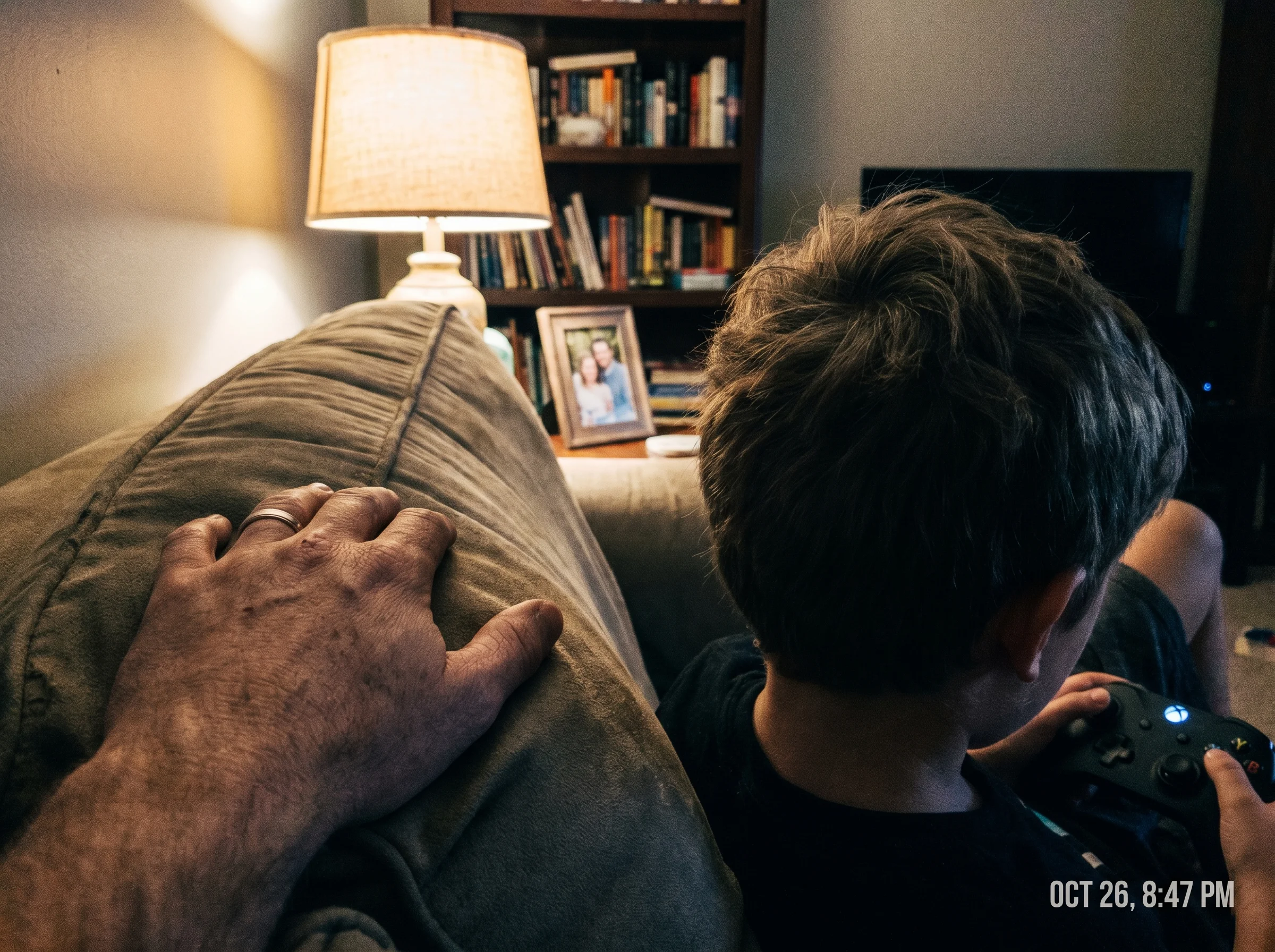
Whatever they say next is more useful than every article you've ever read about screen time. Including this one.
If you want a deeper dive into which strategy games are actually worth your kid's time by age, I broke that down in our pillar guide to strategy games for kids. Start with the conversation, though. The game recommendations come second.

From this article
Pause, Play, Connect: Core Deck
After the match ends: Watching one game is step one. Having a question ready that beats "how was your game" is step two, and that's the part most of us dads fumble. The Pause, Play, Connect Core Deck keeps a stack of better ones within reach on the coffee table.
Related Articles
Looking for more? Check out these related articles:

