
For two years, I told my son that Clash Royale was "rotting his brain." I said it with the smug certainty of a dad who hadn't actually watched a single match.
Then one night, mostly out of boredom, I sat down next to him on the couch and paid attention. Within ten minutes I realized he was managing a resource economy, predicting his opponent's next three moves, and adjusting his deck strategy on the fly based on what cards had been played. He was thinking harder than I'd been thinking all week at work.
I was the one with the rotting brain. Mine had stopped paying attention.
That night kicked off a slow education for me on what strategy games actually do for kids, and what I'd been missing by writing them off. So when people ask me what are the benefits of playing strategy games, I don't give them the standard "improves cognitive function" answer anymore. I give them what I actually learned.
 A way into the conversationPause, Play, Connect: Core Deck172 prompts that open up a conversation with your kid about the games they choose.$49 CAD • 90 cards • 18 reviewsShop the deck
First, Let's Be Honest About What "Strategy Games" Even Means
Most articles on this topic act like strategy games are chess, Risk, and maybe Catan if they're feeling spicy. Meanwhile your kid is playing Clash Royale, Among Us, and building a 40-hour Minecraft civilization with three friends from school.
Here's the rough taxonomy I use now:
- Turn-based: Chess, Catan, Stratego. Slow, deliberate, lots of thinking time.
- Real-time: Clash Royale, StarCraft, Age of Empires. Fast decisions under pressure.
- Social deduction: Among Us, Werewolf, Mafia. Reading people, hiding intentions.
- 4X / empire builders: Civilization, Stellaris. Long-arc planning over hours or days.
- Co-op strategy: Pandemic, Gloomhaven, Overcooked. Solving problems together.
The type matters because the benefits aren't identical. A kid playing Among Us is sharpening different muscles than a kid playing chess. Both are valuable. Neither is "better." My first mistake was thinking only the dusty board games on my parents' shelf counted as "real" strategy. That snobbery cost me about 18 months of actual connection with my son.
Benefit #1: They Teach Kids to Lose Without Falling Apart
Modern childhood has weirdly little structured failure in it. Kids get participation trophies, retake tests, level up in games that are designed so they can't really lose. Strategy games are different. Strategy games are, statistically, mostly losing. Even if you win half your matches, you spent the other half watching your plan fall apart.
That's a feature, not a bug.
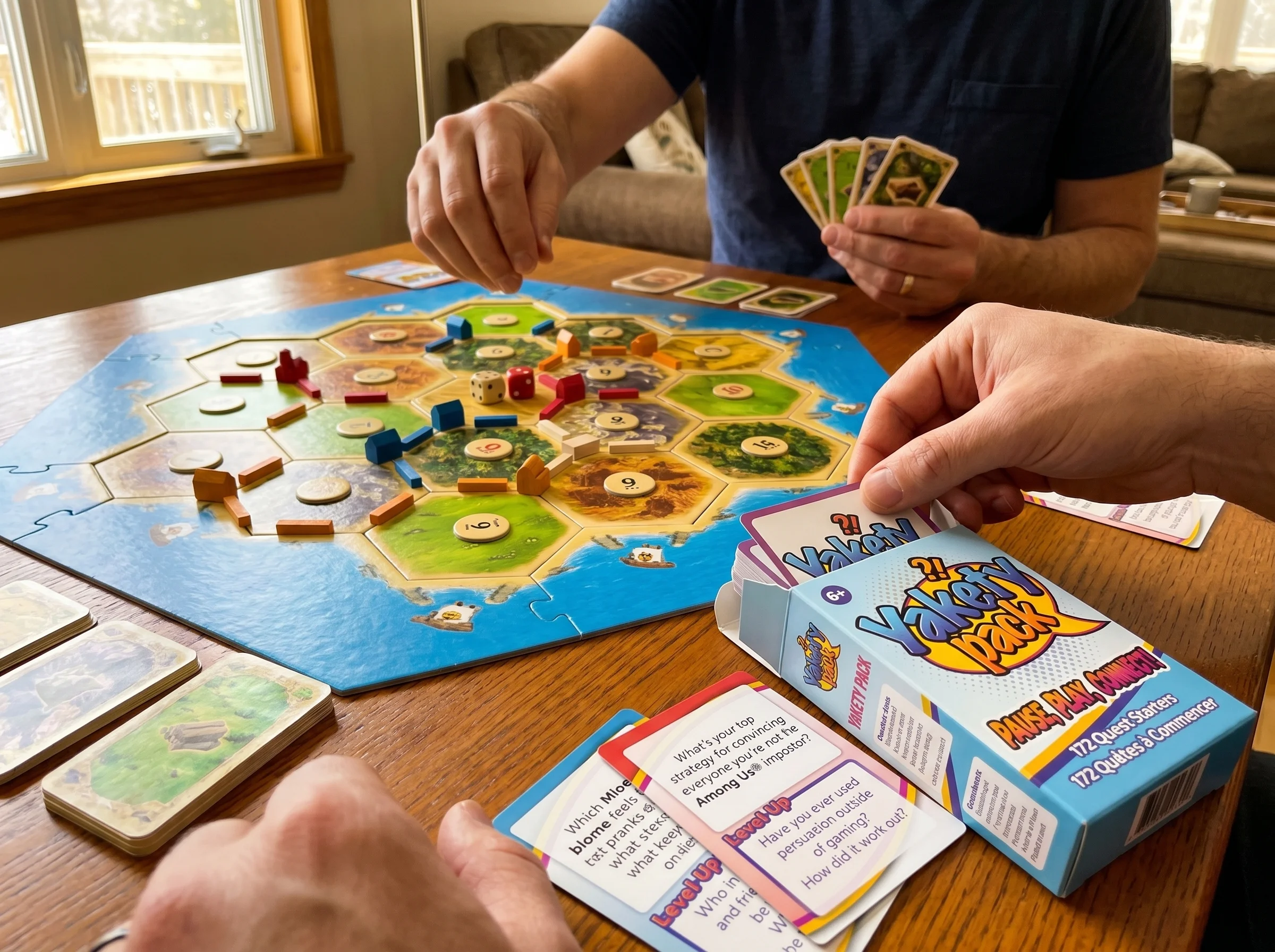
When my son was nine, he flipped a Catan board across the dining room. Wood pieces everywhere. He stomped to his room. My wife looked at me like, "well, that's the last time we play that." I almost agreed with her.
But about a week later, he lost a soccer game on a goal in the last two minutes. Normally that would've been a meltdown. Instead, on the ride home, he said, "I should've played the midfield differently in the second half." That sentence didn't come from soccer. That came from a kid who'd been losing at Catan every Sunday and slowly learning that losing has information in it.
The rage-quit phase is part of the benefit. It's where they learn that the world doesn't end when you lose, and that there's usually a reason you lost that you can actually study. You just have to be patient enough to ride out the storm before the lesson sticks.
Benefit #2: They Force Real Decision-Making, Not Just Reactions
Most of what our kids consume is reactive. Scroll, swipe, like, tap. Even most action games are pattern-recognition and reflexes. Strategy games are the opposite. They make you sit with a choice.
Do I take the wheat port now and slow down my road-building? Do I save my elixir for a counter-push or attack now while their tower is weak? Do I research democracy or stay in monarchy for two more turns?
Those decisions involve trade-offs, opportunity cost, and consequences that don't show up for a while. That's the exact mental work kids will need to do later when they're choosing classes, choosing friends, choosing whether to study or scroll. Strategy games are basically a low-stakes gym for high-stakes decisions. Researchers at the American Psychological Association have noted that strategic gameplay builds problem-solving skills that carry into school performance.
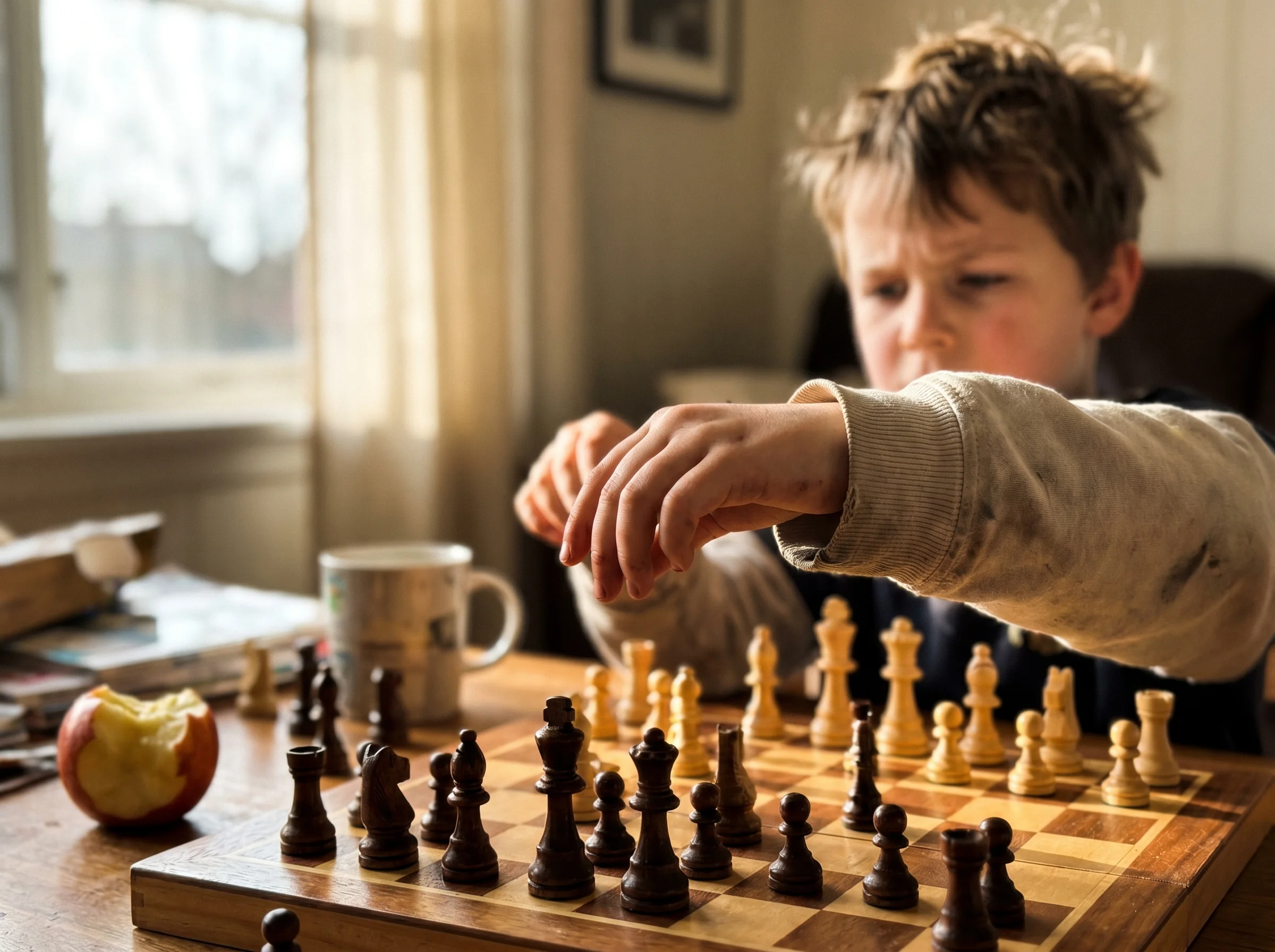
One honest caveat: this benefit only really kicks in when the game is slightly harder than your kid. If they're crushing it without thinking, they're not getting strategic reps. They're just enjoying themselves. Both fine. But don't confuse the two.
Benefit #3: They Build Perspective-Taking (The Sneaky Social Skill)
To beat someone at a strategy game, you have to think like them. What are they going for? What would I do in their position? What are they probably planning?
That's literal theory of mind, the same skill that lets a kid figure out why their friend was upset at recess or why a teacher reacted the way they did.
My daughter was playing Risk with her cousin a couple of years back. At one point she said, almost to herself, "He's going to attack Asia next because he needs the continent bonus, and he's worried I'll take Africa." She was eleven. She was doing more social-cognitive work in that moment than I'd seen out of her in a month of school reports.
Social deduction games like Among Us or Mafia turn this dial up to eleven. Kids spend the whole game asking, "what is this person trying to make me believe, and why?" That's not a small skill. That's most of adult life.
 One more thing to askPause, Play, Connect: Core Deck$49 CAD • 172 promptsSee the deck
Benefit #4: They Create Shared Problem-Solving Time With Other Humans
This is the one nobody markets, and I think it's the biggest of all.
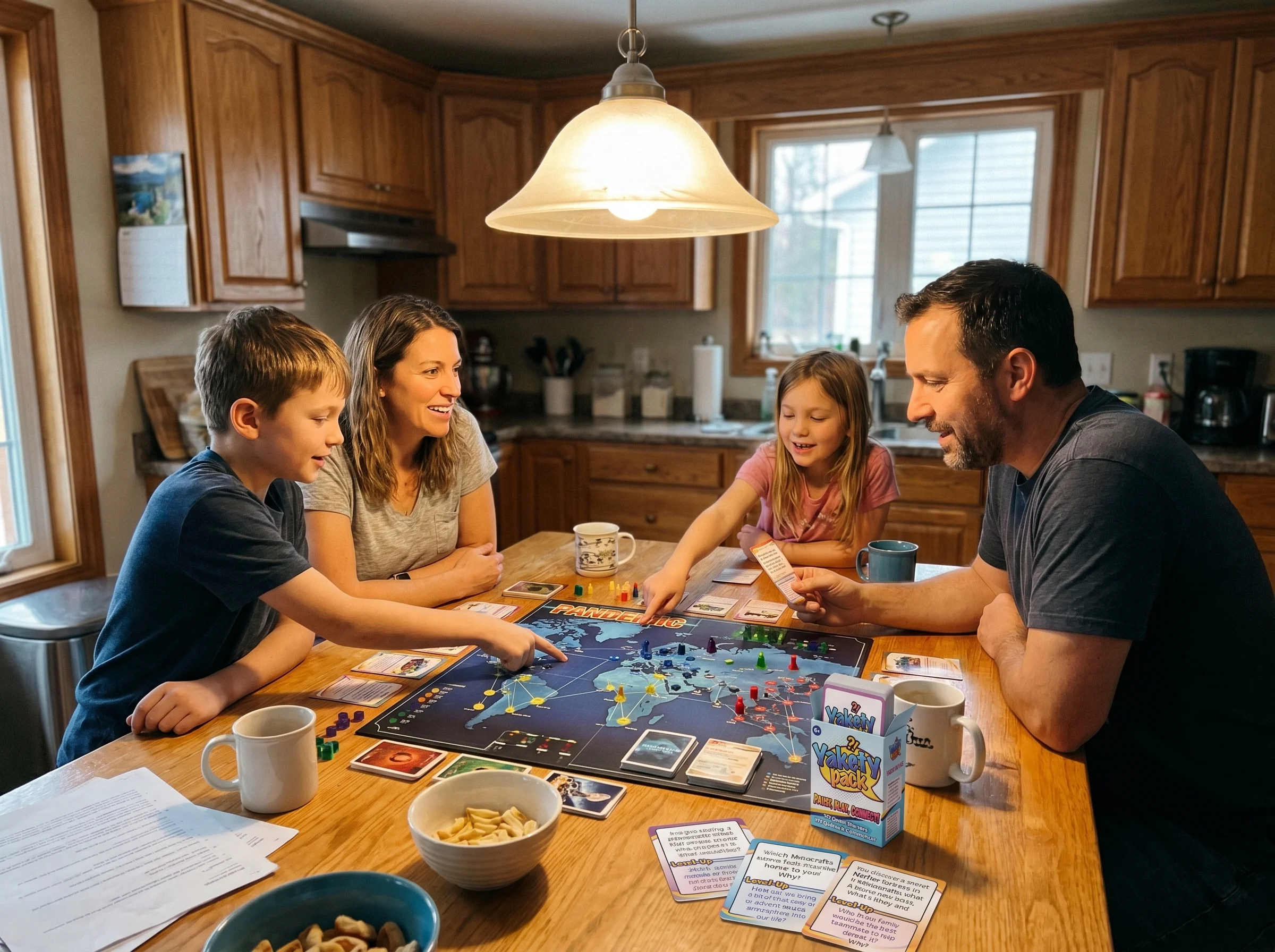
Co-op strategy games like Pandemic or Gloomhaven literally cannot be played without talking through problems together. "If you go to Cairo, I can hit Lagos, and we still have one action to spare." That's a kid and a parent negotiating, planning, and executing a shared idea. Try getting that out of "how was school today?"
Even competitive strategy games create rich post-game conversations. "Why'd you sacrifice that piece?" "I knew you'd take it, and that opened up my queen." That kind of exchange tells you how your kid thinks under pressure, what they value, what they're willing to risk. I've learned more about my son in those debrief conversations than in any parent-teacher conference.
This is honestly the reason we built Yakety Pack. We kept noticing that the best conversations with our kids happened right after games, not at the dinner table. One of our cards asks, "What's a move you made in a game that you're still proud of?" That question opens up a completely different conversation than "how was your day?" Kids will tell you stories about a play they made three months ago, and somewhere in there you'll hear what they think bravery is, or fairness, or being a good teammate. The game is the door. The conversation is the room.
Benefit #5: They Train Patience in a World That Killed It
Strategy games run on delayed gratification. You set up. You build. You wait for the right moment. The payoff comes late, and sometimes it doesn't come at all. That's the exact opposite of the dopamine drip kids get from short-form video, where the reward is every three seconds.
Even fast strategy games like Clash Royale require more patience than they look. You're saving elixir, holding a counter card, waiting for the right push. My son lost matches for months because he'd dump his whole hand the second the game started. Eventually he learned to wait. That's a skill that doesn't stay in the game.
Not all strategy games are equal here. Some are more about pattern matching than patience. But most of them, played seriously, will ask a kid to delay a reward for something better later. That alone is worth the screen time.
How to Actually Get the Benefits of Playing Strategy Games (Just Playing Isn't Enough)
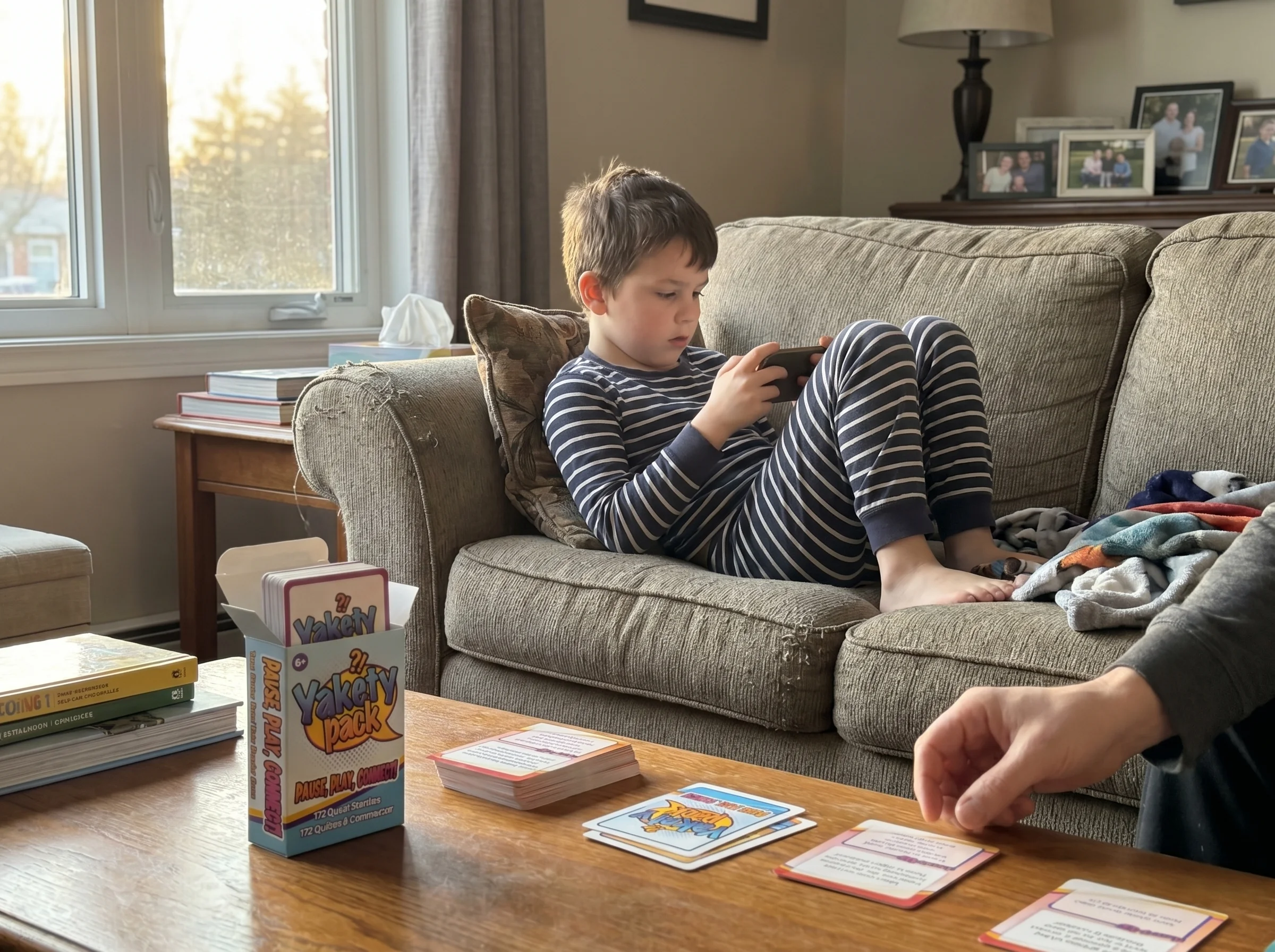
Here's the thing nobody says out loud: kids don't automatically absorb the benefits of strategy games. The benefits show up when the playing gets talked about.
A few things that have worked for me:
Debrief, don't coach. Don't sit there during the game telling them what to do. That kills it. Wait until it's over and ask one open question. "What's the move you wish you'd made differently?" Then shut up and listen.
Pick games slightly above their level. Not way above. Slightly. Frustration is fine. Despair isn't.
Let them beat you sometimes. Not always. A kid who only wins learns nothing. A kid who only loses quits.
Skip the "educational" label. Don't pick chess because it sounds smart. Pick the game your kid actually wants to play. A kid who voluntarily plays 500 hours of Clash Royale is getting more strategic reps than a kid forced through 20 hours of chess lessons. Engagement is the multiplier on every benefit on this list.
A Few Questions I Get a Lot
Are video strategy games as good as board games? Mostly yes. The catch: board games force face-to-face talking, which is a benefit in itself. Video strategy with friends online is close, but solo play against AI gives you the cognitive benefits without the social ones. Mix them up.
What age should we start? Earlier than you think. There are strategy games designed for 4-year-olds (Outfoxed, Hoot Owl Hoot). The real strategy benefits start kicking in around 6 or 7, but the habits start way earlier.
My kid loses their mind when they lose. Do we stop? No. That reaction IS the practice. Just pause when it gets too hot, talk about it later when they've cooled off, and try again. The rage is the muscle warming up.
Do the benefits actually transfer to real life? Only if you talk about them. The game itself plants the seed. The post-game conversation is what makes it grow.
One Thing to Try This Week
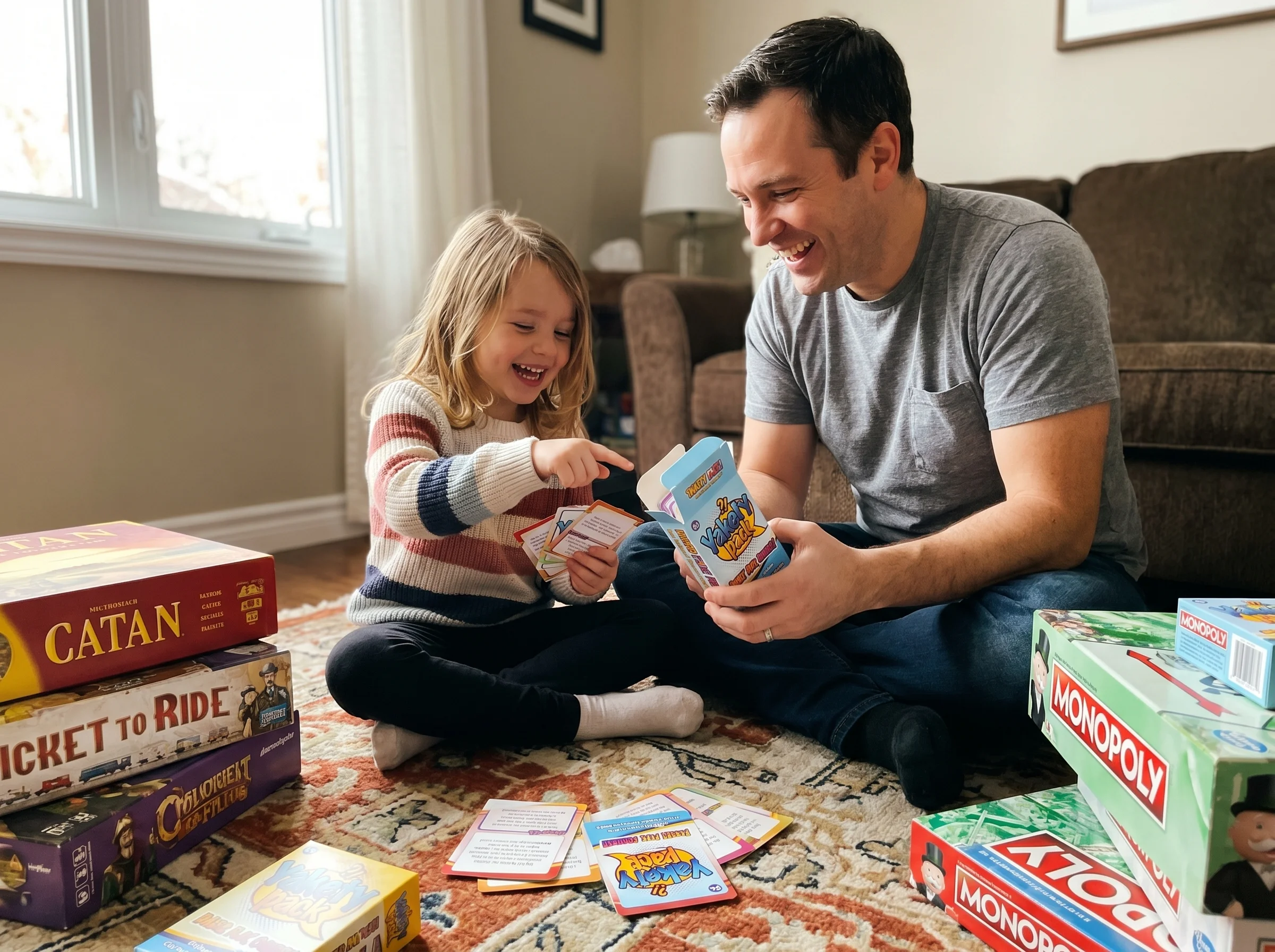
Sit down next to your kid while they play one strategy game. Don't judge, don't coach, don't ask if they've done their homework. Just watch. Ask one question afterward, something like, "what were you trying to do there?"
You'll see something you didn't expect. Maybe how patient they are, or how aggressive, or how they treat someone who's losing. You'll learn something about who they're becoming.
That's the benefit I missed for years. I thought strategy games were about making my kid smarter. They're really about making my kid visible. The brain stuff is a bonus.
The window is the gift.

From this article
Pause, Play, Connect: Core Deck
Making the debrief stick: The benefits transfer when the game gets talked about, and the opening question is the hard part. The Pause, Play, Connect Core Deck gives you a stack of better versions of "what were you trying to do there?"
Want the deeper toolkit? The full bundle adds the Parent Power-Up deck and two digital parent guides, $146 of family fun for $59.

