
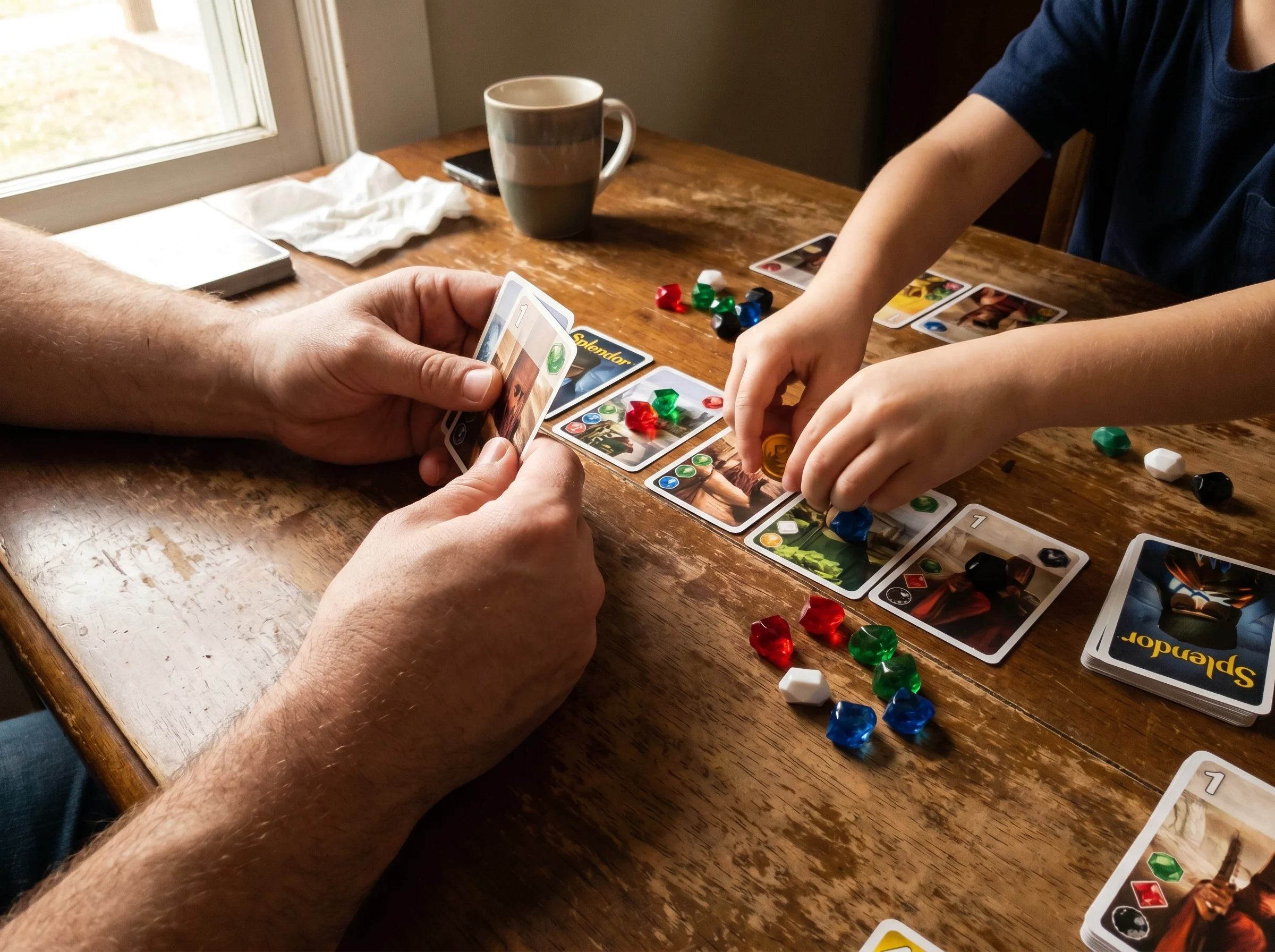
Last Saturday my 9-year-old beat me at Splendor. Not a polite "let dad win" beat. Not a "oh wow, you got lucky, kiddo" beat. A calculated, two-moves-ahead, "I saw what you were going for three turns ago and I bought the green gem to block you" beat.
And the wildest part? When I asked him how he saw it coming, he said, "It's like in Clash Royale. You can't just react. You gotta know what your opponent's saving up for."
That sentence rearranged my brain. Because for years I'd been treating his Clash Royale time as the thing to manage, and our board game nights as the thing to encourage. Turns out he'd been training for Splendor the whole time. I just didn't know how to see it.
If you're hunting for strategy games for kids, I'm betting there's already a strategist living in your house. You might just not recognize them yet. So before we get to the games (we will, I promise, with actual specifics), let's talk about how to spot what you've already got, and how to build on it without killing it.
 A deck for the tablePause, Play, Connect: Core Deck172 prompts that give the family something to talk about once the board games are packed up.$49 CAD • 90 cards • 18 reviewsShop the deck
First, Recognize the Strategist You Already Have
Here's the thing nobody writing these lists wants to admit: most kids today are already playing strategy games. They're just on a screen.
Minecraft? That's resource management and long-term planning. Clash Royale? Elixir economy and counter-deployment. Among Us? Pure social deduction, same family tree as Werewolf and The Resistance. Roblox tower defense? Positioning, opportunity cost, sunk cost. Fortnite build battles? Spatial reasoning under time pressure.
These aren't "junk" versions of strategy. They're strategy. There's actually a growing body of research showing that action and strategy video games train the same cognitive muscles we praise in traditional games.
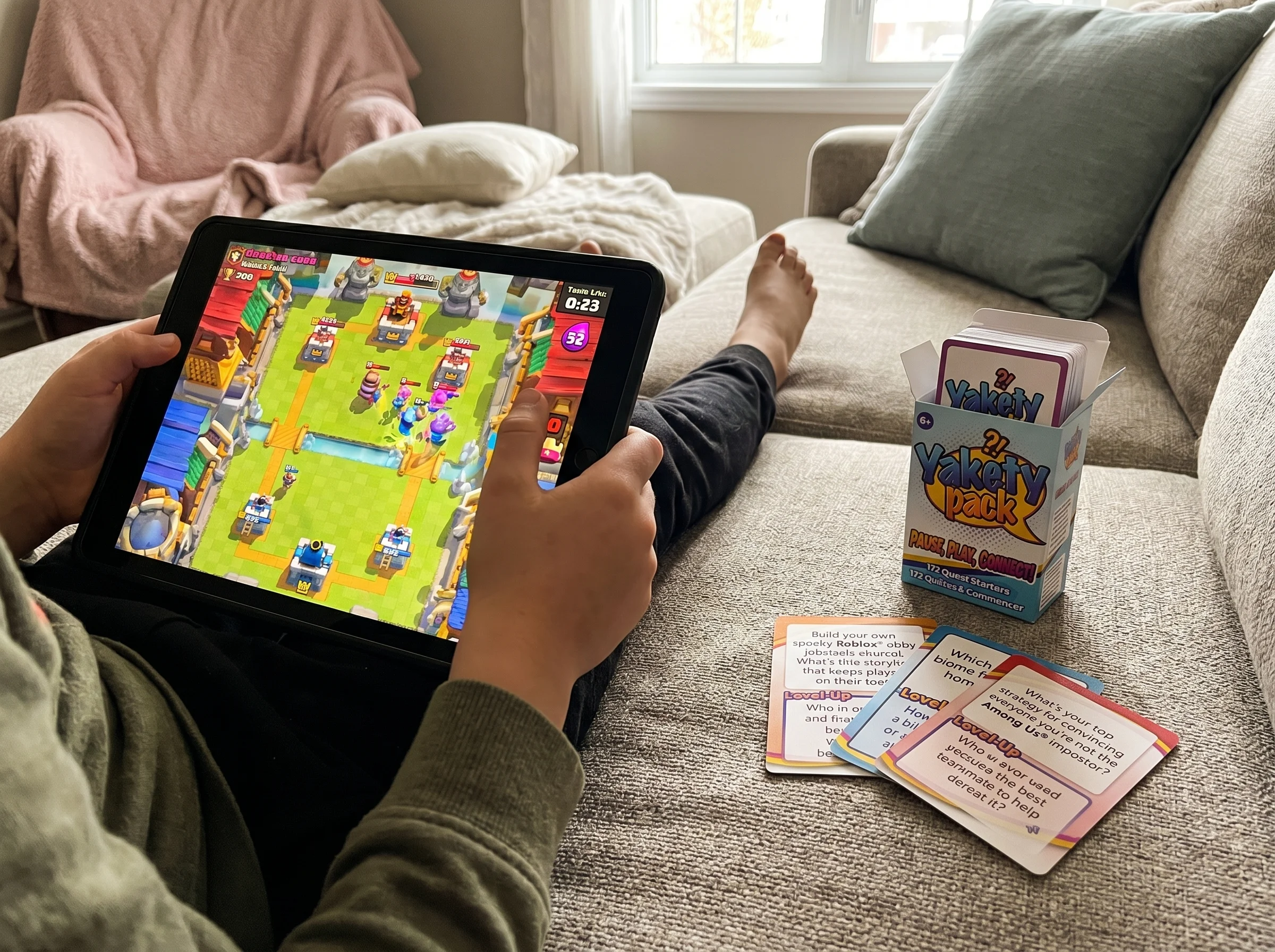
Quick test you can run tonight: ask your kid to walk you through a decision they made in a game today. Not "what did you do?" but "why did you do it?" If they say something like "I saved my elixir because I knew he'd play his giant next," congratulations. You have a strategist.
Why this matters: when you start from "you're already good at this, want to try a new version?" your kid leans in. When you start from "let's put down the iPad and try something educational," they're already mentally gone.
The Clash Royale-to-Splendor jump my son made wasn't because I taught him. It was because he recognized the shape of the problem. That's the real skill. And once you see your kid making those connections, you stop trying to replace screens and start using them as a launchpad.
"Thinky" Games vs. Sneaky-Strategy Games
Most strategy game lists treat all strategy the same. It's not.
There are thinky games, where the strategy is on the box, in the title, and right in your face. Chess. Risk. Stratego. Go. These games announce themselves. "I am a strategy game. Prepare to think." Some kids love that. Most don't, at least not until later, and forcing it is how you end up with a kid who says "board games are boring."
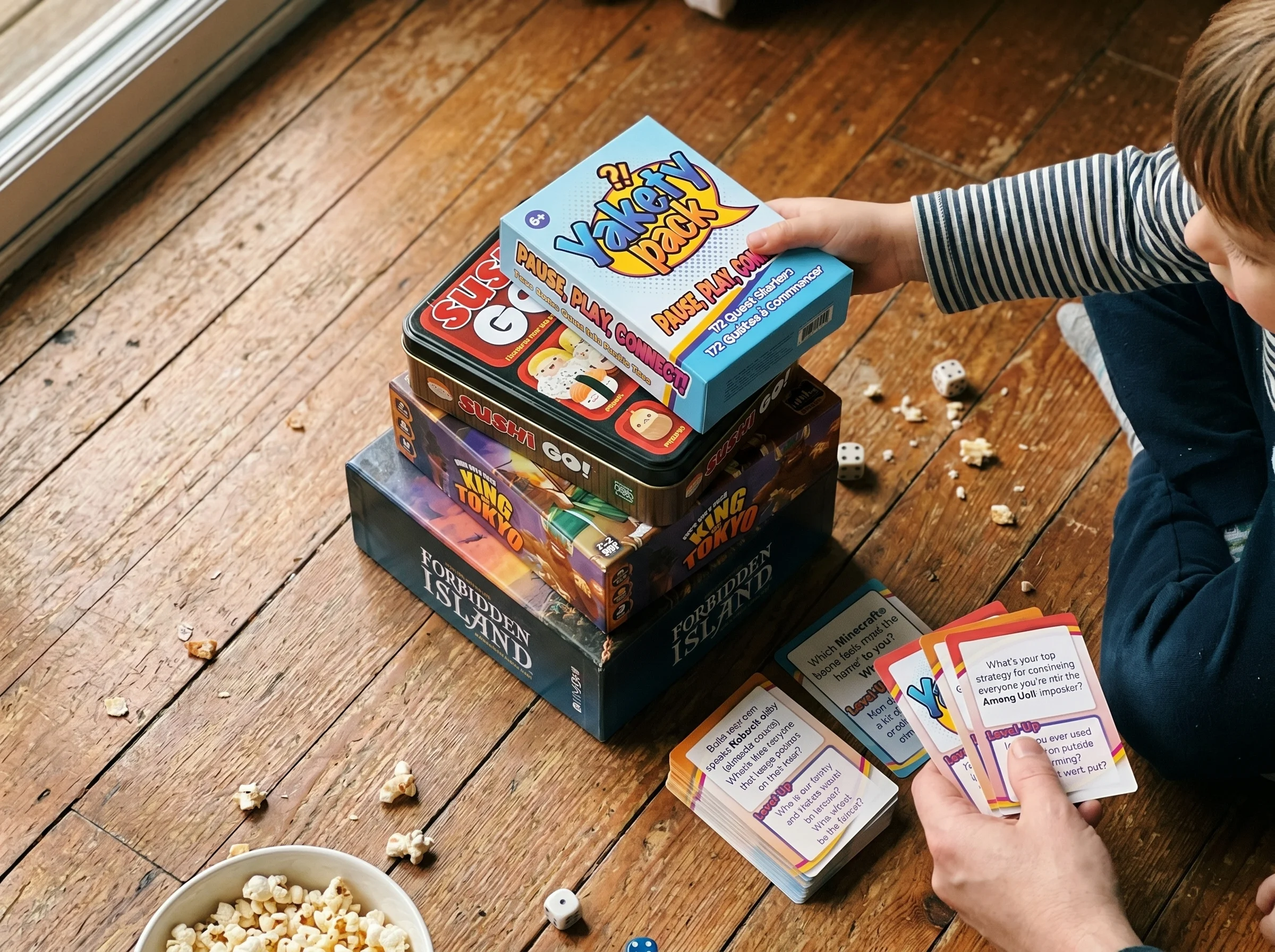
Then there are sneaky-strategy games, where the strategy is hidden under a theme the kid actually cares about. King of Tokyo is about monsters smashing each other. Sushi Go is about grabbing the best dumplings. Ticket to Ride is about building trains across America. Splendor is about collecting shiny gems. Forbidden Island is about not drowning.
Under all of those cute themes is real strategy. Optimization. Resource management. Tempo. Risk assessment. But the kid doesn't feel like they're doing math. They feel like they're stealing your sushi.
My rule of thumb: pick the theme first, the mechanics second. A kid who loves dragons will tolerate a lot of rules to play with dragons. A kid who hates the theme will hate the game no matter how brilliantly designed it is. This is why "best strategy game" lists keep failing parents. The right game for YOUR kid depends on what they're already drawn to.
Strategy Games for Kids That Actually Work, By Kid Type
Forget age ranges for a second. The box says "8+" but I've seen 6-year-olds crush Sushi Go and 11-year-olds bounce off it. What actually matters is the type of kid you have.
The Competitive Kid Who Hates Losing
You need games with short rounds and enough luck to mitigate the skill gap. Don't put this kid in a 90-minute game where you can see the loss coming from turn three. That's torture.
Try King of Tokyo (smashing monsters, dice-rolling, 30 min) or Sushi Go (15 min, card drafting, adorable). The randomness means even a less experienced player has a real shot. And the games end before resentment can build.
The Kid Who Loves Building Stuff
If your kid spends hours in Minecraft creative mode or building elaborate Lego cities, they're an engine-builder. They want to construct something over time.
Try Splendor (build a gem empire), Machi Koro (build a town), or Catan Junior (build pirate hideouts). The "watch my thing grow" feeling is the hook.
The Kid Who Loves Stories
These kids want narrative. They make up backstories for their stuffed animals. They want their games to have characters and stakes.
Try Forbidden Island (cooperative, the island is sinking, save the treasures), Outfoxed (Clue for kids), or Mysterium Kids (a friendly ghost helps you solve a mystery). Cooperative narrative games hit different for these kids.
The Kid Who Loves Video Games
Lean into it. Unmatched plays like a fighting game, with characters like Bigfoot, Buffy, and Robin Hood squaring off. Magic: The Gathering is, yes, absolutely playable with 8+ kids who have video game brain, and there are starter decks designed for exactly that. Cosmic Encounter has wild alien powers that feel like character abilities in a video game.
These games translate the video game vocabulary your kid already has into a tabletop format. You're not asking them to abandon their interests. You're meeting them there.
The Reluctant Strategist Who Says They Hate "Thinking Games"
This is the kid everyone gives up on. Don't.
The trick: social deduction games. Skull King, Coup, The Resistance, One Night Ultimate Werewolf. These don't feel like strategy. They feel like lying to your family, which is hilarious. But every decision is a strategic one: who do I trust, what do I bluff, when do I commit?
True story: I tried Ticket to Ride with my niece a couple years ago. She's 10, she's smart, she would rather chew tinfoil than play a "math game." It was a disaster. She stared at the board, said "this is boring," and went to her room. I felt like an idiot.
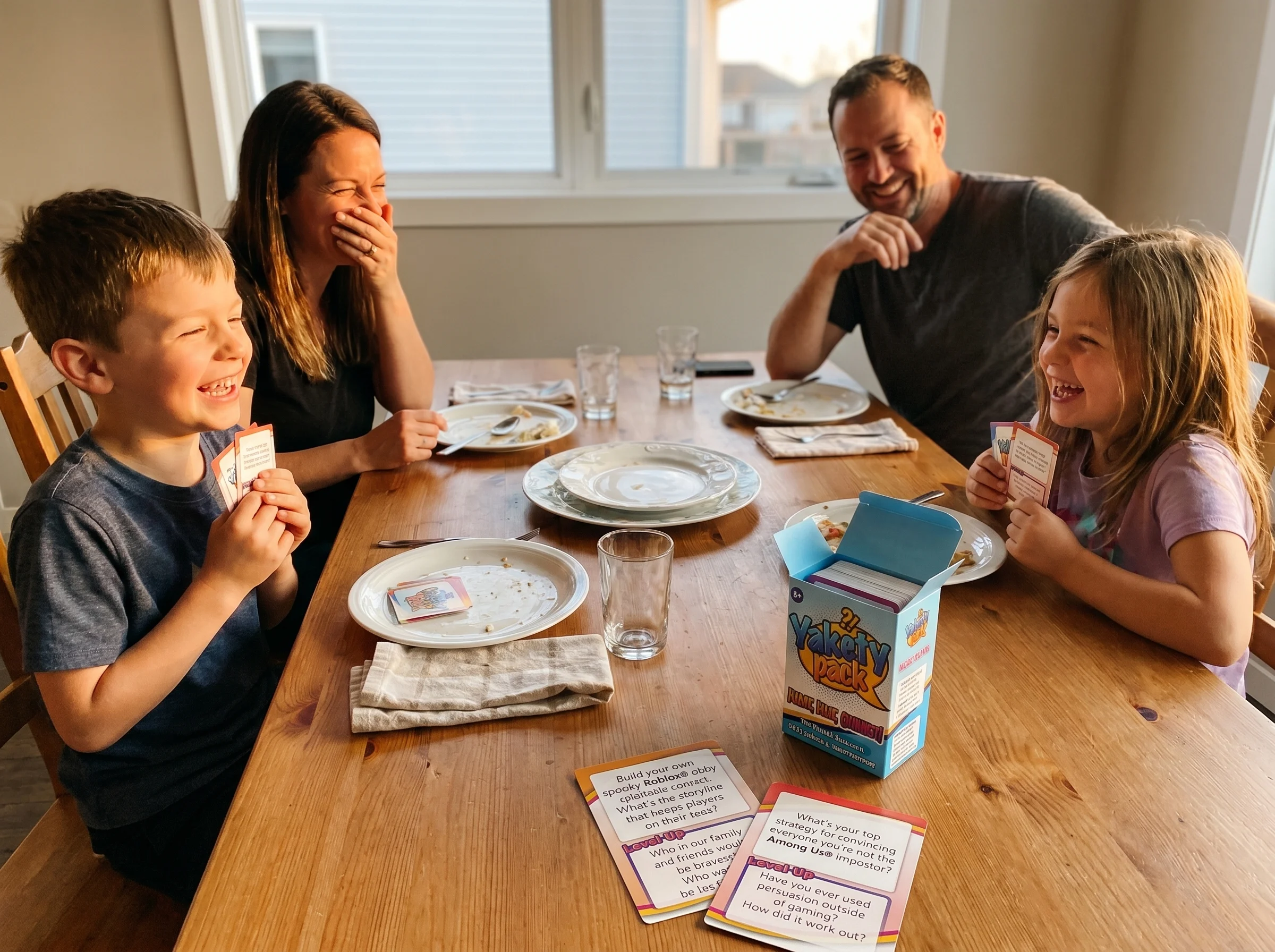
Six months later, we tried Skull King at a family dinner. Different kid. She was bidding aggressively, talking trash, reading the table. She's now the family champion and won't shut up about it.
The strategy was the same. The packaging was different. That's the whole game.
The Real Problem Nobody Talks About: The Rage Quit
If you've played strategy games with your kid for more than two weeks, you've seen it. The moment when they realize they're going to lose. The pieces get flipped. The tears come. "I'M NEVER PLAYING THIS AGAIN."
This is the moment that ends family game night in most households. And here's what I did wrong for two years: I tried to teach the lesson in the moment.
"Hey buddy, losing is part of learning. If you don't lose sometimes, you don't get better. Let's think about what went wrong."
Useless. Worse than useless. He couldn't hear a word of it because he was flooded. I was just adding shame to frustration. There's actual neuroscience behind why this fails. When a kid is emotionally flooded, the thinking part of their brain goes offline, and no lecture is getting through.
What actually works:
- Name the feeling. "That was really frustrating. You worked hard and it didn't go your way."
- End the game. Don't push through. Don't make him finish "to be a good sport." Pack it up.
- Come back tomorrow. The lesson lands later, not in the meltdown.
The line I use now, almost word for word: "That was rough. You were three moves from winning. Want to look at it tomorrow?"
Eight times out of ten, he does. And the next morning, calm and curious, he wants to know what he missed. That's when the actual strategy conversation happens. Not in the middle of the meltdown. After.
Skip this step and you'll never play strategy games with your kid again. I promise.
How to Play Without Turning It Into a Lecture
Kids smell teaching from a mile away. The minute a board game starts to feel like homework, it dies. Here's what kills the vibe, and what doesn't.
Don't narrate their moves. "Ooh, are you SURE you want to do that?" Just let them make the move. Even if it's bad. Especially if it's bad. They'll figure it out faster by losing once than by being saved ten times.
Don't ask "what's your strategy?" mid-game. That's an interview question. Nobody wants to be interviewed while they play. Ask after.
Lose on purpose sometimes when they're learning, never once they're competent. Kids can tell when you're throwing the game. The second they notice, the win means nothing. More on this in a minute.
The single best question I've found, after a game: "What did you almost do?"
Not "what did you do?" Not "what was your strategy?" "What did you almost do?" That question reveals their thinking. The moves they considered and rejected. The trap they saw and avoided. The bluff they didn't pull. That's where the gold is.
When we built Yakety Pack, one of the conversation cards we kept coming back to was "What's a move you made today you're proud of?" It works for soccer, it works for Fortnite, it works for Catan. Kids love being asked about their decisions, not their performance. There's a huge difference between "did you win?" and "did you make a choice you're proud of?" One is a verdict. The other is a window.
Should You Let Them Win?
The honest answer: yes, then no, then never.
Phase 1, learning: Let them win. Or play handicapped. Give yourself fewer pieces, fewer cards, blind moves. The point in this phase is just keeping them at the table. Crush them now and they'll never come back.
Phase 2, improving: Play your B-game. Make plausible mistakes. Not obvious ones. Don't move your queen into a pawn's mouth. But take the second-best option occasionally. They need to win sometimes by their own merit, not your charity.
Phase 3, real: Full effort. No mercy. This is where actual respect gets built.
The first time my son beat me at chess for real, he was 8. He took my queen with a fork I didn't see coming. I sat there for a minute, working out if there was a way back. There wasn't. He won.
He didn't celebrate. He just looked at me and said, "You weren't going easy, were you?"
I said no.
He sat with that for a long minute. Then he nodded, packed up the board, and said "good game." Best gaming moment of my life. Better than any win.
That moment only exists because I'd stopped letting him win a year earlier. If I was still pulling punches, he'd have no idea what his win meant. The "no" in "you weren't going easy" is what made it real.
 No board, no rulesPause, Play, Connect: Core Deck$49 CAD • 172 promptsSee the deck
Two Strategy Games for Kids to Start With Tonight
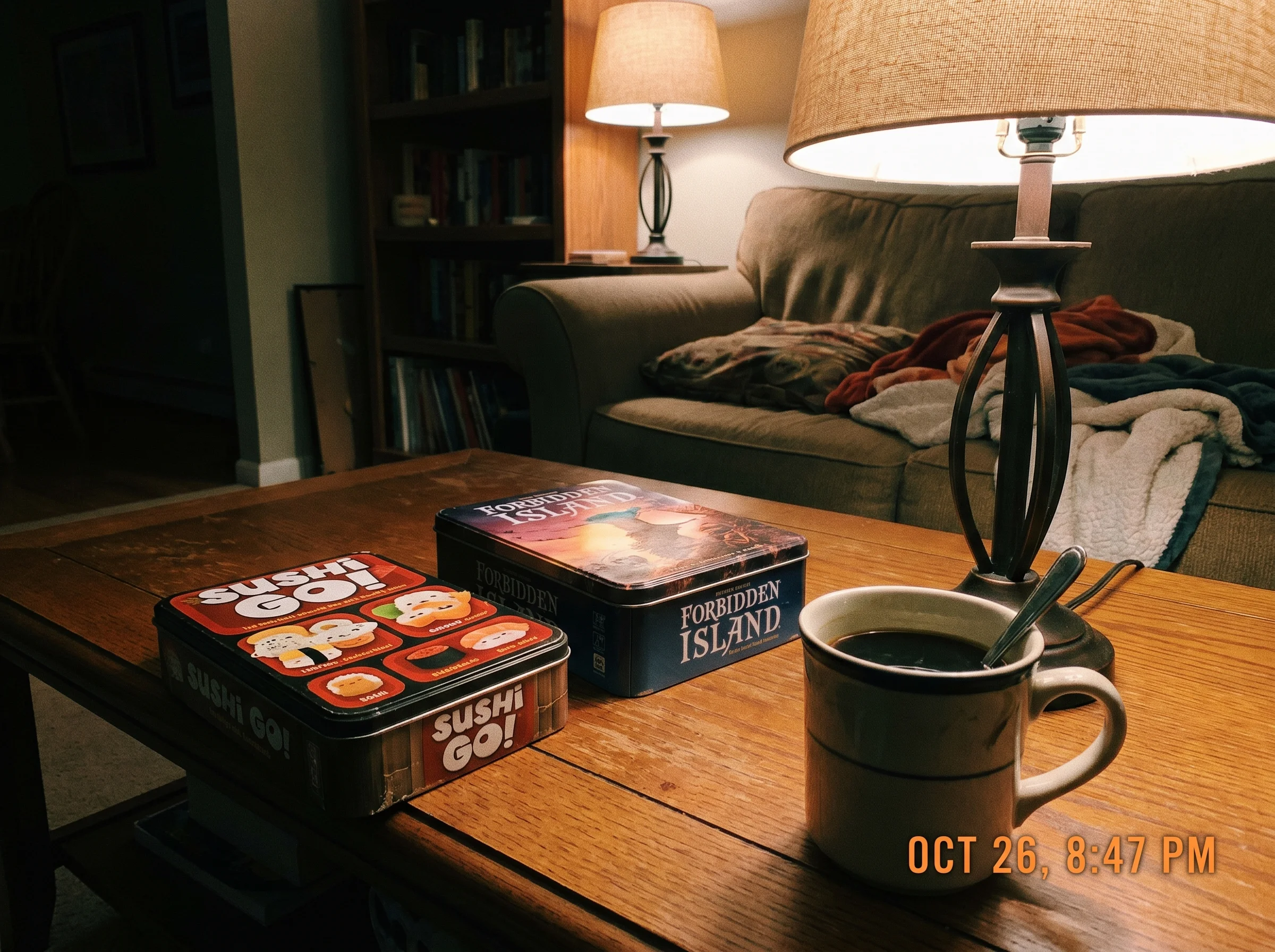
If you've read this whole thing and just want to be told what to buy, fine. Here are the two I'd start with if you have no idea where to begin.
Sushi Go ($10, plays in 15 minutes, ages 7+). Cards with cartoon sushi. You draft cards, pass the rest. Kids get it in one round. There's real strategy under the dumplings (set collection, opportunity cost, blocking) but it never feels like math. Plus it's ten bucks. If it bombs, you're out the price of two lattes.
Forbidden Island ($20, plays in 30 minutes, ages 8+). Cooperative. You vs. the game. Nobody rage-quits because nobody loses to a person. You're a team trying to grab treasures off an island that's sinking under your feet. Builds the "thinking together" muscle that nothing else builds quite the same way.
Why these two: low cost, low time, high replay. If your kid loves Sushi Go, they're probably a tactical/optimization kid. Try Splendor next. If they love Forbidden Island, they're a narrative/cooperative kid. Try Mysterium or a cooperative RPG-lite. If neither lands, you might have a deduction kid. Get The Resistance or Coup and watch what happens.
A Few Quick FAQs
My kid loves Fortnite but says board games are boring. Is there hope? Yes. They're not bored of strategy, they're bored of slow. Find a 15-minute game with a theme they care about. Sushi Go, King of Tokyo, Unmatched. Speed matters more than depth at the start.
Is chess too hard for a 6-year-old? Depends on the kid, but probably not the full game. Try Chess.com's puzzles feature, or the Story Time Chess set, which teaches piece movement through silly stories. Chess is a marathon. Start with sprints.
My kid wins by copying my moves. Are they actually learning? Yes, this is real learning. It's called pattern recognition and it's literally how chess grandmasters train. Don't shame the copying. Just slowly play moves they can't copy because they don't yet understand why.
What about a kid with ADHD? Short rounds, active turns, theme-driven. Avoid games with long downtime between turns. King of Tokyo, Sushi Go, and Skull King all work great because something's happening every 30 seconds. Avoid Risk and Monopoly. Death by waiting.
Are video game "strategy games" really building the same skills? Mostly, yes. Civilization, StarCraft, Clash Royale, Bad Piggies, even Plants vs. Zombies. They train pattern recognition, resource management, and forward planning. The transfer to tabletop isn't automatic, but it's real. Name the skill out loud ("nice elixir trade") and watch the transfer accelerate.
The Real Point of All This
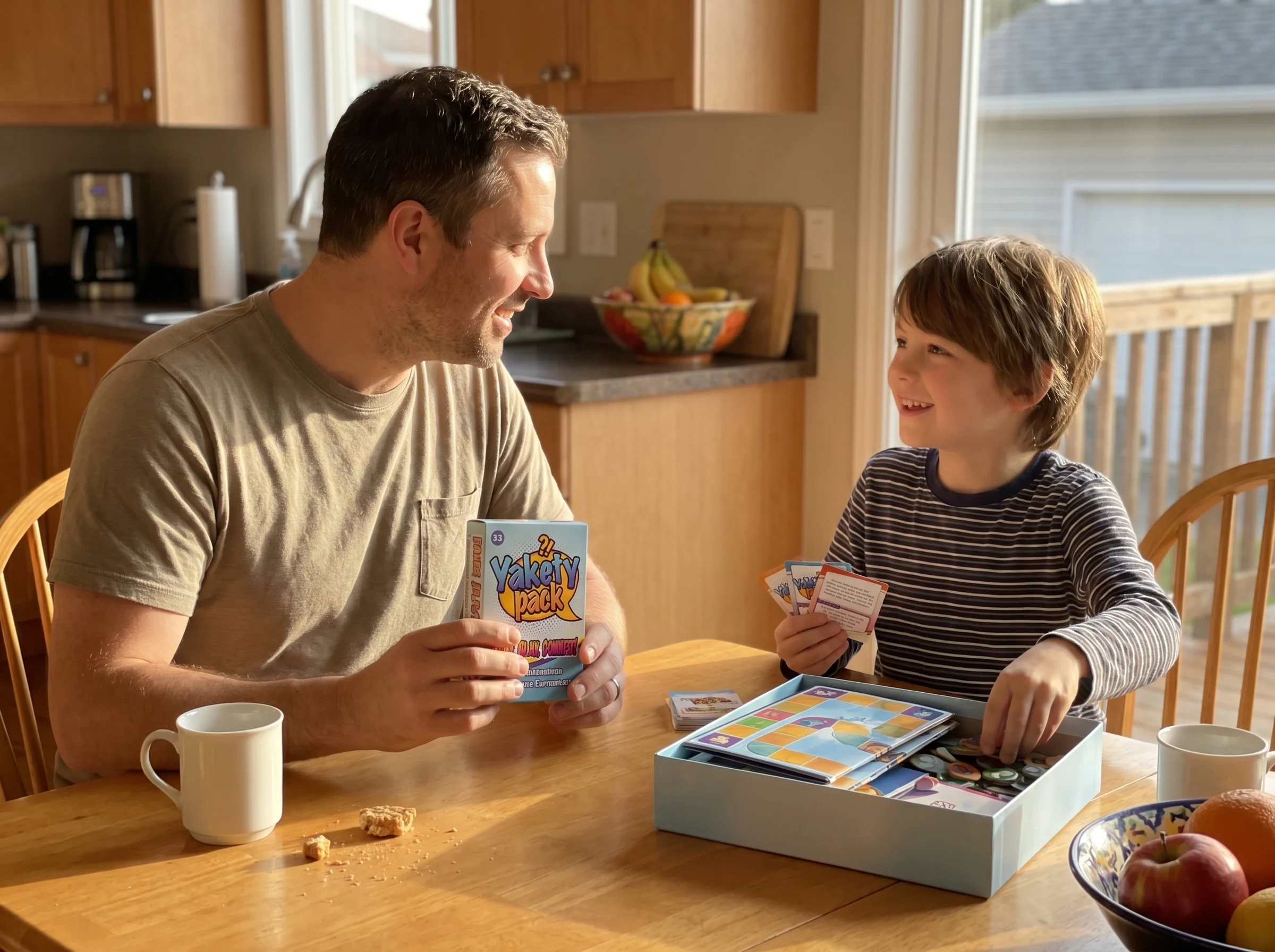
Strategy games aren't valuable because they replace screens. They're valuable because they create a shared language with your kid.
My son and I now talk about "value trades" in Clash Royale the same way we talk about move trades in chess. We talk about "tempo" in Splendor and "tempo" in Fortnite building. The vocabulary travels. The thinking travels. The connection travels.
That's the whole thing. The game is the excuse. The thinking out loud is the prize.
So here's my one ask: next family game night, pick one game. Doesn't matter which one. Play it. After it's over, ask one good question. "What did you almost do?" works every time.
That's it. Don't lecture. Don't grade. Just be curious about how your kid thinks. The strategy will take care of itself.
We built Yakety Pack for exactly these kinds of conversations, the ones that start with a game and end somewhere you didn't expect. But honestly? You don't need anything to start except a deck of cards and a question. The rest is just paying attention.
Now go get crushed at Splendor by a 9-year-old. It's an incredible feeling. I promise.

From this article
Pause, Play, Connect: Core Deck
While you pack up the pieces: "What did you almost do" is one great debrief question; game night goes further when you have a rotation of them. The Pause, Play, Connect Core Deck belongs on the shelf next to Sushi Go.
Want the whole setup? The full bundle adds the Parent Power-Up deck and two digital parent guides, $146 of family fun for $59.

