
You've said it. I've said it. Every parent has said it at least once: "Just go play."
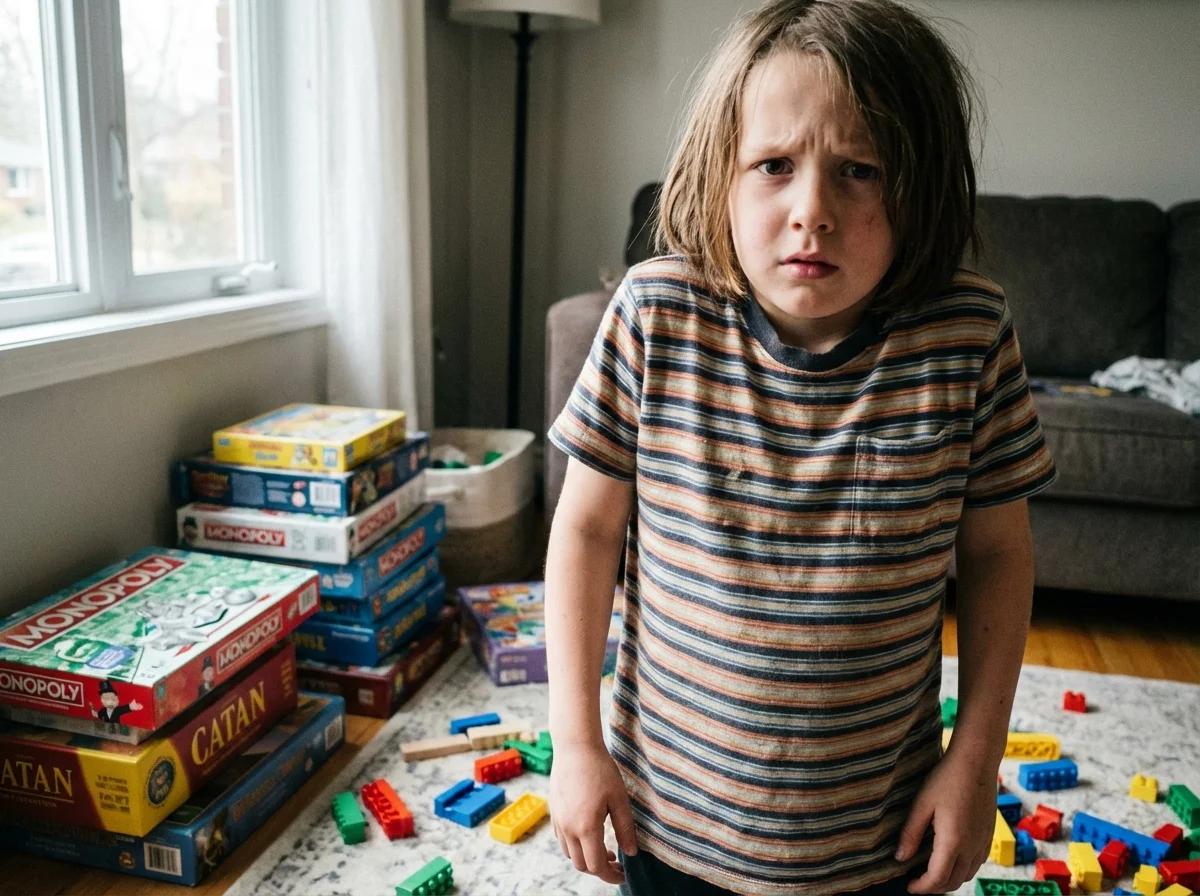
And then watched your kid stand in the middle of the living room like you just asked them to solve calculus. Surrounded by toys, books, art supplies, a backyard with a trampoline, and they literally cannot figure out what to do with themselves.
It's not laziness. It's not defiance. It's not "kids these days."
It's dopamine. And until you understand what's happening in your kid's brain, you're going to keep fighting a battle you can't win with willpower alone.
 When boring is the complaintPause, Play, Connect: Core Deck172 prompts that give you something to say when the screens go off.$49 CAD • 90 cards • 18 reviewsShop the deck
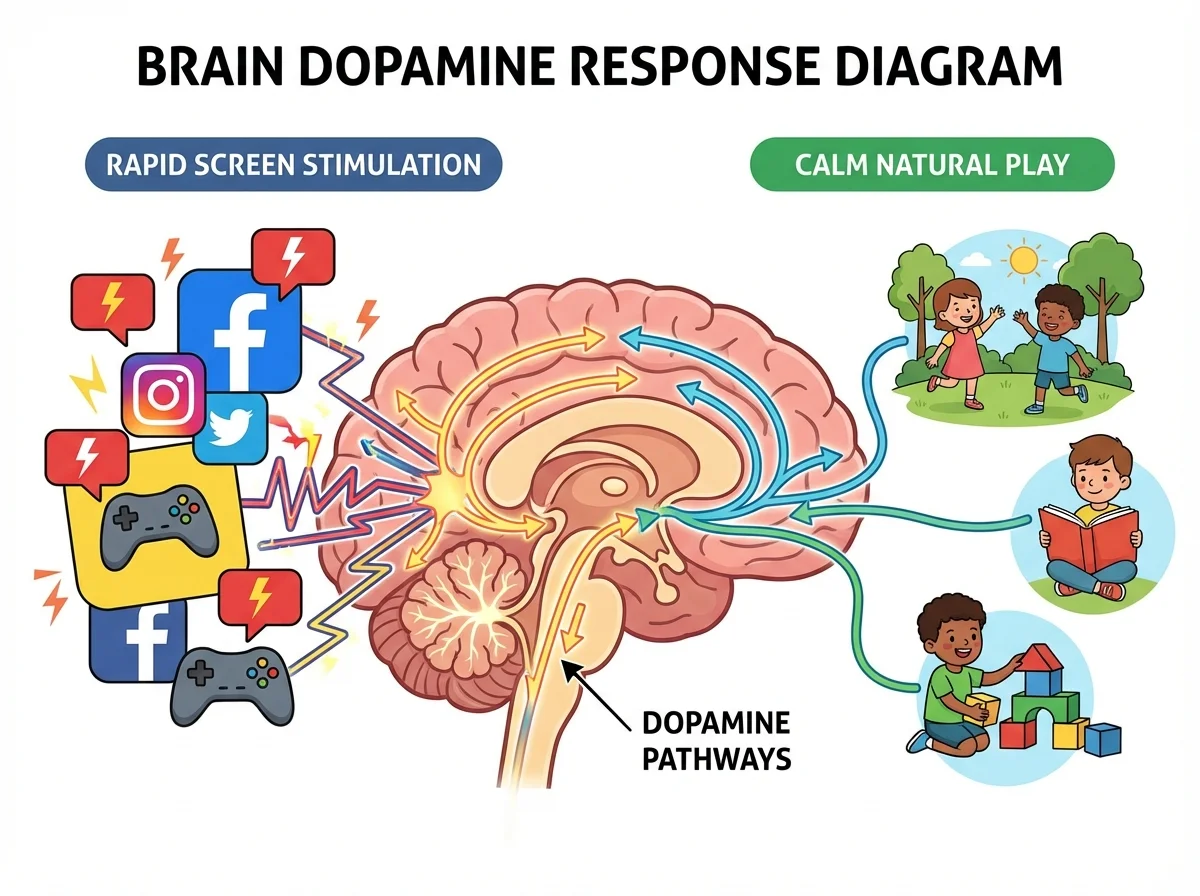
Your Kid's Brain on Screens
For the bigger picture this fits into, see our pillar piece on turn screen time into connection time.
Here's what nobody tells you at the pediatrician's office when they hand you the "limit screen time to two hours" pamphlet.
Screens don't just entertain your kid. They train their brain.
Every swipe on TikTok, every level cleared in a game, every YouTube video that auto-plays into the next one delivers a small hit of dopamine. Not a massive one. A perfectly calibrated micro-dose that keeps your kid's brain saying "one more."
Dr. Anna Lembke at Stanford calls this the "dopamine economy." Your brain has a baseline level of dopamine, the chemical that drives motivation and reward. When something repeatedly floods that system with easy hits, the baseline shifts upward. What used to feel normal now feels boring.
This is why your kid can watch three hours of YouTube and still say they're bored. Their brain's definition of "normal stimulation" has been recalibrated. A Lego set that would have captivated them for an hour at age four now can't compete with a device designed by teams of engineers whose entire job is keeping eyeballs on screens.
This isn't your kid being broken. This is your kid's brain doing exactly what brains do - adapting to the environment you give it.
Why "Just Go Play" Doesn't Work
Think about the last time you spent an hour scrolling your phone. Then someone asked you to sit down and read a book.
How'd that go?
If you're honest, you probably picked up the book, read two paragraphs, checked your phone, read another paragraph, then gave up. Not because the book was bad. Because your brain was still running at scroll speed.
Now multiply that by ten, because your kid's brain is still developing. The prefrontal cortex, the part responsible for impulse control and delayed gratification, doesn't fully mature until age 25. Your eight-year-old literally has less hardware available for resisting the pull of easy dopamine.
So when you say "go play" and they stare at you blankly, here's what's actually happening:
Their dopamine baseline is elevated. Everything that isn't a screen feels flat, gray, boring. Not because it IS boring, but because their brain is still calibrated for high-stimulation input.
Their attention threshold is set to "fast." Screens deliver new stimulation every 15-60 seconds. A board game asks them to sustain attention for 20-30 minutes. That gap feels enormous to a brain tuned for rapid rewards.
They've lost the skill of self-directed play. This one hurts, but it's true. Finding something to do requires imagination, initiative, and tolerance for the awkward "what now?" feeling. Screens eliminate all three by providing constant direction.
This isn't a character flaw. It's a predictable neurological response.
The Dopamine Gap (And Why the First 20 Minutes Are the Worst)
I call this the dopamine gap. It's the space between what your kid's brain expects and what non-screen activities deliver.
Picture it like this: screens run at a dopamine level of 8 out of 10. Reading a book is maybe a 3. Building with Legos is a 4. Playing outside is a 5 (once they get going).
When you pull your kid off screens and point them toward a book, their brain experiences a drop from 8 to 3. That gap? It feels terrible. It's the same mechanism behind why people feel irritable when they quit caffeine or sugar. The brain is screaming for the level of stimulation it's used to.
Here's the critical part most parents miss: the gap is temporary.
The first 10-20 minutes after screens are the worst. Your kid will complain. They'll say everything is boring. They might have a meltdown. This is their nervous system adjusting, not evidence that your kid is incapable of playing.
I watched this exact pattern with my own kids. After a long weekend of too much screen time, Monday afternoon was brutal. "There's nothing to do." "Everything is boring." "Can I just have my iPad back?" But if I could hold the line for about 15-20 minutes, something shifted. They'd pick up something. Start building. Go outside. Start inventing some game that made no sense but kept them busy for an hour.
That 15-20 minute window is everything. And most parents cave at minute seven.
For the Awkward Bridge: Most kids need a softer prompt than "go play." Keep a Pause, Play, Connect deck by the couch so a question is within reach when the screens go off.
Bridge Activities: Closing the Dopamine Gap
A simple bridge activity is a deck of conversation cards for families with gamer kids at the kitchen counter; the cards do the activating.
You can't go from TikTok to a chapter book. I wrote about this concept as the dopamine bridge in our guide to screen time alternatives, and it's the single most practical tool I've found for this problem.
The idea is simple: instead of asking your kid's brain to jump from high-stim to low-stim, give them a middle step.
Physical Movement (The Best Bridge)
This is the cheat code. Seriously.
Physical activity does something unique neurologically. It burns off the restless energy that builds during screen time AND it generates dopamine through a healthy pathway. Your kid doesn't feel like they're giving something up because their brain is still getting stimulated, just differently.
After screens, try:
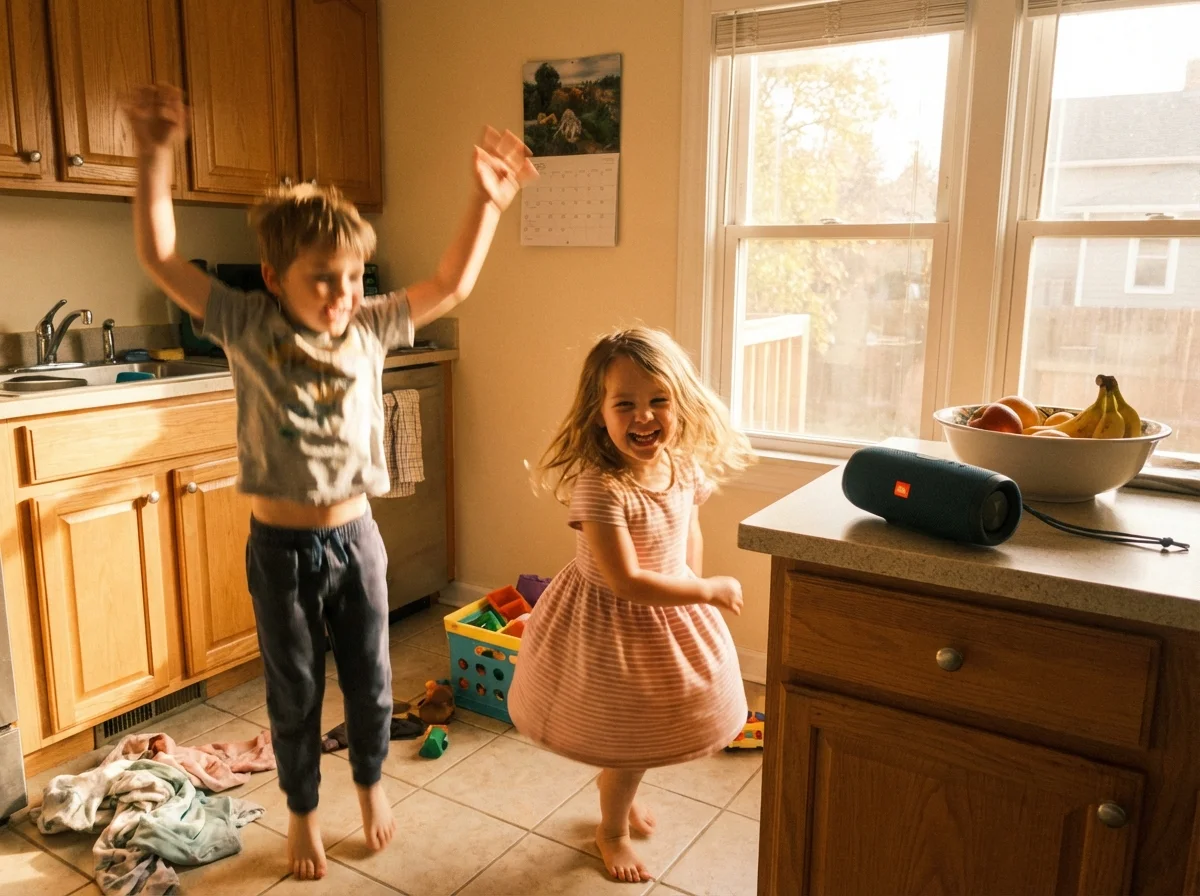
- Dance party in the kitchen (5 minutes is enough)
- Shooting hoops or kicking a ball around
- A quick bike ride around the block
- Wrestling or roughhousing (yes, really)
- Jumping on the trampoline
You're not trying to tire them out. You're trying to reset their nervous system. Ten minutes of physical movement can bridge the gap that would otherwise take 20 minutes of misery.
Sensory Activities (Underrated)
Anything that engages the hands works surprisingly well. There's research showing that tactile engagement activates reward pathways differently than visual stimulation.
- Kinetic sand or Play-Doh
- Water play (bath time counts)
- Cooking or baking together
- Building with magnetic tiles
- Drawing or painting
The key is having these accessible. If your kid has to ask you to get the art supplies down from a high shelf, find the right paper, set up a workspace... they've already lost interest. Pre-stage bridge activities where kids can grab them independently.
Music and Audio
Music hits a sweet spot. It's stimulating enough to not feel like deprivation, but it shifts the brain away from visual processing.
- Put on music and let them be goofy
- Audiobooks (especially funny ones)
- Kid-friendly podcasts
- Playing an instrument (even badly)
- Karaoke or singing along to something
Conversation and Connection
This one surprised me. Sometimes the bridge isn't an activity at all. It's a person.
When my kids come off screens and hit that "everything is boring" wall, sometimes the most effective thing I do is just sit with them and talk. Not about screens. Not about what they should be doing instead. Just... talking.
Pause, Play, Connect conversation cards have been helpful here because they give you a starting point when nobody knows what to say. One card asks something like "What's the weirdest dream you've had?" and suddenly my kid is talking for ten minutes about a dream where our dog could fly. The dopamine gap closes because human connection is genuinely rewarding, just in a slower, deeper way.
The Two-Week Reality Check
I'm going to be honest with you because I think parents deserve honesty more than they deserve comfort.
The first two weeks of reducing screen time are rough.
Not "slightly inconvenient" rough. "You'll question every parenting decision you've ever made" rough.
Here's what the timeline actually looks like:
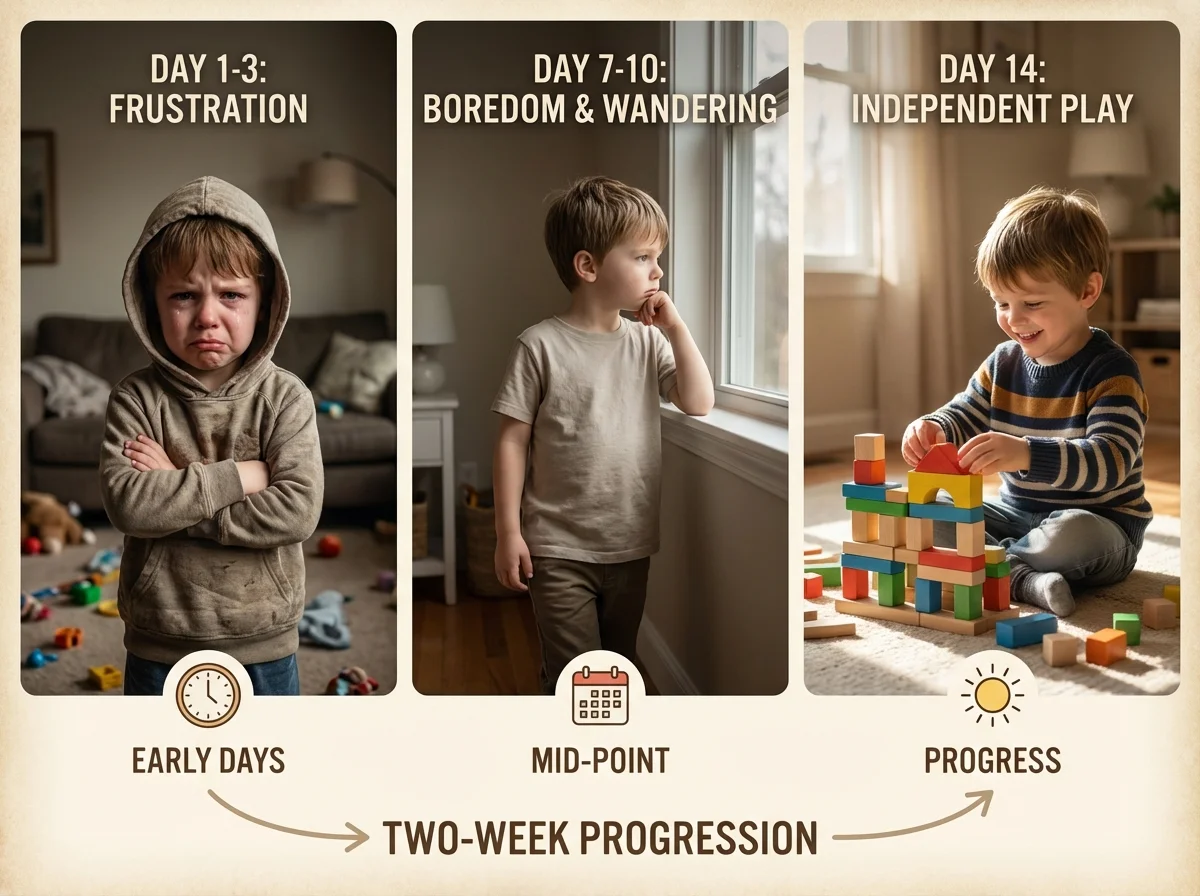
Days 1-3: The revolt. Your kid will act like you've taken away oxygen. Tantrums, complaints, declarations that you're the worst parent ever. This is the dopamine withdrawal talking, not your child's actual feelings about you.
Days 4-7: The testing phase. They'll try every strategy to get screens back. Negotiation, bargaining, sudden interest in "educational" content, promises of good behavior. Stay consistent. Not rigid, but consistent.
Days 8-10: The boredom plateau. This is where it gets weird. They're not fighting you anymore, but they're not exactly thriving either. Lots of wandering around. Lots of "I don't know what to do." This is actually progress, even though it doesn't feel like it.
Days 11-14: The shift. Slowly, almost imperceptibly, something changes. They start picking up old toys. They start going outside without being told. They start inventing games. The neural pathways for self-directed play are waking back up.
Week 3 and beyond: The new normal starts forming. Your kid's dopamine baseline is resetting. Activities that felt boring two weeks ago start feeling genuinely interesting. This is the neuroplasticity working in your favor instead of against you.
Most families I've talked to who failed at reducing screen time quit during days 4-7. They interpret the misery as evidence that their kid "needs" screens, when really it's evidence that the dopamine recalibration is working.
 During the awkward stretchPause, Play, Connect: Core Deck$49 CAD • 172 promptsSee the deck
What You're Actually Doing Wrong (Probably)
I'm including this section because I made every one of these mistakes. Learn from my failures.
Mistake 1: Cold turkey on a random Tuesday
Taking away all screens with no warning or plan is setting everyone up for disaster. Your kid didn't build this dependency overnight and it won't resolve overnight.
A better approach: gradual reduction with clear communication. "Starting this week, we're going to have screen-free afternoons. Here's what we're going to do instead." Then have the bridge activities ready.
Mistake 2: Offering boring alternatives
"Go read a book" is not a compelling pitch to a kid whose brain is running at scroll speed. You need to meet them closer to where they are. Physical activity, creative projects, social interaction. Then they can work their way down to quieter activities as their baseline adjusts.
Mistake 3: Not managing your own screen time
This is the one nobody wants to hear. If you're telling your kid to put down the iPad while you're scrolling Instagram, they notice. Kids learn from behavior, not lectures. The families I've seen succeed with screen time reduction are the ones where parents also commit to less mindless scrolling during family time.
Mistake 4: Treating all screen time equally
Watching your kid play Minecraft with friends is fundamentally different from watching them scroll YouTube Shorts alone. One involves problem-solving, creativity, and social interaction. The other is passive consumption. If you treat them the same, you're fighting the wrong battle.
Age-Specific Bridge Strategies
The dopamine gap looks different at every age. What works for a six-year-old won't work for a twelve-year-old.
Ages 5-7: The Redirect Window
Young kids are actually the easiest to bridge because their attention is still relatively flexible. Physical activity works almost instantly at this age. The key is having options visible and accessible, not stored away in closets.
Keep a "boredom bin" in a common area with rotating activities. Swap items every week so there's always something that feels new. Novelty helps close the dopamine gap because new = interesting, even if it's just a set of markers they haven't seen in a while.
Ages 8-10: The Negotiation Phase
This is where kids start arguing about fairness and making deals. They need to feel like they have some autonomy in the process. Let them help choose bridge activities. Give them a menu of options rather than directives.
Timer-based challenges work well at this age. "See how tall a tower you can build in 10 minutes." The countdown creates urgency, which generates its own form of stimulation.
Ages 11-13: The Independence Requirement
Tweens will reject anything that feels like it's for "little kids." They need bridge activities that feel mature and self-directed. Music production on GarageBand, learning card tricks, cooking something complicated, building model kits. The activity needs to respect their developing identity.
Physical activity still works as a bridge, but frame it differently. Not "go play outside" but "want to shoot hoops?" or "let's go for a walk."
The Controversial Take: You Don't Need to Eliminate Screens
I know this article is about why kids can't stop screen time. But here's what I actually believe after years of navigating this as a dad and entrepreneur:
The goal isn't zero screens. The goal is a brain that can function well with AND without them.
A kid who can enjoy an hour of Minecraft and then go outside and play for an hour has a healthy relationship with screens. A kid who falls apart the moment screens are removed doesn't. The difference isn't the amount of screen time. It's the flexibility of their dopamine system.
Everything I've described, the bridge activities, the two-week adjustment, the gradual approach, it's all building that flexibility. You're not trying to create a screen-free kid. You're trying to create a kid whose brain can shift between high-stim and low-stim without breaking down.
That's a skill that will serve them for the rest of their lives. Because let's be honest, they're going to live in a world full of screens. Teaching them to manage their relationship with dopamine is more valuable than any screen time limit you could set.

For the Long Reset: The dopamine gap closes faster with a nightly ritual. A deck of Yakety Pack conversation cards on the dinner table is the easiest place to start.
Your One Move This Weekend
If this article resonated but feels overwhelming, here's one thing to try.
Next time your kid finishes screen time, don't say "go play." Instead, say "let's do something physical for ten minutes first."
Dance party. Basketball. A walk around the block. Anything that gets their body moving.
Then, after ten minutes, step back. Don't direct them. Just let them figure out what's next. You might be surprised at what happens when you bridge the gap instead of demanding they leap across it.
The dopamine problem is real. But it's not permanent, and it's not your kid's fault. Their brain is doing exactly what it was designed to do. Your job is to help them build the flexibility to do more.
At the dinner table tonightPause, Play, Connect: Core Deck172 prompts for the dinner table, ready to read straight off the card.$49 CAD • 90 cards • 18 reviewsShop the deck
Related Articles
Want to dig deeper into creating screen-free moments that actually work? Check out these guides:
- Screen Time Alternatives That Actually Work - The complete guide to replacing screen time with activities kids genuinely enjoy
- When Gaming Becomes a Problem: Signs to Watch For - How to tell the difference between healthy gaming and something more concerning
- Playing Video Games With Your Kids: A Parent's Real Guide - Why joining them in their world changes everything
Frequently Asked Questions
Is screen time actually addictive, or are parents overreacting?
The word "addiction" is debated among researchers, but the neurological mechanism is real. Screens activate the same dopamine reward pathways as other compulsive behaviors. Whether you call it addiction or habit, the practical effect on your kid's brain is the same: elevated dopamine baseline, reduced interest in lower-stimulation activities, and difficulty self-regulating. You're not overreacting. You're observing a genuine neurological response.
How much screen time is actually okay for kids?
The honest answer: it depends on the kid and the content. The AAP guidelines (one hour for ages 2-5, consistent limits for 6+) are a reasonable starting point, but they miss the nuance. An hour of creative Minecraft play is fundamentally different from an hour of passive YouTube scrolling. Focus less on minutes and more on whether your kid can transition away from screens without melting down. If they can, your current balance is probably fine.
My kid has ADHD. Does the dopamine problem hit them harder?
Yes. Kids with ADHD already have lower baseline dopamine levels, which is partly why screens are so compelling for them. The stimulation fills a neurological gap. This means the dopamine drop when screens stop can feel more intense. Bridge activities are even more critical for ADHD kids, and physical movement is especially effective. Consider working with your pediatrician on strategies specific to your child's needs.
Will reducing screen time affect my kid's social life?
This is a legitimate concern. For many kids, screens ARE their social life (gaming with friends, group chats, social media). The goal isn't to cut social screen time. It's to reduce passive consumption. Keep the FaceTime calls with grandparents, the multiplayer Minecraft sessions with friends, the collaborative activities. Cut the solo scrolling. Your kid's social connections shouldn't be collateral damage in the screen time conversation.
How long does it take for a kid's dopamine levels to normalize?
Research on dopamine receptor recovery suggests 2-4 weeks for noticeable changes, with full baseline adjustment taking 6-8 weeks. But you'll see behavioral improvements much sooner. Most families report their kids starting to self-initiate non-screen activities by week 2-3. The brain is remarkably plastic, especially in children. The adjustment period feels long when you're in it, but it's genuinely temporary.

