
The first time I challenged my son to a Rocket League 1v1, he scored on me in eleven seconds. The second goal came at twenty-three seconds. By the time I quit, I'd been dunked on six times and he was laughing so hard he fell off the couch.
Best hour we'd had in months.
I'm going to save you a lot of Googling. Most articles about fun gaming contests between parent and child are written by people who don't game and are secretly hoping the contest will teach your kid a lesson about screen time. This isn't that. This is a list of things that actually work, from a dad who has genuinely, repeatedly, and publicly lost to a 12-year-old.
Let's go.
Why Contests Beat "Just Playing Together"
Here's what nobody tells you: "let's play together" is a garbage invitation. It's open-ended, it has no stakes, and your kid already knows you're going to bail after ten minutes to check your phone.
A contest is different. It has a start, a middle, and an end. There's a scoreboard. There's a story. When it's over, you've built something you can both point at and remember.
The other thing contests do: they give shy kids a reason to talk. If my son is quietly stewing about a hard week at school, a direct question gets me nothing. But five minutes into a Rocket League match, when he just curved a shot around my defender, he's yelling, he's teaching me, he's alive. The competition creates the opening. Researchers at the American Psychological Association have noted that shared gaming can genuinely strengthen family bonds when parents engage with curiosity.
 Questions the scoreboard leaves outPause, Play, Connect: Core Deck172 prompts that give you something better to ask than how was that, once the round ends.$49 CAD • 90 cards • 18 reviewsShop the deck
The Handicap Rule (Read This Before You Start)
Your kid has 2,000 hours in their favorite game. You have zero. This is not a problem to solve. It's the whole joke.
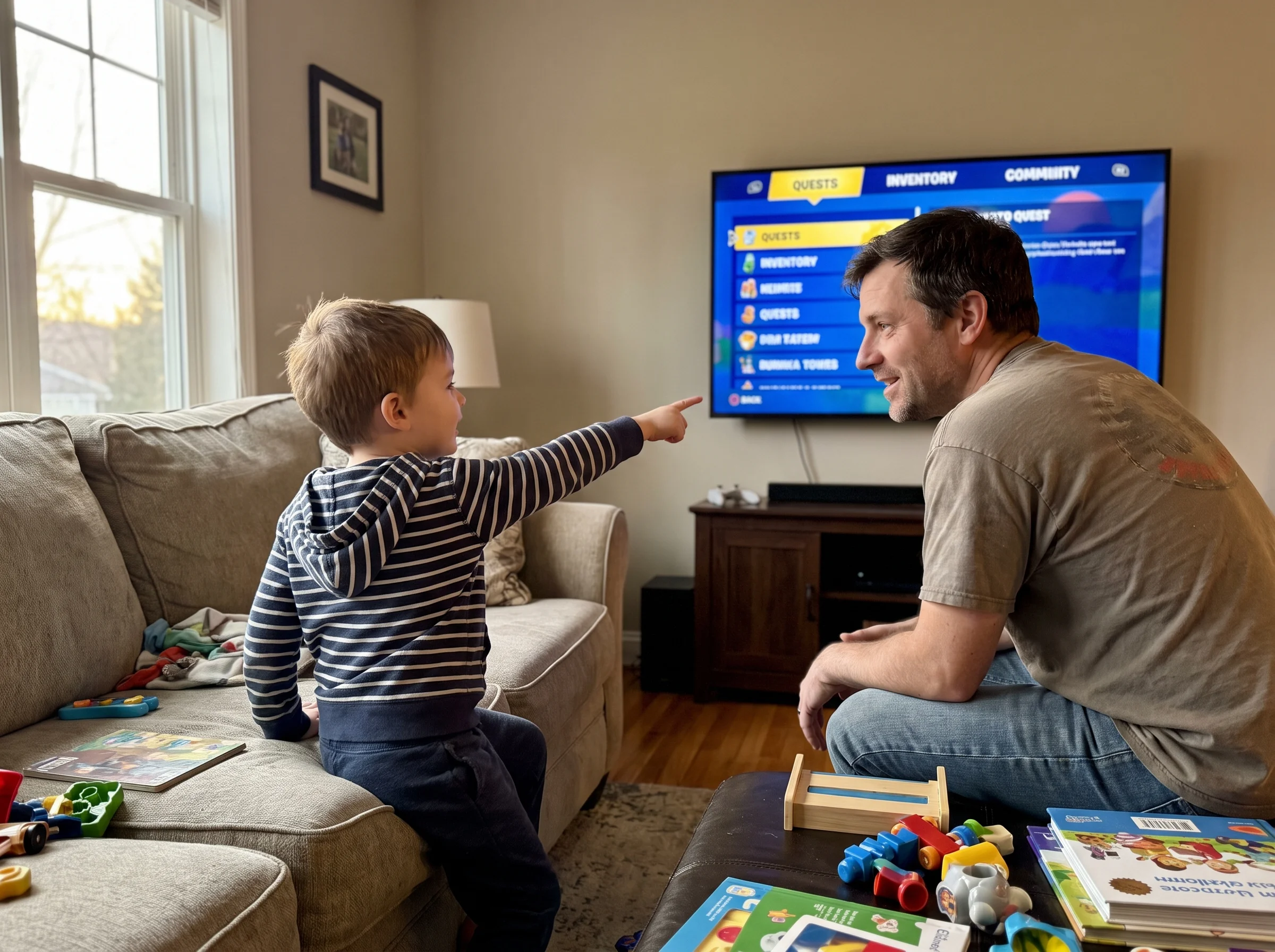
Some handicap systems that actually work:
- The head start. In racing or speedrun games, they wait 30 to 90 seconds before starting. My son used to give me a two-minute head start in Minecraft speedruns and still lap me. That became our bit.
- The character nerf. They play as the weakest character, or with one hand, or upside down (yes, we've tried this).
- Let them pick your handicap. Kids love designing the punishment. "Dad, you can only use the pickaxe. No sword." Fine. I die a lot. It's hilarious.
- The reverse handicap. If you're somehow better at something (retro games, chess, party games), YOU take the hit. This teaches them what you've been teaching yourself for years: losing gracefully is a skill.
The skill gap isn't the problem. Pretending it doesn't exist is the problem.
Fun Gaming Contests Between Parent and Child If You've Never Held a Controller
If your last console was a Nintendo 64, start here:
- Mario Kart with auto-drive on. Yes, this is a real setting. The kart drives itself. You still steer, throw shells, and lose to your kid. But you're competitive enough to make it interesting.
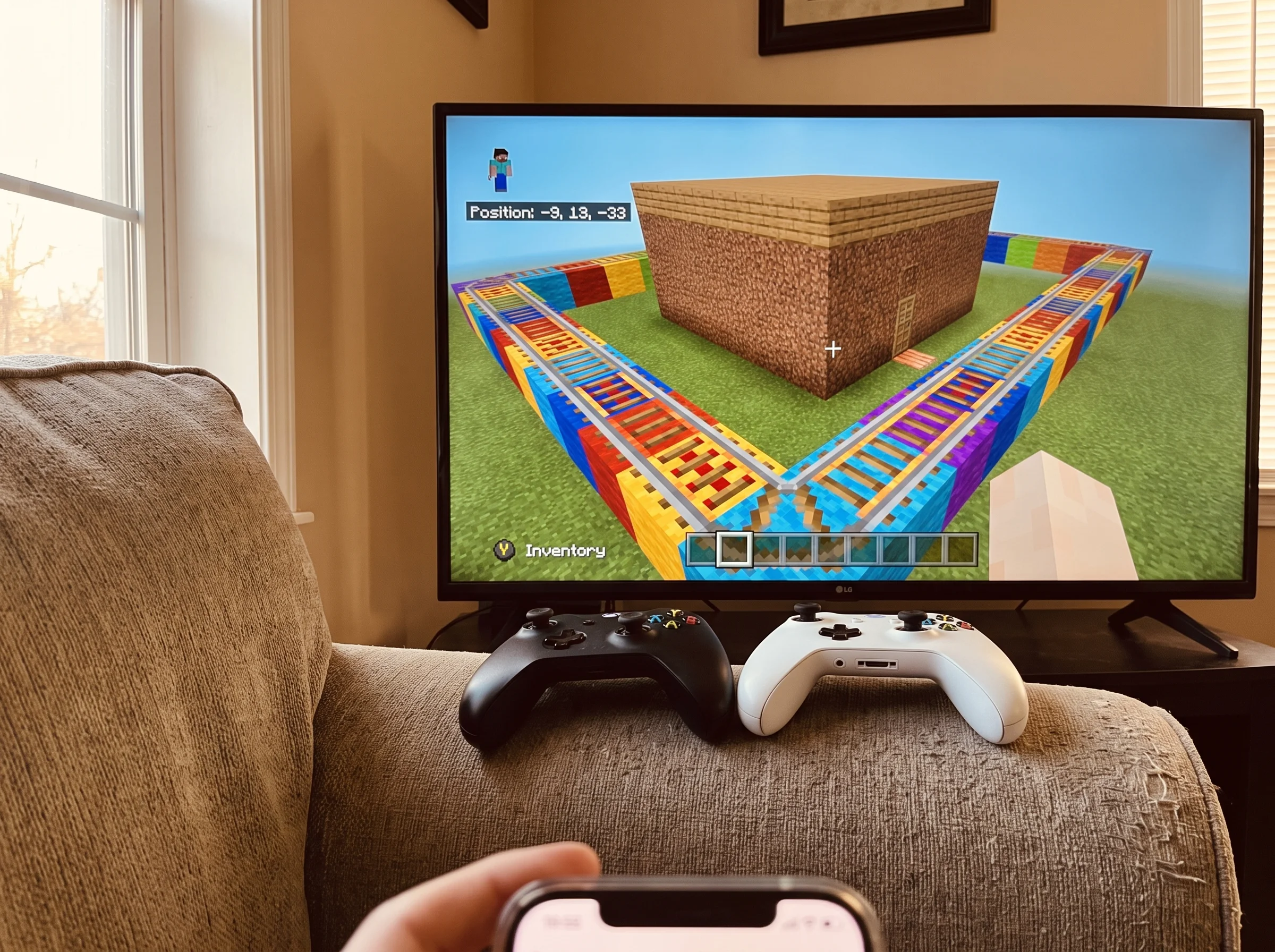
- Minecraft build-offs. Give yourselves 20 minutes and a theme. "Build a haunted house." "Build the worst restaurant in town." No reflexes required, just creativity. The first time we did this, I built what I generously called a "house" (four walls, a door, one window). My son built a working roller coaster with a loading platform and mood lighting. We still bring it up two years later.
- Trivia contests using their games. Name every Pokemon starter. Name every weapon in Fortnite. You will lose. That's fine. You're showing them you took the time to even ask.
- Shared-goal speedruns. You're not competing against each other. You're both trying to beat a level as fast as possible, then comparing times. This one's great because you can talk the whole way through.
Contests for Parents Who Actually Game
If you're one of the dads who never put the controller down:
- Fighting game first-to-five. Smash Bros, Street Fighter, whatever. Short rounds, quick momentum shifts, easy to trash-talk through.
- Fortnite Zone Wars. It's a limited creative mode, quick matches, and it's how my son taught me what an "edit" is.
- Co-op speedruns. Portal 2 and It Takes Two are the gold standard. You can't finish either one without actually talking to each other.
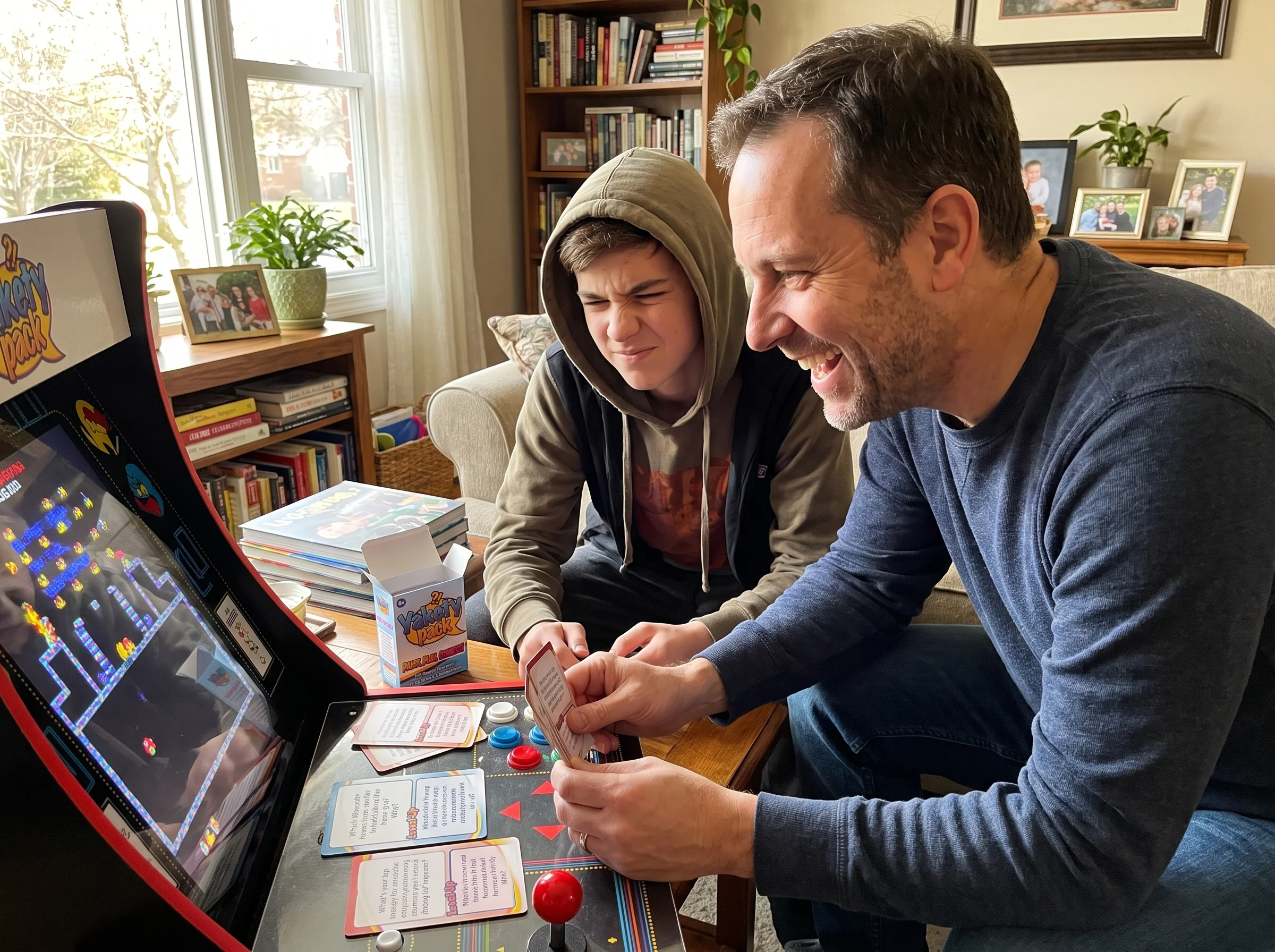
- Retro score attack. This is where you finally have the edge. Pull up Pac-Man, Tetris, or Galaga. Watch your kid discover that Dad has muscle memory from 1987.
 The twenty minutes afterPause, Play, Connect: Core Deck$49 CAD • 172 promptsSee the deck
The "You Teach Me, I Teach You" Format
This is the one I'd bet the farm on if I could only pick one.
Half the session: your kid teaches you their game. Not just how to play, but the lore, the strategy, why this skin is better than that skin, who their favorite streamer is. Ask actual questions. Don't fake interest, get interested.
Other half: you teach them something. Chess. Poker. Euchre. A weird arcade game from your childhood. The role reversal is where the magic is. When they're teaching, they're the expert. When you're teaching, they get to see you as a person with a whole history before you were "Dad."
I asked my son once to explain his Fortnite loadout. Forty minutes later I understood not just his loadout but the entire social hierarchy of his friend group, who was mad at whom, and why one kid always picks Peely. That's not gaming. That's a status report on his life.
Prizes That Don't Suck
The prize is the punchline, not the point. Keep it dumb.
- Loser cooks dinner (or picks the takeout).
- Winner picks the weekend activity.
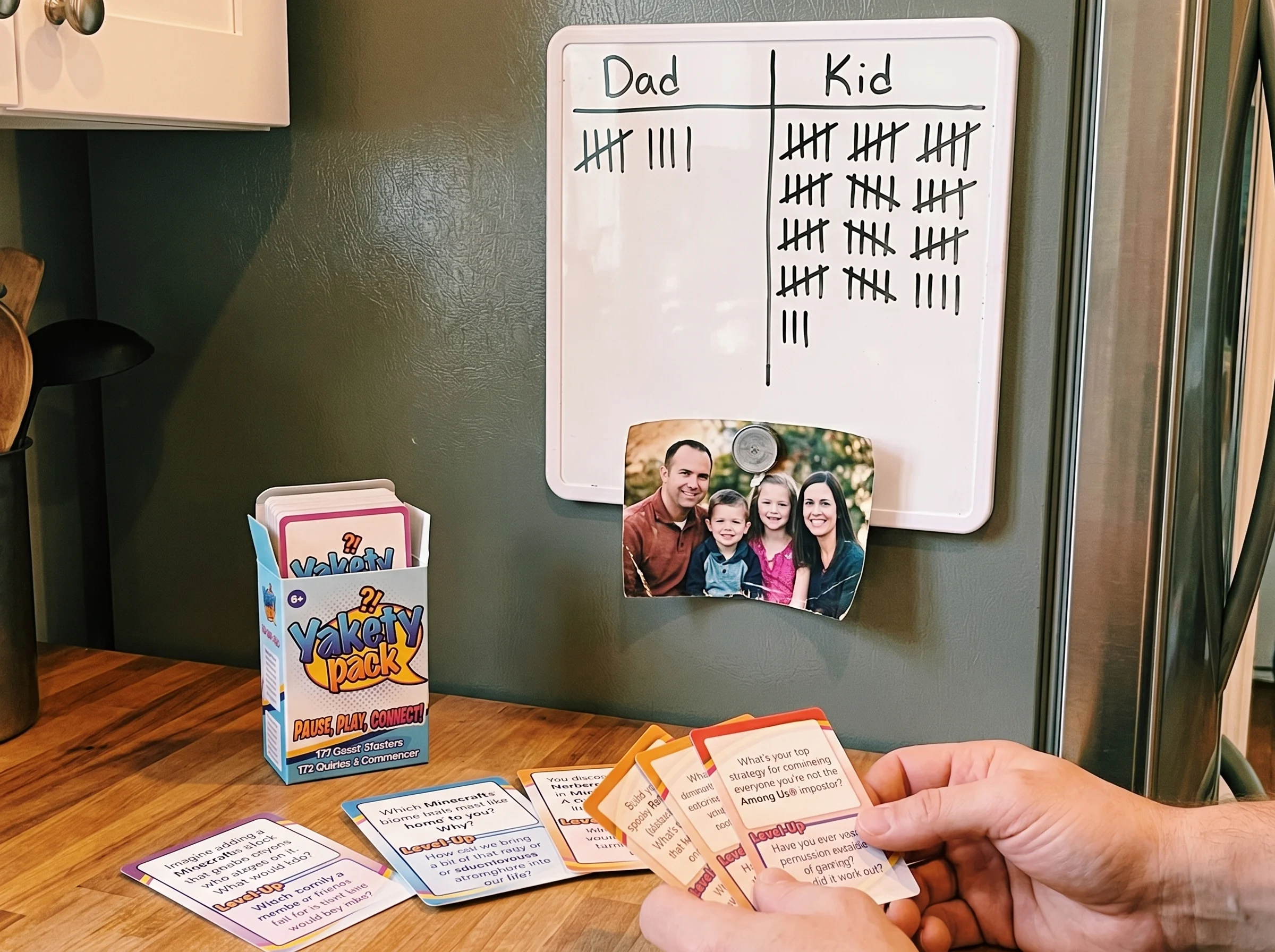
- A running tally on the fridge. Ours is a whiteboard. It has been "Dad: 3, Kid: 47" for approximately a year.
- Documented bragging rights. Take a screenshot. Print it. Frame it. Ridiculous is the goal.
Do not use screen time as a prize. It sends the message that gaming is contraband, and it also implies you think their hobby is a vice. Bad energy.
What to Do When It Goes Sideways
It will go sideways. Here's the field manual:
The rage-quit. Do not lecture. Do not "I told you so." Say "yeah, that one hurt" and walk away. Come back in an hour. They'll come back too.
When YOU win and they can't handle it. Their ego is more fragile than yours. Don't gloat. Compliment a specific thing they did well: "That save in round three was insane." Move on.
When they get bored mid-contest. Call it. "This one's a dud, let's play something dumb." A "reset game" (usually something chaotic like Fall Guys or Gang Beasts) resets the mood in about four minutes.
When they say you're cringe. You are. That's the price of admission. Keep showing up.
The Part Everyone Skips: The Post-Game
Here's the secret. The contest isn't the point. The twenty minutes AFTER the contest is the point.
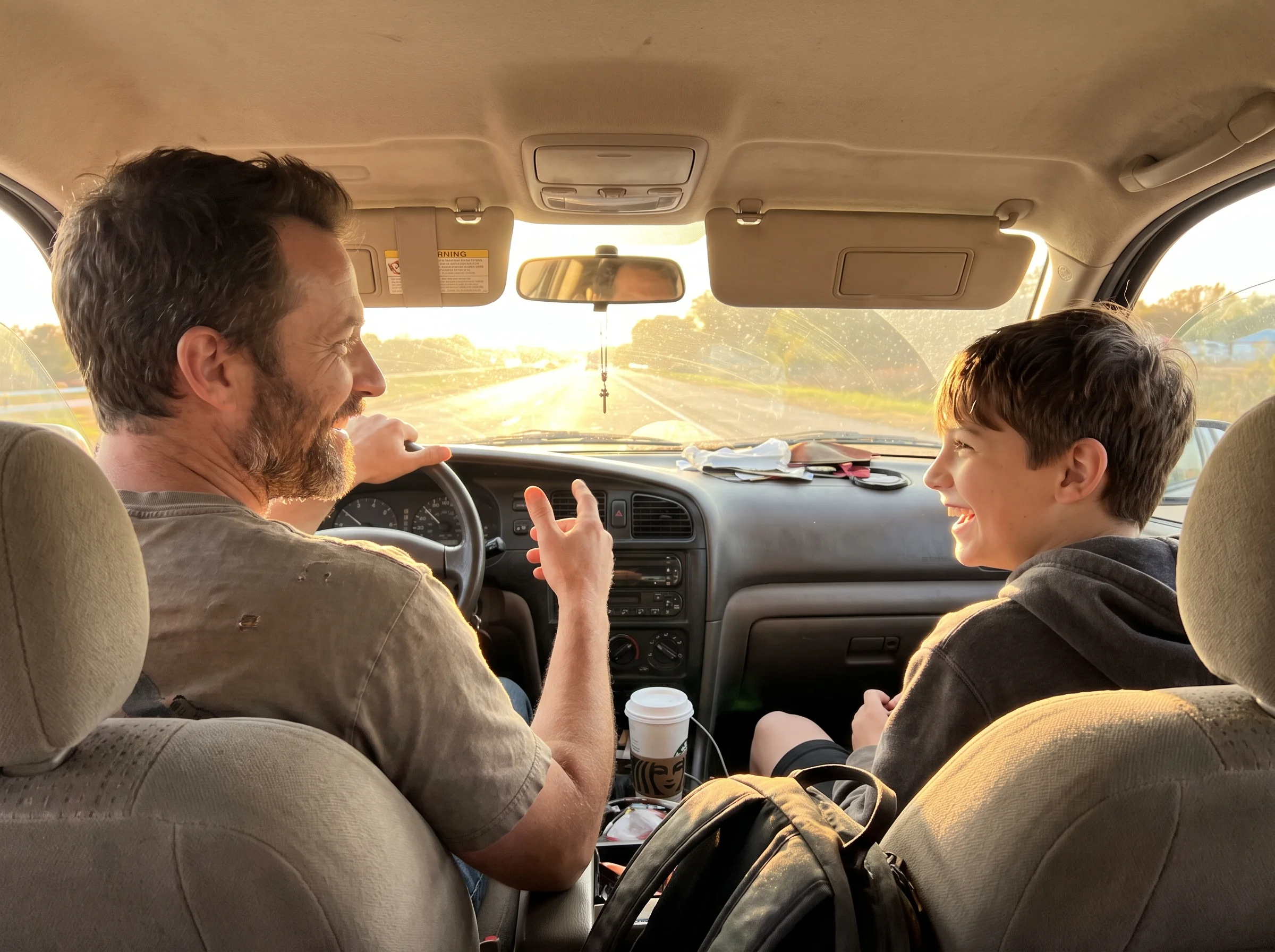
In the car on the way to practice. At dinner. At bedtime. They're still buzzing. You now have a shared reference. You can say "remember the roller coaster" and get a full smile out of a 14-year-old, which if you have a teenager, you know is currency.
But you have to ask the right questions. "How was gaming?" gets you a grunt. "What was your favorite part?" is a dead question, they can't answer it. Try these instead:
- "What would you have done differently in that last round?"
- "Who's the toughest opponent you've ever played online?"
- "If you could nerf one thing in that game, what would it be?"
- "What character would you want as a best friend in real life?"
That last one is actually why we built Yakety Pack. My wife and I kept fumbling the post-game conversation. I'd ask a bad question, get a bad answer, and lose the moment. So we started writing down the questions that actually worked, the ones that got twenty-minute answers out of a kid who'd been giving one-word replies. Eventually there were enough of them to make a deck. It started as a car-ride-home tool for after gaming sessions. Now other families use it too.
You don't need our cards to do this. You just need to stop asking "how was your game" and start asking something a kid would actually want to answer.
The Counter-Intuitive Advice
Don't try to get good at their game.
I know every article tells you to "learn what your kid loves." Fine. Learn it. But don't grind Fortnite in secret so you can be competitive. Kids can smell a try-hard from six blocks away, and there's nothing more cringe to a 12-year-old than a parent trying to be cool at their thing.
Being genuinely bad and genuinely curious beats being secretly competent every time. The Rocket League bloodbath worked because I wasn't pretending I could win. I was just showing up, losing, laughing, and asking him to teach me why I kept getting dunked on. That kind of curious co-play is exactly what Common Sense Media recommends for parents who want to connect through gaming instead of policing it.
One Thing to Do This Week
Pick a game your kid already loves. Ask them for a 1v1, or a build-off, or a speedrun. Tell them they can set the handicap. Play one round. When it's over, don't ask "how was that?" Ask "what would you do differently next time?"
Then just listen.
The score doesn't matter. What matters is that a year from now, you both still remember the flooded village, the roller coaster, the eleven-second goal. Contests give you those shared references. Shared references are what you talk about for the next ten years.
That's the whole game.
When the tally goes upPause, Play, Connect: Core Deck172 prompts that fit the car ride and the dinner table, when the game is still fresh.$49 CAD • 90 cards • 18 reviewsShop the deck

