
For two years, every conversation I tried to have with my son about screens ended the same way. Him shrugging. Me sighing. Both of us walking away annoyed and a little further apart than we started.
I thought I was being a good parent. I'd read the articles. I had the talking points. I asked the calm, measured questions. "How long were you on the Switch today?" "What were you playing?" "Don't you think that's enough for one day?"
What I was actually doing was running a low-grade interrogation and calling it connection. He knew it. I didn't.
Here's what finally worked, and what I wish someone had told me three years ago when I was Googling "how to talk to my son about screen time" at 11pm with that specific brand of parental dread. If you want better family screen time conversations, the fix isn't a new rule. It's a new stance.
Stop Calling Them "Screen Time Conversations"
The label is the first problem.
The minute a kid hears "we need to talk about screens," they brace. Same way you and I braced when our parents said "we need to talk." Nothing good ever followed those words. The frame is adversarial before anyone's said anything real.
And kids, especially kids who game, have had this conversation a hundred times. With you. With teachers. With grandparents who heard something on the news. They know the script. They know their lines. They know yours. Everyone plays their part, nothing changes, everybody loses.
So here's the reframe that changed everything for me: I'm not having a screen time conversation. I'm having a "what do you love" conversation. Sometimes the screen comes up. Sometimes it doesn't. Either way, the goal is the kid, not the device.
The night this clicked for me, I'd just asked my son "how was Roblox today?" for what felt like the hundredth time. Got the hundredth grunt. I went to bed annoyed, woke up at 2am, and realized I was asking him a question I didn't actually care about the answer to. I didn't care how Roblox "was." That's not even a real question. What did I want to know? I wanted to know about HIM. What he laughed at. Who he was playing with. What was on his mind.
The next night I tried something different. "What's the weirdest thing that happened in a game this week?"
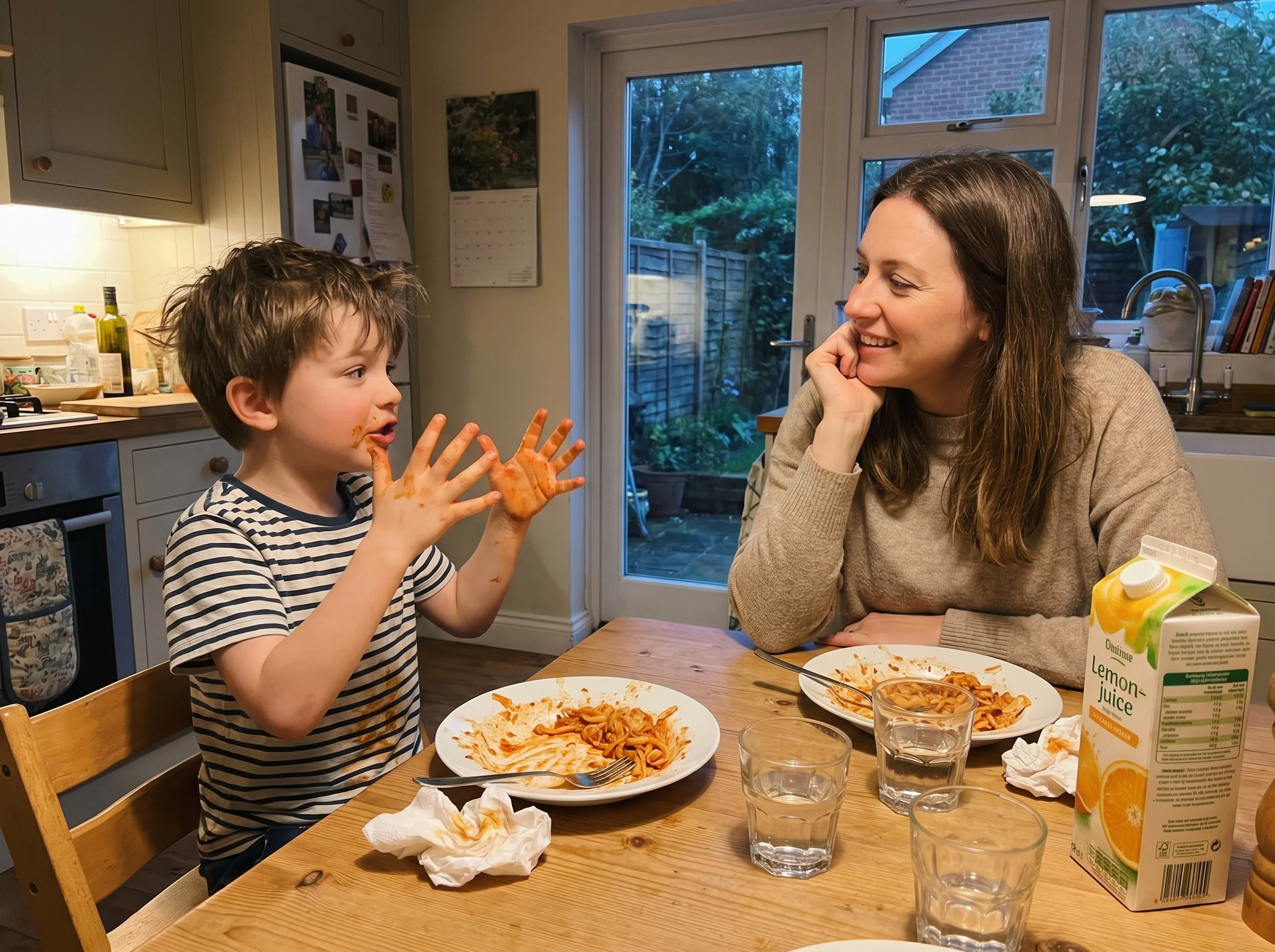
He talked for fifteen minutes. About a friend who kept falling off the same ledge. About a player who was clearly someone's grandma. About a glitch where his character's head turned around backwards and he couldn't stop laughing.
I hadn't unlocked a parenting hack. I'd just asked a question that treated him like a person instead of a problem.
 Room to be interestingPause, Play, Connect: Core Deck172 prompts that get a kid telling you about their week instead of reporting on it.$49 CAD • 90 cards • 18 reviewsShop the deck
The Questions That Actually Get Answers
Here's the rule I wish I'd known: specific beats general, every single time.
"How was your day?" gets you "fine." "Who'd you sit with at lunch?" gets you a story.
Same thing with gaming. "What did you play?" gets you a title. "What's the most ridiculous thing you saw on YouTube this week?" gets you a YouTuber's whole personality, three jokes, and a window into your kid's sense of humor.
Some questions that have worked in my house:
- "Who'd you play with today?" (Tells you about their friend group, which is half the reason they're on there in the first place.)
- "What's a game you think I'd actually be decent at?" (They get to size you up. Kids LOVE sizing parents up.)
- "If you could put one game character in our family, who would it be and what would they do?" (Weird question. Always works.)
- "What's the most annoying thing about your favorite game?" (Complaining unlocks people. Adults and kids both.)
- "What's something you learned in a game this week that surprised you?"
- "Has anyone been a jerk online lately?" (Opens up the whole "what's it actually like in there" conversation without making it a lecture.)
The night my son told me about flooding his entire Minecraft village by accident, I'd just asked "what's the craziest thing that's happened in your world this week?" Twenty minutes of pure storytelling. The villagers. The water. The panic. The friend who logged on and immediately got swept away. He was animated, hands moving, laughing at himself.
I had asked "how was Minecraft today?" for weeks before that and gotten nothing. The question mattered. Not because I'd discovered some magic phrase, but because I'd finally asked something that gave him room to be interesting instead of accountable.
This is honestly why my co-founder and I built Yakety Pack. We kept noticing the same thing in our houses: our kids would talk for an hour with the right question and shut down with the wrong one. We needed a way to remember the good ones in the moment, because in the moment, my brain defaults to "how long were you on?" every time.
When You're the One With the Screen Problem
We need to talk about this one, because nobody else will.
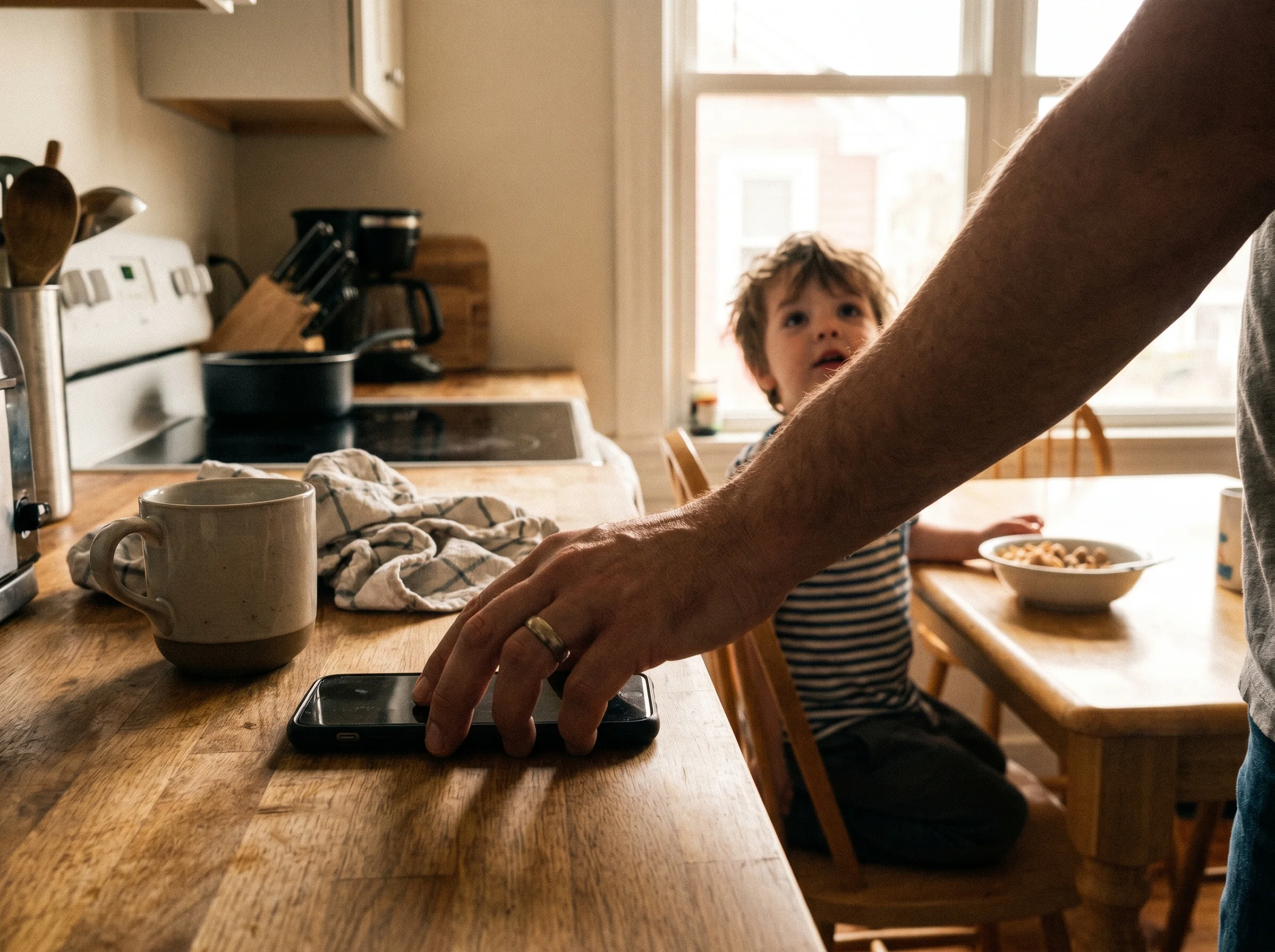
If you're on Instagram for an hour after the kids go to bed, your kid knows. If you're checking email at dinner, your kid knows. If your phone is the first thing you reach for in the morning, your kid knows. They have been watching you since they were two. They know your relationship with that device better than you do. Research from Common Sense Media keeps showing the same thing: kids model their parents' phone habits more than parents realize.
So when you sit down to talk about THEIR screen time, you are carrying that whole history into the room. You don't get to pretend otherwise. They're not going to pretend otherwise.
Last summer my daughter, who's ten and has a sniper's eye for hypocrisy, called me out at the dinner table for being on email. I started to defend it. "It's work, it's important, I just need to send one thing." She gave me the look. The one that says "you'd never let me get away with this."
I put the phone down. "You're right. I'm sorry. That was rude."
That ten seconds did more for our screen time conversations than any lecture I'd ever given. Because the next time we talked about her tablet, I had standing. I had admitted I was figuring it out too. We were on the same team trying to solve the same problem, instead of me being the rules guy and her being the kid trying to get away with stuff.
The phrase that's worked best for me: "I know I'm on my phone too much. Can we figure this out together?"
That sentence, delivered honestly, is worth ten weeks of rules.
The "Show Me" Move
This is the single biggest shift I've made as a parent of gamers.
Instead of asking ABOUT their game, ask them to TEACH you.
When you ask "what's Fortnite like?" you're still positioned as the parent gathering intelligence. When you say "okay, sit down, show me how this works, I want to actually play," everything flips. They're the expert. You're the learner. They get to roast you. You get to be bad at something in front of them, which is good for both of you.
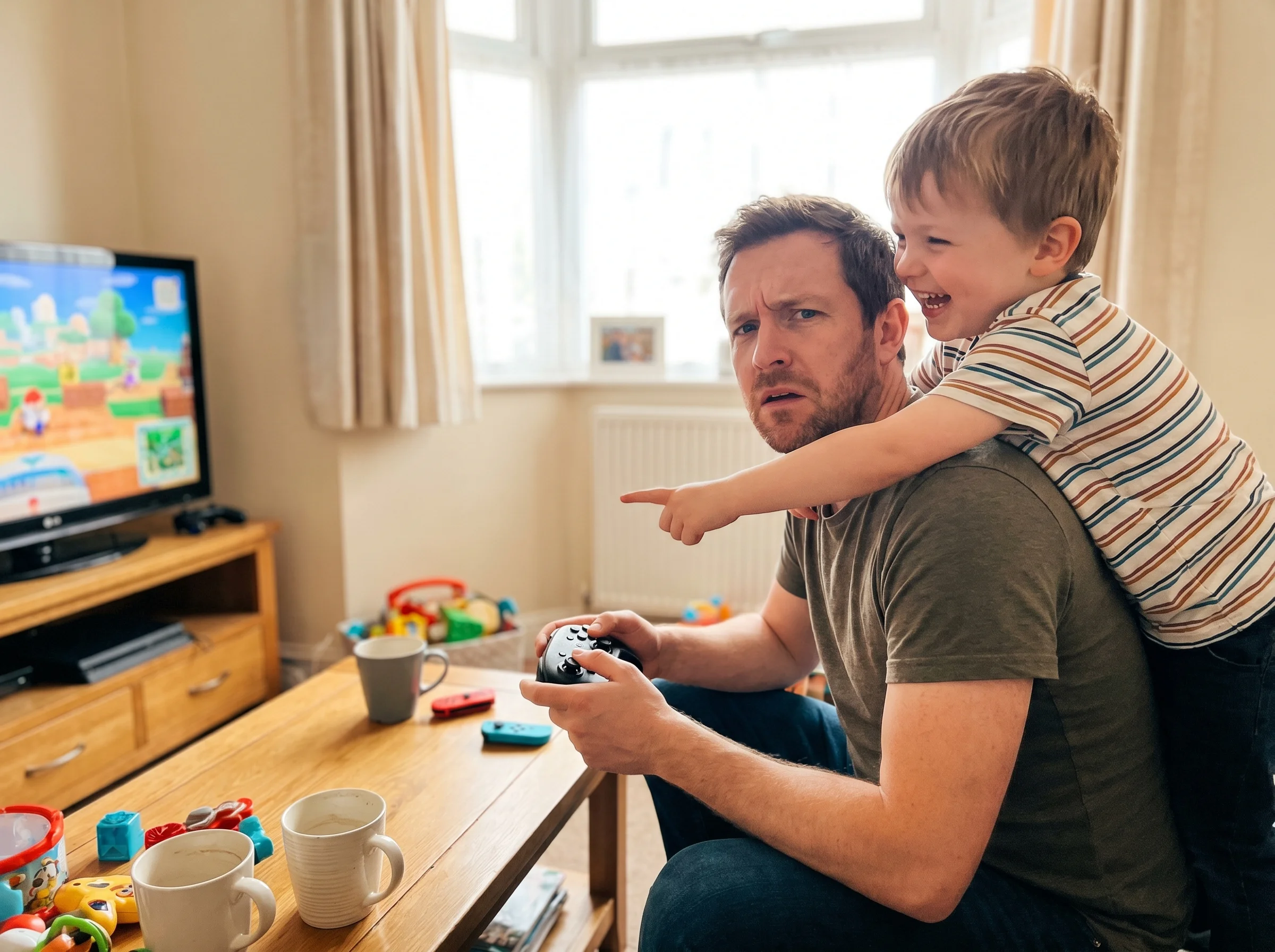
My son tried to teach me Smash Bros about a year ago. I got destroyed. Not "had a good run and lost close" destroyed. I mean my character was launched off the screen so many times he started apologizing for me. My son laughed so hard he was crying. Then he started actually coaching me. "No, Dad, you have to press B when you jump." "Dad. DAD. You're walking off the edge."
That hour told me more about him than a year of dinner table check-ins. The way he taught. The way he got frustrated when I didn't get it. The way he celebrated when I finally landed a hit. I learned more about my kid's personality in 60 minutes of being terrible at Smash Bros than I had in months of asking "how was your day."
You don't have to be good. You have to be willing to be bad. That's the whole move.
 Curious first, rules laterPause, Play, Connect: Core Deck$49 CAD • 172 promptsSee the deck
Talking About Limits Without It Becoming a Fight
Here's where I'm going to lose some people. Rules and limits are necessary. I'm not anti-limits. We have plenty of them in my house.
But the limits conversation is the LAST conversation, not the first. If you've been leading with rules, that's why nothing's working.
Connection comes first. Then conversation. Then collaboration on what the rules should look like.
When we finally sat down as a family to set actual screen rules, I didn't write them alone. I asked, "what do you think is fair?" and listened. My son's first answer was, predictably, "unlimited screens forever." We laughed. Then we talked.
What we landed on was specific. Not "less screens" but "phones charge in the kitchen overnight, not in bedrooms." Not "less gaming" but "no gaming until homework's done and you've been outside for at least 30 minutes." Specific rules are enforceable. Vague rules are arguments waiting to happen. The American Academy of Pediatrics actually recommends families build a media plan together for this exact reason.
The other piece that mattered: I had to be honest with my kids about the fact that not all screen time is the same. Watching TikTok alone for two hours is genuinely different from building a server with three friends in Minecraft for two hours. One is mostly passive scrolling that, by his own admission, sometimes makes my son feel kind of gross afterward. The other is collaboration, problem-solving, and friendship maintenance.
If you treat both the same, your kid will (correctly) decide you don't actually understand what they're doing. And once they decide that, they stop talking to you about any of it.
The rule in our house isn't "X hours of screens." It's "what are you doing on there, and is it making you feel good or weird?" Imperfect. But honest. And my kids can answer it.
When the Conversation Goes Sideways (Because It Will)
You are going to blow it.
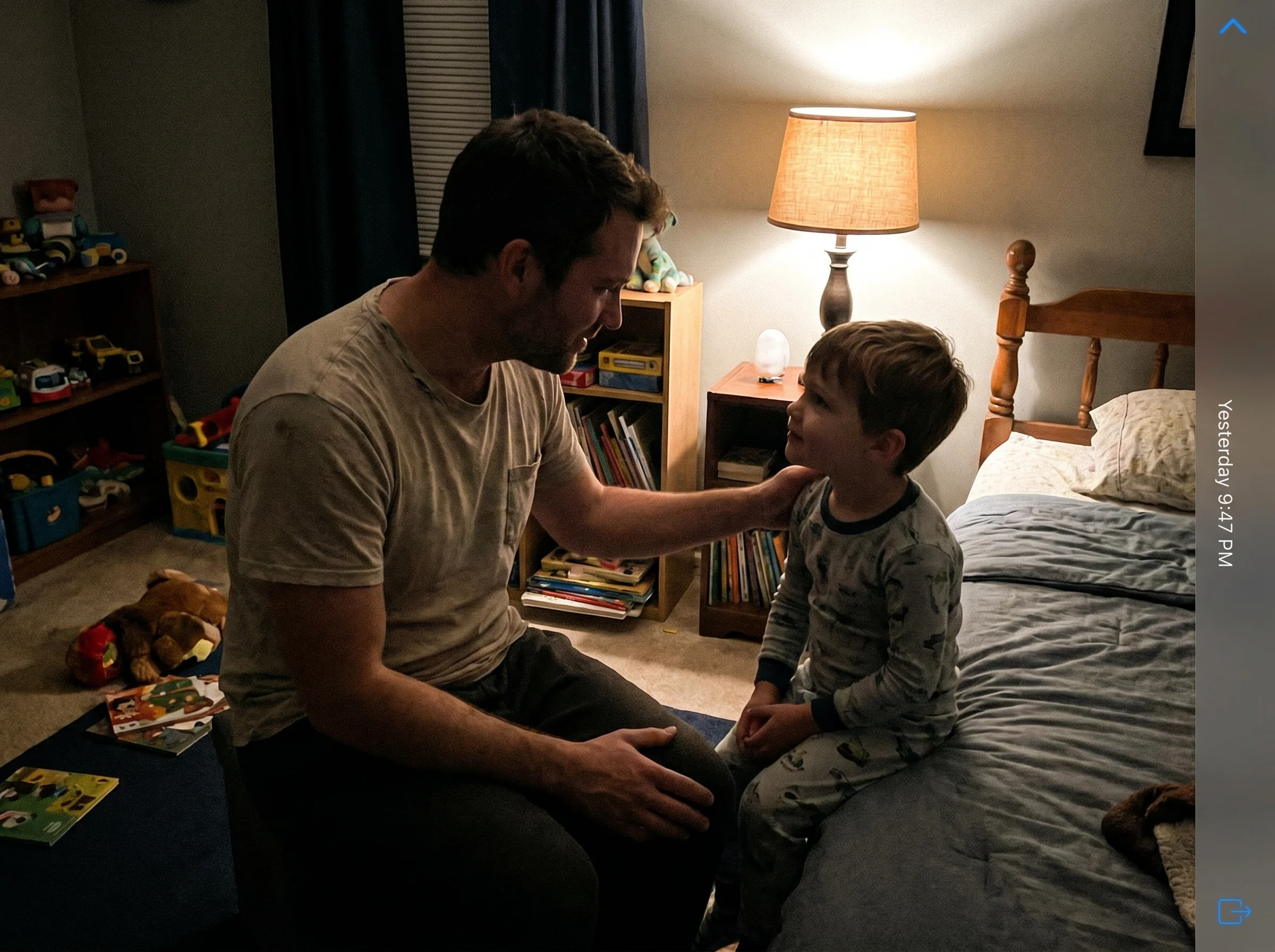
I have blown it. I have lectured when I meant to listen. I have taken away the Switch in a moment of frustration when the actual problem was that I was tired and grumpy. I have said "because I said so" and watched my kid's face close up and known, immediately, that I'd just lost ground.
The good news: the repair conversation is more powerful than the original conversation. Kids don't expect adults to come back and own it. When you do, it lands.
What this looks like in my house: "Hey, I didn't handle last night great. I was tired and I just shut you down. Can we try again?"
That's it. That's the whole script.
My son's response the first time I tried it was a quiet "yeah, okay." But the conversation that followed was real. He told me what he'd been trying to say. I actually listened. We figured something out.
The long game is what matters here. One conversation doesn't fix anything. Fifty conversations might. The goal isn't to nail it tonight. The goal is to keep showing up tomorrow.
Conversation Starters That Actually Work (Steal These)
In the moment, with a tired kid and a tired you, your brain will default to "how was your day?" Mine still does. So here's a list to keep in your back pocket, organized by when they tend to work best.
Car rides (no eye contact = best conversation real estate in your house):
- "What's the funniest thing you saw online this week?"
- "If you could design a video game, what would it be about?"
- "Who's the best player in your friend group, and why?"
Dinner table (keep it light, keep it specific):
- "What's a game you'd want to play as a family?"
- "What's the most annoying thing a YouTuber does?"
- "Did anything weird happen in a game today?"

Before bed (this is when they actually open up if you let them):
- "What was the best part of your day?"
- "Is anyone in your games being a jerk lately?"
- "What are you looking forward to playing this weekend?"
Weekend mornings (low stakes, lots of time):
- "Want to show me what you've been building?"
- "Can you teach me one game today?"
- "Who do you usually play with on Saturdays?"
We put a bunch of these on cards in Yakety Pack because I personally kept forgetting them in the moment. You absolutely don't need cards to do this. You just need to ask something they didn't expect.
A Few FAQs I Get From Other Parents
"What if my kid still won't talk to me?" Keep asking. Don't make it a thing. The kid who won't talk this month might talk next month if you've stayed curious and not turned every conversation into a lecture. Patience is the whole strategy.
"What if my partner and I disagree on the rules?" Have THAT conversation first, without the kids in the room. Show up united, even if you compromised to get there. Kids smell parental disagreement and will exploit it. Not because they're bad. Because they're kids.
"How do I know if their gaming is a problem or just a hobby?" Look at the rest of their life. Are they still seeing friends? Sleeping? Eating? Doing okay in school? Showing some interest in things off the screen sometimes? If yes, it's probably a hobby that takes up a lot of space, which is what hobbies do. If no, and especially if they're isolating or struggling, that's the real conversation, and it's not about screens, it's about what's underneath. The World Health Organization's guidance on gaming is worth a read if you're genuinely worried.
"What if I've already messed this up for years?" Same as me. Same as most of us. Start tonight. Ask one different question. Own one thing you got wrong. Kids are more forgiving than we give them credit for, especially when we stop trying to be right.
The Long Game

Here's what I'd tell myself three years ago, if I could:
You are not going to fix this in one conversation. You are not going to find the magic question. You are not going to read the right article and walk downstairs and have a breakthrough with your kid.
What you ARE going to do is shift your stance, slowly, from concerned to curious. From monitor to learner. From rules-setter to person who actually wants to know what your kid loves and why.
That shift takes months. It takes a hundred small moments. It takes blowing it and coming back. It takes putting your phone down at dinner. It takes losing at Smash Bros. It takes asking better questions and then actually listening to the answers.
One good conversation tonight. Another one next week. Another the week after. That's the whole thing.
Nobody's nailing this on the first try. Including me. Especially me.
But my kid and I talk now, about games and about everything else, and three years ago I would've told you that was never going to happen. So if you're in the shrugging-and-sighing phase, hang in there. The conversation is closer than it feels.
Just ask a better question tonight. See what happens.

From this article
Pause, Play, Connect: Core Deck
Before the next shrug: A better question only helps if it's ready when your kid looks up from the Switch. Keeping a deck of Pause, Play, Connect cards by the couch beats defaulting to "how long were you on?"
The full bundle adds the Parent Power-Up deck and two digital parent guides, $146 of family fun for $59.

