
The first time I tried to lay down screen time rules with my son, I had a printed schedule, a timer app, and what I thought was a reasonable speech. Twenty minutes later he was crying in his room and I was sitting at the kitchen table wondering why a conversation about Minecraft had turned into a referendum on whether I loved him.
Turns out I'd done the whole thing backwards.
I've spent the better part of five years figuring out how families actually talk about screen time at home without it becoming a weekly war. Most of what I learned, I learned by getting it wrong first. So if you're a family discussing screen time rules at home and dreading the conversation, let me save you some of the bruises.
Setting Rules Isn't the Same as Having a Conversation
Here's the trap I fell into, and almost every parent I talk to falls into the same one: we treat the rules like the work. We research the "right" number of hours. We draft a contract. We print the schedule. And then we sit our kid down and present it like a verdict.
That's not a conversation. That's a sentencing hearing.
Rules without buy-in are just future arguments waiting to happen. Your kid will agree to anything in the moment if they think it gets them back to their game faster. Then Tuesday rolls around and suddenly you're the bad guy enforcing something they never actually agreed to in their heart.
The conversation IS the work. Not the prep for the work. The actual sit-down, ask-questions, listen-more-than-talk part is where rules either get built to last or built to collapse.
 Seven days of curiosityPause, Play, Connect: Core Deck172 prompts that give you something to be curious about before the rules conversation starts.$49 CAD • 90 cards • 18 reviewsShop the deck
Before You Talk Rules, Talk Games
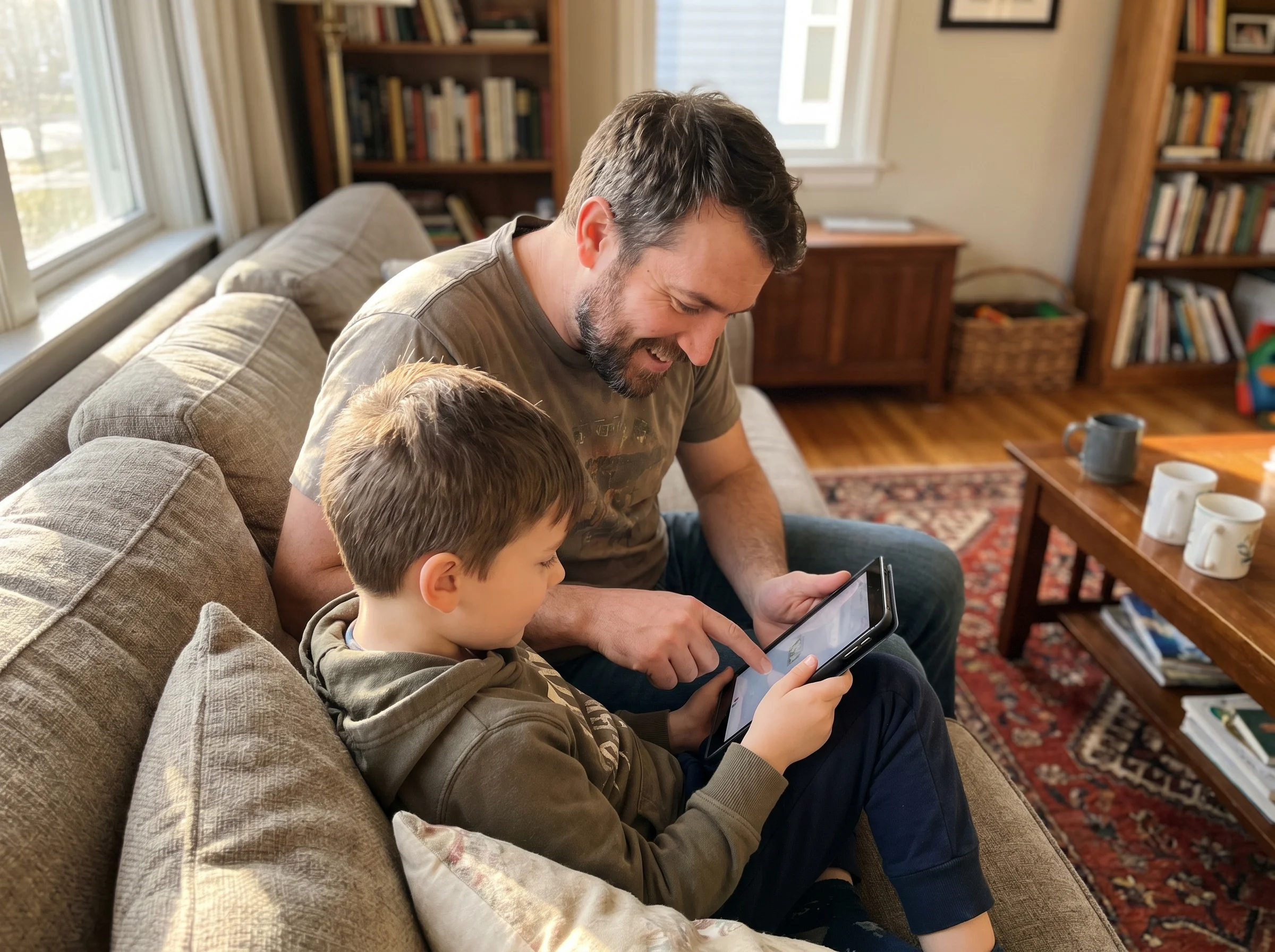
This is the part nobody tells you. Before you bring up screen time at all, spend a week just being curious about what your kid plays.
Not "is it appropriate" questions. Not "how much time did you spend on it" questions. Real ones.
- "What's the craziest thing that's happened in your world this week?"
- "Who do you usually play with?"
- "What are you trying to build right now?"
- "What's the goal of this game, like how do you win?"
- "What's the most annoying thing about it?"
I tried asking my son "how was Minecraft today?" for weeks. Got grunts. The day I asked "what's the craziest thing that happened in your world this week?" he talked for twenty minutes about accidentally flooding his village. The question mattered. Research from the American Psychological Association backs this up too: kids who feel their gaming is understood by parents are more open to family conversations about it.
This is actually how Yakety Pack started. My co-founder and I kept hitting the same wall: we wanted to connect with our kids about gaming, but we didn't know how to ask in a way that actually got us in the door. So we made a deck of cards full of the kinds of questions that open kids up instead of shutting them down. Not a screen time solution. A conversation starter.
Once you've spent a week genuinely curious about their world, the screen time conversation becomes a totally different thing. You're negotiating from inside their world instead of yelling from outside it.
Build Rules Around Natural Stopping Points, Not Just Clock Minutes
I spent two years setting "fair" time limits with my son before I realized he wasn't fighting the time limit. He was fighting being interrupted mid-match in a game where leaving early let his teammates down.
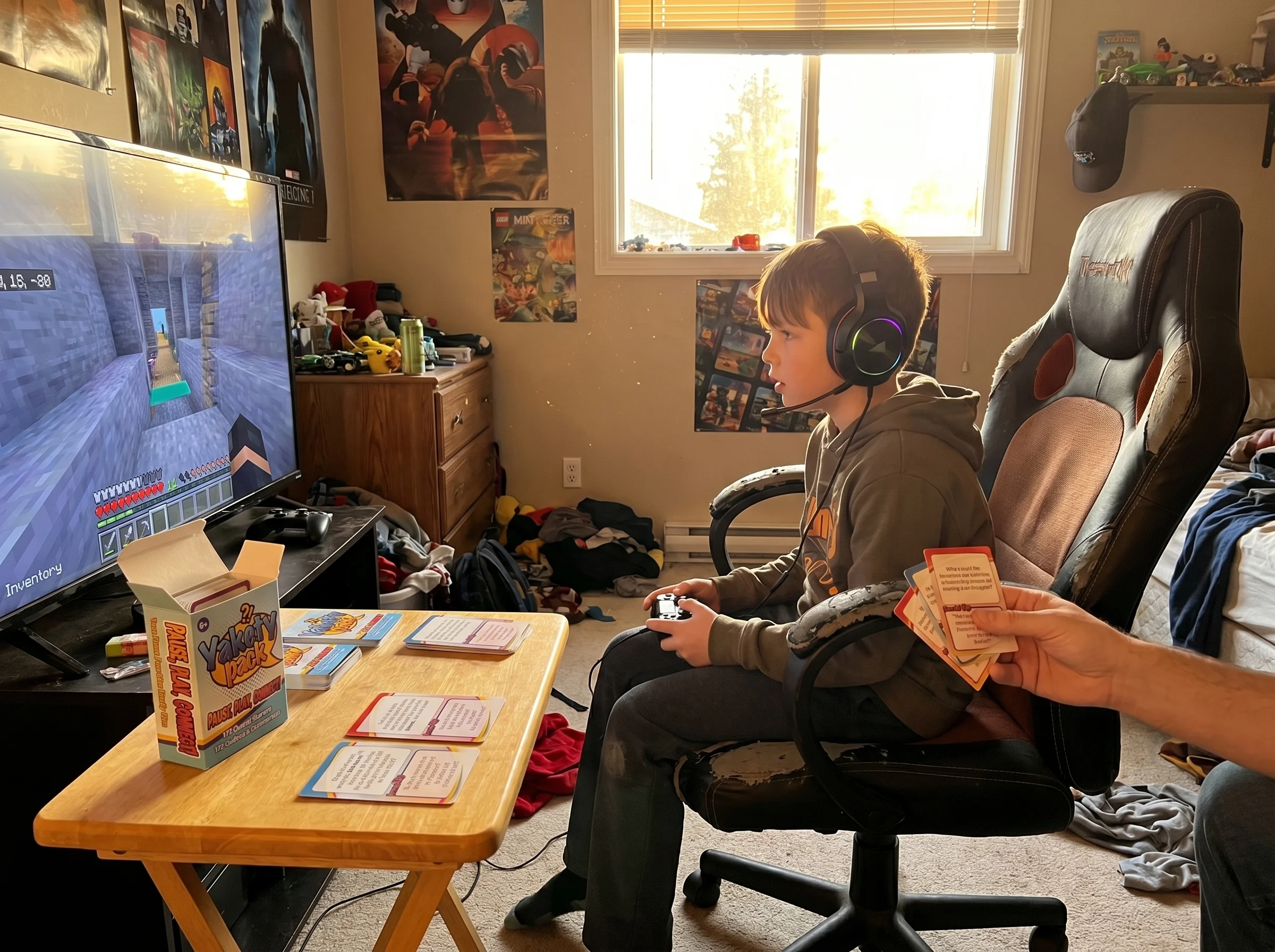
Think about that for a second. In a lot of online games, if you bail mid-match, your team is now playing four-on-five. You get reported. Sometimes you get penalties. To a kid who cares about his friends and his reputation in that world, "ten more minutes" can literally mean "go let your friends down on purpose."
When I figured that out, we rebuilt the rules around natural stopping points. End of the match. End of the quest. After the next save point. With a clear cap on how many more rounds.
Sample compromise: "You can finish this match, but no queueing for another one. When this one ends, we're done."
The fight went away. Not partly. Not mostly. It went away.
If your kid plays something where stopping mid-action has real social or in-game consequences, your clock-based rule is going to feel like a punishment every single time. Build rules around how the game actually works.
The Family Meeting That Actually Works
When you're ready to actually talk rules, here's what's worked in our house with our family discussing screen time rules at home together:
Everyone's at the table. The 14-year-old, the 8-year-old, both parents. Even the kid who barely uses screens. This isn't a trial for the heaviest user.
Open with three questions, in this order:
- "What do you love most about the games and apps you use?"
- "What gets in the way of you enjoying them, like when does it stop being fun?"
- "If you were the parent, what rules would feel fair to you?"
That last one is the magic one. Kids almost always propose stricter rules than you would. And even when they don't, the act of proposing makes the final agreement theirs.
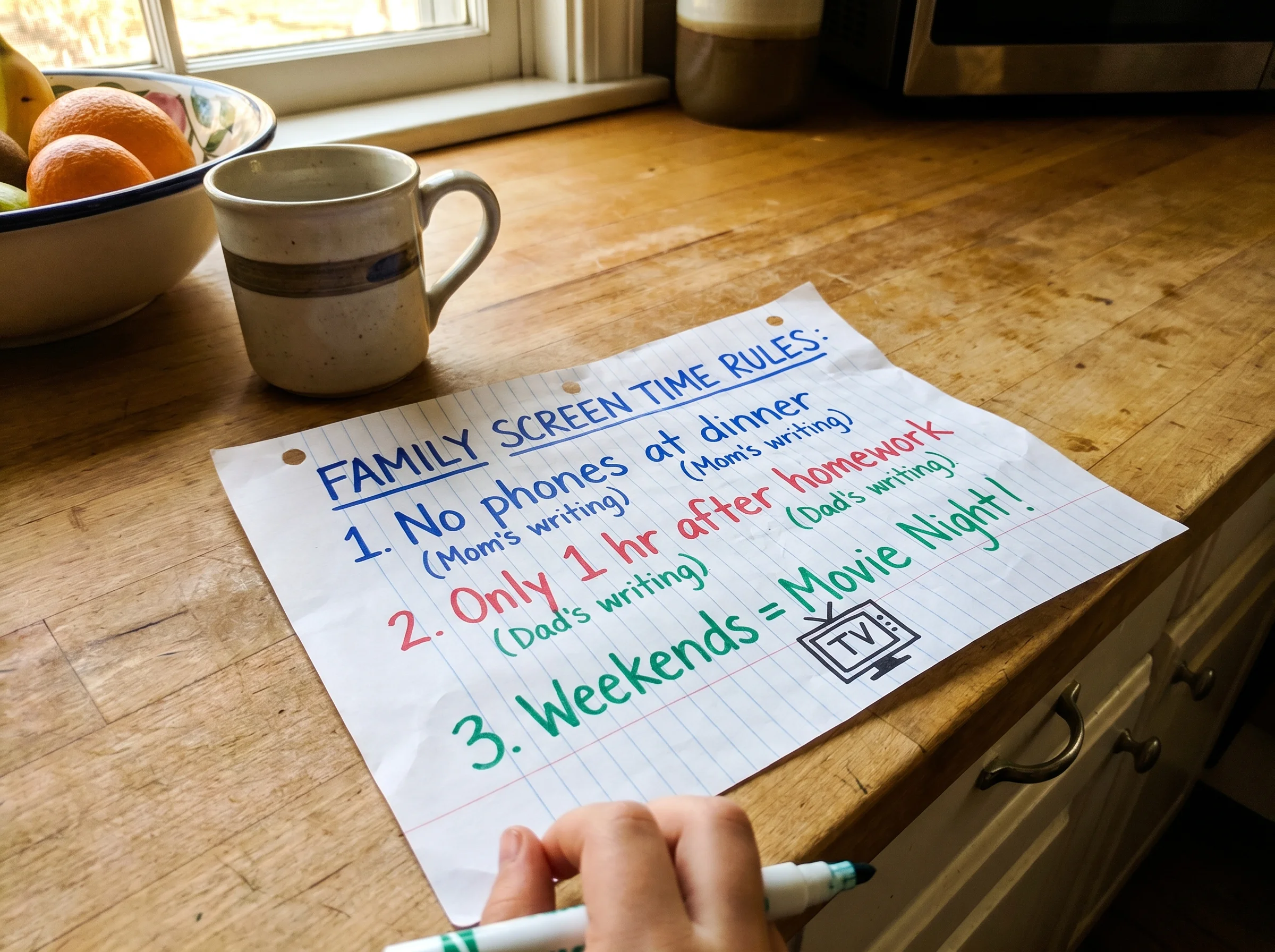
Write it down together. On paper. With everyone's input visible. Not a contract you hand them. A document you build with them.
 Something everyone gets to answerPause, Play, Connect: Core Deck$49 CAD • 172 promptsSee the deck
The Parent Hypocrisy Problem
We have to talk about this part because nobody does.
About a year into our family's screen time experiment, I was telling my son to put his iPad away at dinner. He looked at me, looked at my phone sitting next to my plate, and said "okay, you first."
Reader, I had no comeback.
Whatever rules you set, you're in them too. Phones at dinner. Phones in bedrooms. Doomscrolling on the couch while telling your kid they've had enough. Your kid sees all of it. They're keeping score even when you think they're not. The folks at Common Sense Media have written a lot about this, and the data lines up with what every parent already knows in their gut: kids model what we do, not what we say.
In our house we landed on family-wide rules instead of kid-only rules. No phones at the table. No screens after 9pm in shared spaces. Charging stations in the kitchen overnight. The minute I included myself, the resistance from my kids dropped about 80%. It wasn't a rule being done TO them anymore. It was a rule we were all in together.
Handling the Hard Stuff
Different ages, different rules. Tell your younger kid the truth: "Fairness doesn't mean everyone gets the same thing. It means everyone gets what's right for them. When you're 14, you'll get 14-year-old rules too." Then actually follow through when they hit that age.
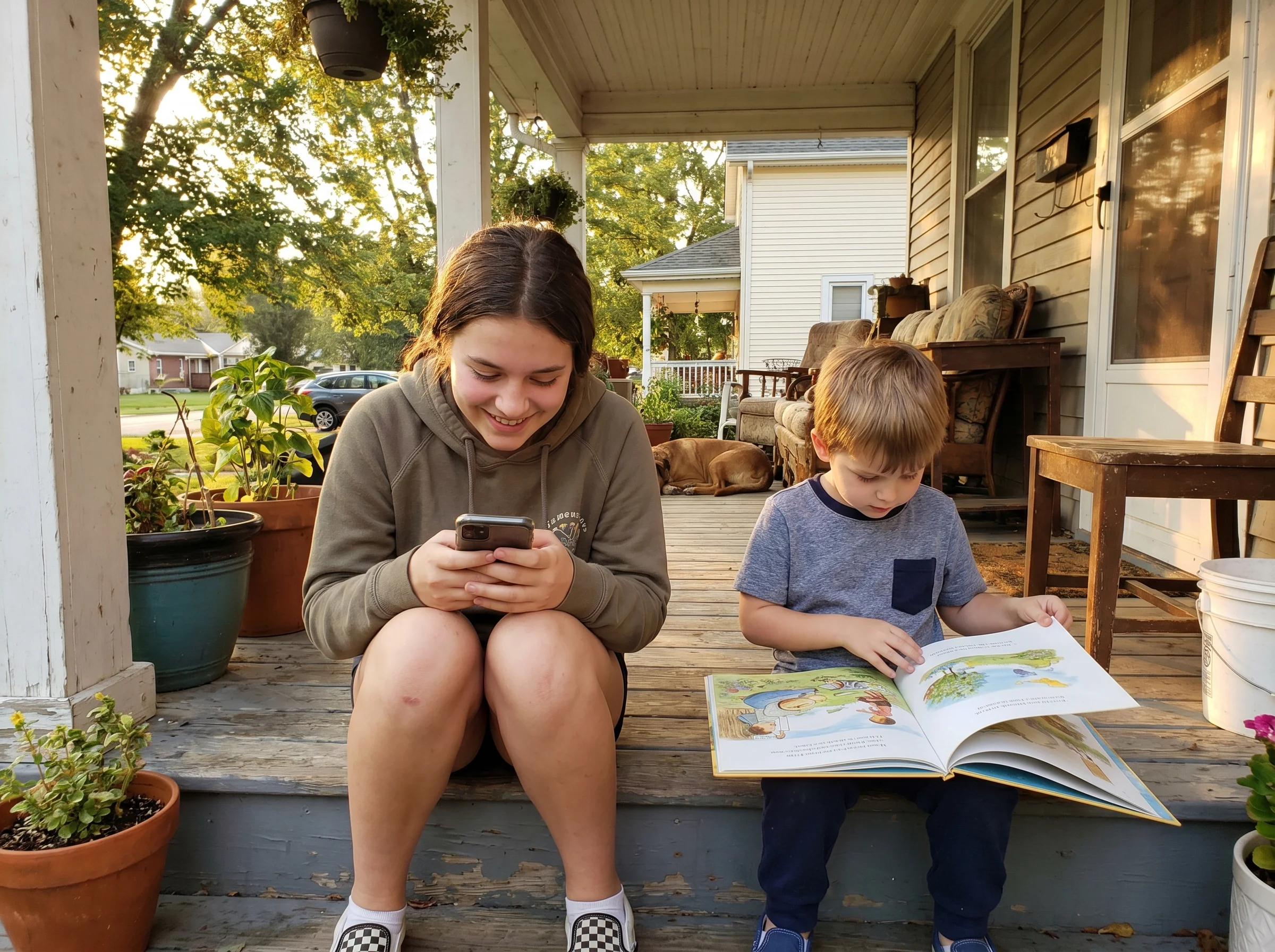
Sleepovers and grandma's house. Pick your battles. We treat sleepovers as off-rules nights, the same way we treat them as off-bedtime nights. Grandma's house is grandma's rules. Trying to enforce home rules everywhere just turns you into the screen cop in your kid's memory.
"All my friends play more than me." Don't argue the facts. You'll lose, because some of those friends probably do. Try: "Maybe they do. Our family's working out what's right for us. Tell me what you feel like you're missing out on." Then actually listen, because sometimes the answer is real (they're getting left out of group chats during the day) and the rule does need to flex.
When the Conversation Goes Sideways
Sometimes your kid storms off. Sometimes they cry. Sometimes they tell you you're ruining their life and slam a door.
That's okay. That's the conversation going somewhere real, not failing.
The 24-hour rule has saved me more times than I can count. "We don't have to figure this out right now. Let's both think about it and come back tomorrow." Walking away from a heated moment isn't avoiding the conversation. It's protecting the conversation from being decided by everyone's worst version of themselves.

When you do come back, don't open with the rules. Open with a question. There's one in our Yakety Pack deck I've used a dozen times to crack things back open after a hard moment: "What's something you wish I understood better about what you do online?" It's almost impossible to stay defensive when someone asks you that.
Your Next Step
If you're staring down this conversation tonight, don't write the rules. Write the questions.
Pick three things your kid plays. Come up with one genuinely curious question about each. Ask them at dinner or in the car. Don't follow up with a rule. Don't follow up with a worry. Just listen.
Do that for a week. Then have the meeting.
I promise it'll go differently than the printed-schedule version.
If you want the bigger picture on how all of this fits together, I've written more about family screen time conversations and how to set the whole table for them, not just the rules chapter. You might also find it helpful to read about asking better questions about your kid's gaming world before you sit down for the meeting. The rules are the easy part once the conversation is real.

From this article
Pause, Play, Connect: Core Deck
Write the questions first: If tonight's homework is three curious questions instead of a rule sheet, the Pause, Play, Connect Core Deck has done that homework for you, one card per dinner or car ride.
Going all in? The full bundle pairs it with the Parent Power-Up deck and two digital parent guides, $146 of family fun for $59.

