
My son was 14 when he asked, at the dinner table, if you could go to college for playing video games. I laughed. Not in a mean way, more of a "come on, buddy" laugh. The same laugh my dad probably gave me when I told him I wanted to be a sportscaster in fifth grade.
Turns out I was the one who needed educating.
Three years later, my kid is the one explaining to me which programs are legit, which coaches actually played at a high level, and why the team's social media manager might end up with a better career than the starting jungler. The whole world of esports scholarships is real, it's growing, and almost everything you'll read about it online is either outdated, overhyped, or written for somebody who isn't you, the parent who just had a weird conversation with their kid and is now googling at 11pm.
This is the guide I wish I'd had that night.
Yes, Esports Scholarships Are Real. Here's the Honest 2025 Picture.
There are over 200 varsity esports programs in the U.S. now. The two big governing bodies are NACE (National Association of Collegiate Esports) and NJCAAE (the junior college version). PlayVS handles a lot of the high school infrastructure. This is no longer a fringe thing held together by a club president and a folding table.
But here's where most articles lose the plot: they quote a "$16 million in scholarships available" stat from 2019 and stop there. The reality is messier.
Most esports scholarships are partial. We're talking $500 to $8,000 a year for the majority of recruited players. Full rides exist, but they're rare and mostly reserved for top-tier League of Legends and Valorant players going to programs like Maryville, Northwood, or Miami University (Ohio). If your kid is Immortal in Valorant or Challenger in League, the conversation changes. If they're Diamond, the conversation is "partial scholarship at a smaller school, and that's still great."
The other thing nobody mentions: NCAA D1 schools mostly don't sponsor esports as a varsity sport. The NCAA voted against governing esports back in 2019. So when people ask "do D1 schools have esports," the answer is "kind of, but not the way you think." Most of the strong programs are at smaller D2, D3, NAIA, and junior colleges. A few big names (Ohio State, Utah, Boise State) have varsity programs, but they operate outside NCAA oversight.
This isn't a bad thing. Some of the best programs in the country are at schools you've never heard of. But you need to recalibrate. Stop thinking "where will my kid get a full ride to a Power 5 school" and start thinking "where will my kid get a meaningful chunk of tuition covered while studying something useful at a school that actually invests in this."
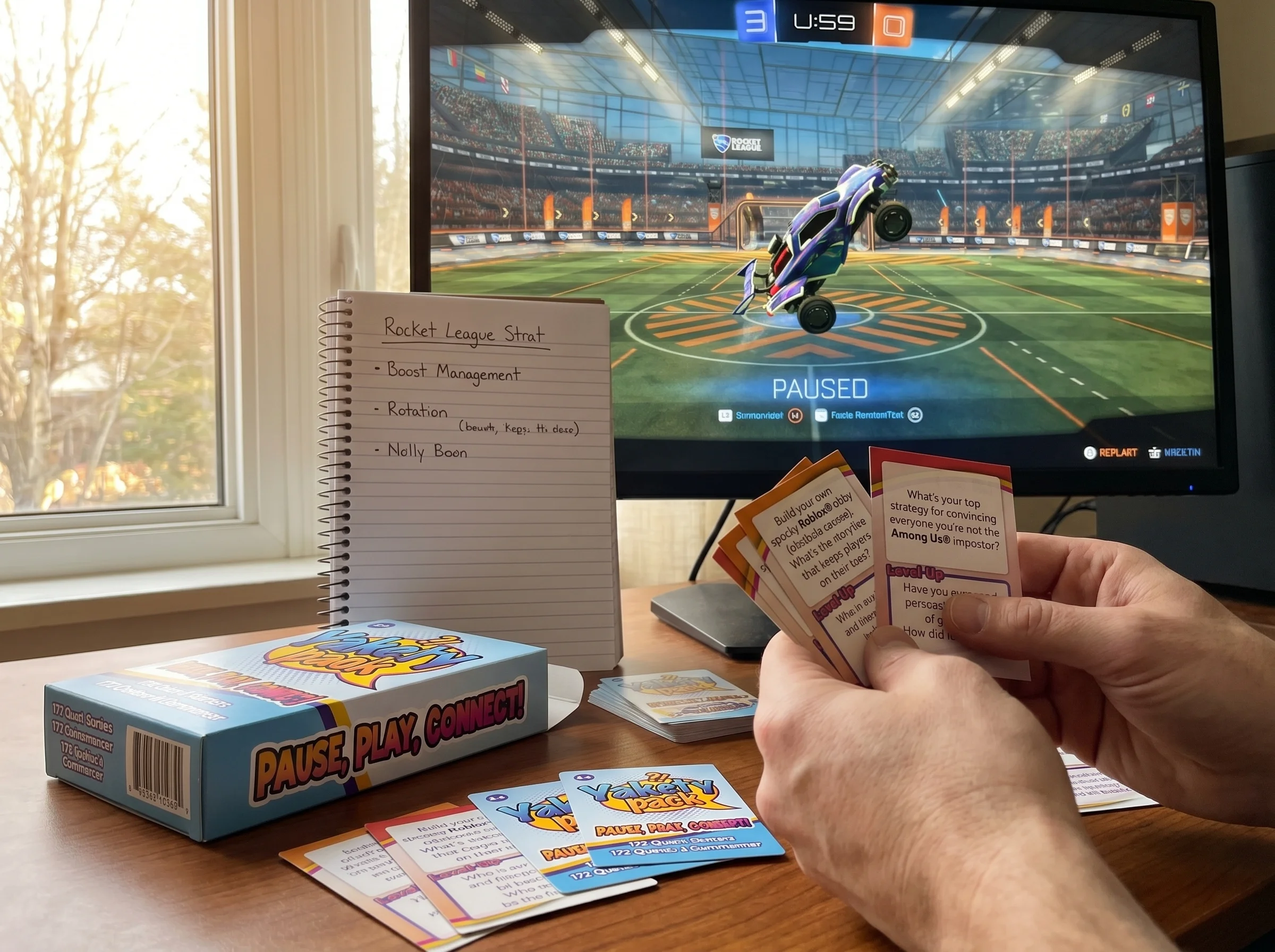
My moment of realizing this wasn't a joke: I sat down and watched my son review a Rocket League replay. He paused it, rewound, talked through rotations, pointed out a teammate's bad boost decision. It was the exact same way I used to break down football game film in high school. Same brain, same focus, same competitive edge. I just hadn't bothered to look.
 Nothing to plan or chasePause, Play, Connect: Core Deck172 prompts that get a kid talking about what they actually love doing.$49 CAD • 90 cards • 18 reviewsShop the deck
Before You Research Schools, Have This Conversation
This is the step everybody skips. I skipped it.
When I finally took the scholarship thing seriously, my first move was to start researching schools. Bookmarking program lists. Comparing tuition costs. Reading about NACE divisions. I was doing parent homework, the way I would have for any college decision.
I brought it up at dinner like I'd cracked a code. "Hey, I've been looking into this. Bellevue College has a Rocket League program, and there's also..."
He shut down. Just nodded and went back to his food.

Took me a few days to figure out what I'd done. I'd taken the thing he loved and turned it into a logistics problem. Suddenly his hobby had a destination attached to it, and that destination was something I picked. I'd skipped right past asking him what he actually wanted out of any of this.
So here's the conversation you need to have first, before any spreadsheet or college visit:
What part of this do you love most? The winning? The team? The strategy? The community? The content side?
Because esports has lanes. Some kids want to compete. Some kids want to broadcast and analyze. Some kids want to build a YouTube channel. Some kids want to coach. Some want to run tournaments. All of these are legitimate paths with scholarship potential, and they require very different prep.
The wrong question is "do you want to go pro?" That's a question with one acceptable answer, and it puts pressure on a 15-year-old to commit to a fantasy. The right question is "what part of this would you do even if nobody was paying you?" Because that's the part that's going to carry them through 20 hours a week of practice in college.
I'll be honest, this is the kind of conversation my family is bad at by default. We're not naturally a "deep talk over dinner" household. We built Yakety Pack partly because I kept asking my son surface-level questions and getting surface-level answers. One of our cards asks something like "what's a game you'd want to be the best in the world at?" It's not a scholarship question. It's a "who are you" question. You'd be surprised what comes out when the prompt isn't loaded with parent agenda.
Whatever tool you use, get the conversation out of the way before you start pulling up college websites. The scholarship hunt only works when your kid is driving it.
Which Games Actually Get Recruited
Not every game has a scholarship pipeline. Here's the real landscape:
The big ones with serious money:
- League of Legends is the granddaddy. Most schools have a League team. Most scholarships flow here.
- Valorant is exploding. If your kid plays Valorant competitively, this is probably the best current path.
- Overwatch 2 is solid but has shrunk since OW1. Still plenty of programs.
- Rocket League is huge at the collegiate level, partly because the skill ceiling is obvious and the matches are short enough to be watchable.
Smaller but real:
- Super Smash Bros. (Ultimate and Melee) has a college scene but fewer scholarship dollars.
- Counter-Strike 2 has programs, especially at schools with European recruiting pipelines.
- Apex Legends is growing.
- Fortnite is awkward. Big prize money in pro circuits, less institutional college support.
- Hearthstone, Madden, FIFA, Street Fighter all exist at some schools but expect smaller programs.
Rank benchmarks, roughly:
- For Valorant, you generally need to be high Diamond minimum to start getting looks at smaller programs. Immortal or Radiant opens up the bigger schools.
- For League, Diamond is the floor at most varsity programs. Master+ for top programs.
- For Rocket League, Grand Champion is the threshold. SSL gets you serious attention.
- For Overwatch, Top 500 or close to it for the best programs, Master/Grandmaster for most.
These aren't hard rules. Programs care about your kid's role, attitude, team experience, and whether they can hold a 3.0 GPA. A coachable Diamond player with leadership qualities will beat a toxic Immortal kid every time.
The Path Nobody Talks About: Non-Playing Esports Scholarships
This is the section I wish someone had shown me first.
A friend's kid spent two years grinding to make their school's varsity Valorant team. Couldn't crack it. Got cut at tryouts senior year. Devastating, honestly. But this kid was hilarious, articulate, and had been casting his friends' matches on Twitch for fun.
He emailed the coach of a small program in Iowa and asked if they needed a shoutcaster. They did. He sent VODs of his casts. Got a $4,000-a-year scholarship to do play-by-play for the school's esports broadcasts. Now he's working as a freelance caster while finishing his communications degree.
Most parents have no idea these paths exist:
- Shoutcasting / play-by-play, calling matches live
- Broadcast production, running cameras, replays, graphics, audio
- Social media and content, managing the team's online presence
- Coaching and analysis, breaking down opponent strategy, running scrims
- Team management, logistics, travel, tournament registration
- Game development clubs, some programs tie scholarships to esports-adjacent CS work
These are often easier to get than playing scholarships, and they translate to actual careers. The job market for "person who can produce a live broadcast and edit content under pressure" is a lot bigger than the job market for "professional Overwatch player." If your kid loves esports but isn't going to be top 500, this is the conversation to have.
 A conversation, nothing morePause, Play, Connect: Core Deck$49 CAD • 172 promptsSee the deck
How to Vet a Program (Half Are Held Together With Duct Tape)
A school adding an "esports program" can mean anything from a state-of-the-art facility with seven full-time coaches to "we put six gaming PCs in a converted classroom and hired the dean's nephew." You have to do the work to tell the difference.
Questions to ask the coach on a call or visit:
- How many hours per week is required practice?
- Do you have academic support or tutors familiar with the program's demands?
- What's the scholarship structure? Is it renewable? What happens if my kid gets cut from varsity?
- How many coaches do you have per game? (One coach for five different games is a red flag.)
- What's your roster turnover look like? Where do graduates end up?
- Can my kid talk to a current player without you in the room?
Red flags:
- Vague answers about the facility
- No mention of academics or academic support
- Coach has been there less than a year and the program is brand new
- All scholarship offers are conditional on weird stuff (streaming hours, Discord moderation)
- They're recruiting your kid hard but you've never seen them play
Green flags:
- A dedicated facility (not a shared computer lab)
- Game-specific coaches, ideally with competitive resumes
- Alumni outcomes they can point to
- Scholarship terms in writing
- They ask about your kid's academics and goals, not just rank
If you can visit, watch a practice. The vibe will tell you everything. Healthy programs feel like a sports team. Unhealthy ones feel like a Discord server with adult supervision.
The 9th-Through-12th Grade Prep Roadmap
If your kid is serious, here's the actual timeline. This is the part competitor articles skip because it's specific and they'd rather just list schools.

9th and 10th grade:
- Focus on ranking up in one or two games, not five
- Start a Twitch or YouTube channel, even if nobody watches. Recruiters want to see VODs.
- Join a high school esports club or PlayVS team
- Keep your GPA above 3.0. Most programs require it. Some require 3.3+.
- Get comfortable on a team. Solo queue grinders sometimes can't function in a structured environment, and coaches notice.
11th grade:
- This is when you start outreach. Email coaches at programs you're interested in. Include rank, role, VOD links, GPA, graduation year.
- Sign up for recruiting platforms. SportsRecruits and NextPlayUSA both have esports verticals now. Some kids also use ESM (Esports Scholarship Match).
- Attend a few collegiate showcase tournaments if you can.
- Take the SAT or ACT. Yes, you still need to.
12th grade:
- Campus visits when possible
- Compare offers carefully (full cost of attendance, not just scholarship dollar amount)
- Ask the hard questions: what happens if I'm benched? Can I transfer my scholarship if I switch from playing to casting?
- Have a backup plan that isn't dependent on the esports offer
The biggest mistake I see at this stage is parents treating the esports offer like the deciding factor. It shouldn't be. Pick the school where your kid would be happy if the esports program disappeared tomorrow. Programs do disappear. Coaches get hired away. Schools cut programs in budget years. You want a school that works without the gaming.
What Happens AFTER the Scholarship
Read this section twice.
A varsity esports schedule at a serious program is roughly:
- 15-20 hours of team practice and scrims per week
- 5-10 hours of individual VOD review and solo queue
- Tournament weekends, sometimes traveling
- Team meetings, content obligations, media training
That's on top of a full course load. Burnout is real, and it hits hard around sophomore year. Kids who played for love in high school can lose the love when it becomes a job with a coach yelling at them about positioning.
The healthiest programs treat esports like a sport. They have offseasons. They mandate breaks. They have mental health resources. They monitor screen time and posture and sleep. The worst ones run kids into the ground for two semesters and then cut them.
Ask the coach directly: "What's your retention rate? How many freshmen are still on the roster as juniors?" If they fumble that answer, walk.

If your kid does get cut, most programs let them keep at least the academic portion of their aid. Get this in writing before signing. Some schools have a "transition" path where cut players move into coaching, casting, or production roles and keep their scholarship. The good programs treat the kid like a person, not a resource.
And here's the thing nobody wants to say out loud: your kid will almost certainly not go pro. The pro scene is brutally small and brutally young. Most pros peak by 22. A college esports career is more like a college baseball career, valuable for the experience and the degree, not a launching pad to seven figures. Treat it that way and everyone will be happier.
The Most Important Advice I Can Give You
Don't chase the scholarship.
I mean it. The parents I've seen mess this up the worst are the ones who suddenly got excited about esports the second they heard "scholarship." Their kid had been playing for years while they grumbled about screen time, and now mom and dad are asking about practice schedules and trying to optimize their rank grind.
Kids smell this from a mile away. The hobby they loved becomes a job their parents are forcing on them, and they bail. I've watched it happen twice in our extended circle.
The kids who actually get recruited are almost universally kids who would have kept playing whether or not college money was on the table. The scholarship is downstream of the love. If you try to manufacture the love to chase the scholarship, you'll kill both.
Your job, as the parent, is not to manage their esports career. Your job is to:
- Understand what they love about it
- Help them think clearly about what they want
- Do the logistics work they can't do (researching programs, helping with outreach, paying for visits)
- Ask good questions and listen to the answers
That's it. The rest is theirs.
A Practical Next Step
Tonight, or this weekend, ask your kid one specific question: "If you could have any job in the gaming world, not just playing, what would it be?"

Don't fix anything they say. Don't connect it to scholarships. Don't pull out your phone to look something up. Just listen.
That answer is the actual starting point. Everything in this guide, the programs and the ranks and the prep timeline, only matters once you know what direction you're pointing.
I spent years being the dad who didn't get it. The good news is, it's not hard to switch sides. You just have to be willing to ask better questions and actually hear the answers. The scholarship stuff figures itself out from there.
And if your kid grunts at you the first time you ask? Try again next week. Try a different question. Try while you're driving instead of at the dinner table. The conversation matters more than the answer.
That's the whole game.

From this article
Pause, Play, Connect: Core Deck
No parent agenda attached: Questions like "what would you be best in the world at" open kids up precisely because nothing rides on the answer. The Pause, Play, Connect Core Deck is a whole box of them for the drives when the dinner table version got a grunt.

