
When my son's grandma died last spring, the first person he wanted to tell wasn't his cousin. It wasn't his best friend from soccer. It wasn't the kid he'd sat next to in class for two years.
It was Marcus. A kid in Michigan he'd never met in person. A kid he'd met playing Rocket League about eighteen months earlier.
I watched him close his bedroom door, put on his headset, and tell Marcus first. And I stood in the hallway feeling a weird cocktail of confusion, sadness, and a small voice in my head saying: huh. So that's what's actually going on here.
I'd spent years quietly thinking my son's online friends were a poor substitute for the "real" thing. That night I realized I'd been measuring friendship with the wrong ruler for a long time. So if you're sitting there wondering whether online gaming friends are real friendships for kids, let me save you the years I wasted figuring it out.
The Short Answer: Yes, Online Gaming Friends Are Real Friendships for Kids
Online gaming friendships are real friendships. They check the boxes that actually matter: consistency, mutual care, shared experiences, emotional support, inside jokes, knowing each other's quirks. The friendship between my son and Marcus has lasted longer than half the in-person friendships I had at his age.
Here's why this is hard for a lot of us parents. We grew up calling friends on a landline that was attached to a wall. We rode bikes to each other's houses. We knew our friends' parents. Friendship had a smell and a sound and a front door.
So when our kids tell us their best friend lives in Michigan and they've never breathed the same air, our brains short-circuit. We apply the geography test: if you can't go to their house, are they really your friend?
But that test doesn't hold up. I've got a college buddy I text every week. I haven't seen him in five years. Nobody would say he's not my friend. Distance stopped mattering for adult friendships a long time ago. We just hadn't updated the rule for our kids.
That moment with Marcus reframed everything for me. Marcus knew my son was sad before his own grandfather did. Marcus showed up. The kid who sat next to him in homeroom for six hours a day didn't even know what happened.
That's friendship. The location is just logistics. Researchers at the Pew Research Center have been saying this for years, most teens now make and keep close friends through games and online platforms. We're behind on the data, not the kids.
 Names you have not metPause, Play, Connect: Core Deck172 prompts that get a kid talking about the friends you have never met.$49 CAD • 90 cards • 18 reviewsShop the deck
What Actually Makes a Friendship "Real"
If "shares a zip code" isn't the test, what is? Here's the framework I wish someone had handed me five years ago. Four markers:

1. Consistency. Do they show up? Same kids, same nights, over months and years? That's a friend group, not a coincidence.
2. Mutual support. Do they cheer each other on when things go right? Check in when things go wrong? Notice when someone's been quiet?
3. Shared history and inside jokes. If your kid is laughing at a reference you don't get and explains it to you with the energy of someone telling a campfire story, that's a relationship with depth.
4. Your kid talks about them when they're NOT playing. This is the big one. Call it the shower test, the dinner test, the car test. Does this person come up in conversation outside of game time? If your kid is telling you about something Marcus said three days ago while you're driving to Target, that friendship has roots.
Apply this honestly and you'll notice something uncomfortable. Some of the school friends your kid has known since kindergarten will fail this test. Some of the online friends you've never met will pass it with everything they've got.
That's not a problem to solve. That's just what modern friendship looks like.
The Hybrid Reality Most Parents Are Missing
Here's a thing nobody told me: a lot of your kid's "online friends" are also their school friends.
For maybe a year, I assumed my son's friend "Tyler" was some random kid from the internet. The name kept coming up. They played together almost every night. I started doing the parent thing in my head, drafting the safety conversation, planning when to ask the questions.
Then one night I asked, kind of casually, "Hey, where's Tyler from?"
"Uh, he sits behind me in math."
I'd met his mom at parent night. She'd given me banana bread.
The Discord server is often just the lunch table after school. The Minecraft realm is the cul-de-sac. Kids today don't really separate online and offline social life the way we do. They game with the same kids they sit next to in third period, plus a few they met through those kids, plus a few who joined the server through a friend of a friend.
Before you assume your kid's gaming friends are strangers, ask. Not in an interrogation way. Just curiously. You'll often find half the "online" friend group is already in your contacts as another mom's number.
The Kids Who Need These Friendships Most
This is the part of the conversation almost nobody has.
For some kids, online gaming friendships aren't just real, they're essential. They're the easiest, safest, most natural social outlet those kids have.
Think about a kid with ADHD. In person, social interactions move fast. Eye contact, body language, tone, timing. It's a firehose. In a voice chat focused on a shared game, the social load drops way down. There's a built-in thing to talk about. The pauses are normal. The pressure is off.
Or a kid on the autism spectrum, who finds social cues exhausting to read. In gaming, the rules are clear. The goals are stated. Friendship can develop through doing something together instead of performing small talk. There's solid research from the American Psychological Association on how gaming supports social connection for neurodivergent kids, and it tracks with what I've watched in my own house.
Or a kid with social anxiety, who freezes up in the cafeteria but is the funniest person in their squad. Or a kid who just moved and doesn't know anyone yet. Or a kid going through that brutal middle school year where their old friend group fell apart and the new one hasn't formed yet.
For these kids, dismissing their online friendships isn't just dismissive. It can cut them off from the most genuine social connection they have. I'd rather my son have three close friends in three states than be lonely in a room full of classmates who don't get him.
If your kid is one of these kids, their gaming friendships are not a sign that something's wrong. They might be the sign that something is finally working.
Red Flags vs. Green Flags: The Honest List
Okay, real talk. Not every online friendship is great, just like not every in-person friendship is great. Here's what I actually look for now, after a lot of trial and error.
Green flags
- Consistent group. Same kids, same nights, over time. Random new people every week is a different situation than a steady squad.
- Your kid talks freely about them. Names come up at dinner. Stories spill out.
- They cheer each other on. Your kid mentions someone hyping them up, or them hyping someone else.
- The friend has set hours. "Marcus has to log off at 9, his mom's strict." That tells you there's a parent on the other end, which is exactly what you want.
- The friendship survives bad days. They lose a game, somebody gets mad, and they still play the next night. Friendships have weather.
Red flags
- Age gaps that feel off. Your ten-year-old's "best friend" is sixteen and only wants to play one-on-one. That's worth a closer look.
- Pressure to move to private platforms. If a friend keeps pushing to leave the game chat and move to private DMs, Snapchat, a different app, that's a pattern worth paying attention to. The FBI has good plain-language guidance on what grooming patterns actually look like in gaming contexts.
- Requests for personal info or photos. Real friends don't need your address. They don't need pictures of you.
- New secrecy. Your kid used to talk openly about gaming and now goes quiet when you walk in. Could be nothing, could be something. Worth getting curious.
- Your kid seems anxious or upset after sessions. Not just frustrated about a loss. Genuinely off. Like something happened with a person.
Here's the move that's worked best for me. When something feels off, I don't lead with "is this person safe?" because that question makes my kid defensive and shuts everything down. I lead with "tell me about Zack. What's he like?"
That tiny reframe changes everything. The first question makes me sound like a cop. The second one makes me sound like a dad who cares about his kid's life. One of those gets me information. The other one gets me silence.
I almost banned a friendship once because I caught a snippet of voice chat that sounded weird out of context. Instead of going nuclear, I asked my son to tell me about the kid. Turned out the kid had been going through a rough time at home and my son was being a good friend. If I'd led with "you can't play with him anymore," I'd have cut off a kid who needed my son and taught my son not to bring real stuff to me.
The honest list isn't about being scared. It's about paying attention. Same as you would with any of their friends.
How to Actually Talk to Your Kid About Their Gaming Friends
Drop the interview voice. I'm serious. Kids smell it from a mile away. The second you sit down with that "we need to talk" energy, you've lost.
Ask the questions you'd ask about any friend. The questions you'd ask if Marcus lived next door.

Things that work:
- "Who's the funniest person in your squad?"
- "Who's the best at the game and who's the worst?"
- "Has anyone in your group been going through stuff lately?"
- "If your group had to pick a leader, who would it be and why?"
- "What's the dumbest thing anyone in the group has ever done?"
Things that don't work:
- "Are you talking to strangers?"
- "Do you know who these people really are?"
- "Have you given anyone personal information?"
The first list gets you stories. The second list gets you grunts and a closed door.
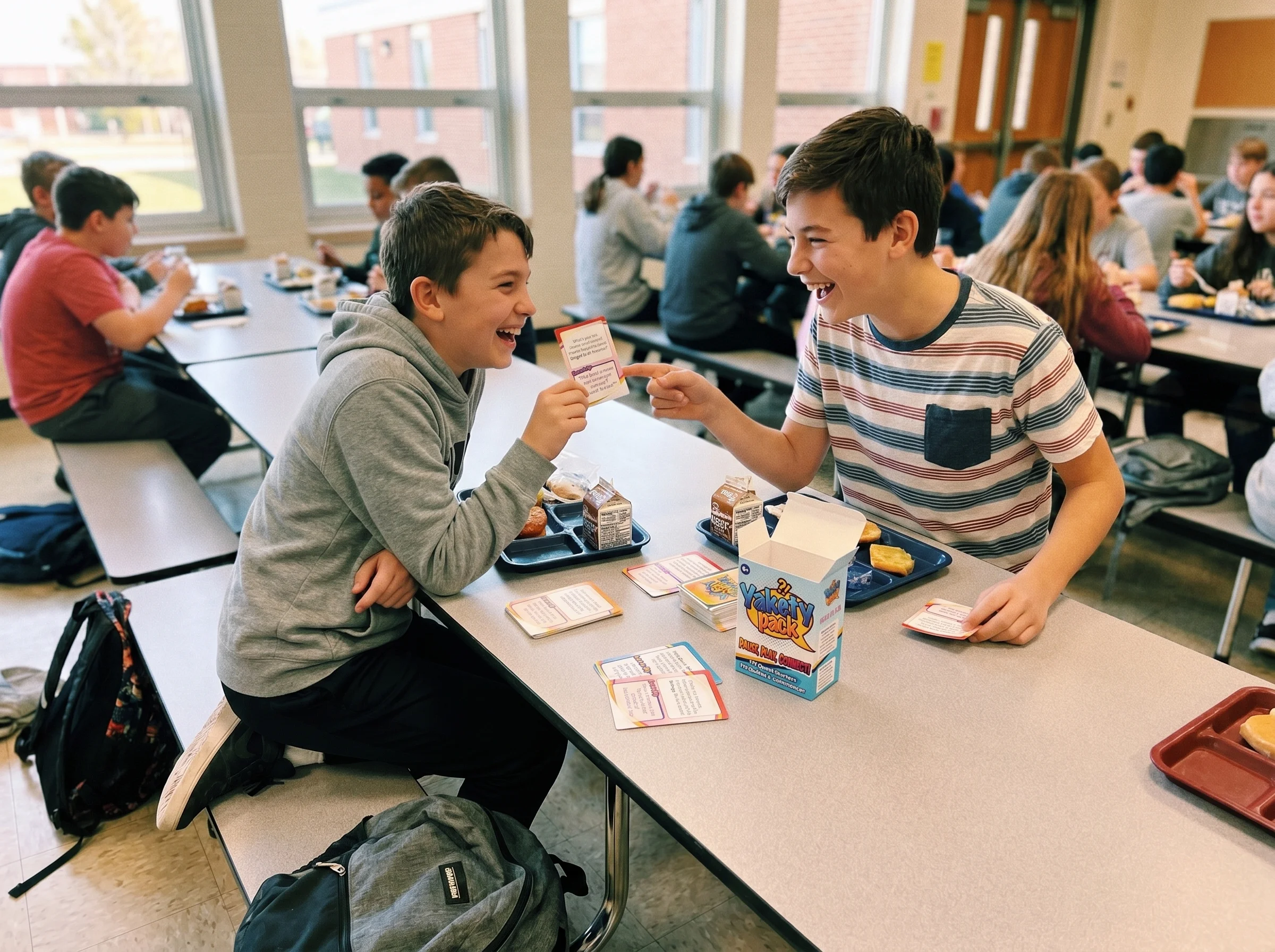
This is honestly where Yakety Pack came from. I needed a way to ask my kid about his world that didn't sound like a parent quiz. One of our cards asks something like "Who's your best gaming friend and what makes them awesome?" My son will talk for ten minutes on that question. He'd give me one word on "are your online friends safe?"
Curiosity gets you in. Suspicion gets the door slammed. That's the whole game.
 Ask who, not whetherPause, Play, Connect: Core Deck$49 CAD • 172 promptsSee the deck
When They Want to Meet in Real Life
This will probably come up at some point. The friendship gets close enough that one or both kids start saying things like "we should hang out for real sometime." It's not automatically a bad thing. It's just the next step of a real friendship, and it deserves a real plan.
Here's how I think about it as a tiered thing. Each step up requires more parent involvement, not less.
Tier 1: Voice chat and gaming. Where most of these friendships live. Pretty low stakes.
Tier 2: Sharing socials or texting outside the game. Now there's contact outside the controlled gaming environment. Worth a conversation about what gets shared and what doesn't.
Tier 3: Phone calls or video calls. Bigger step. I'd want to know about it. Not to forbid it, just to know.
Tier 4: Meeting in person. This requires real planning. Parents talking to parents. Public place. You there. The other parent there. Treat it like you'd treat any meeting between people who haven't met before, with adults present.
The simple rule I use with my son: nothing happens without me knowing, and I promise not to freak out when you tell me. That deal only works if I actually hold up my end. The first time I freak out, the deal is dead. The first time he hides something, the trust is gone.
If you want your kid to come to you when the friendship moves forward, you have to be the kind of parent they can come to. That's not a checklist. That's a long-term reputation you build.
What I Got Wrong, So You Don't Have To

Quick list of things I did wrong before the Marcus moment:
- Called them "internet friends" with a tone in my voice. Kids hear that tone.
- Asked "how was gaming today?" and accepted the grunt as proof that gaming wasn't important to him. The grunt meant my question was bad, not that the topic was empty.
- Assumed every voice in the headset was a stranger when half of them were classmates.
- Treated his gaming friendships as a phase to wait out instead of a window into his actual life.
- Tried to evaluate friendships by my own childhood criteria, which were formed in 1989 and have not aged well.
The fix wasn't loving gaming. I still don't love gaming. The fix was getting curious about my kid's friendships on their actual terms.
A Last Word About Marcus
My son still plays with Marcus three nights a week. They've never met. They've been friends now for almost three years, which is longer than some of my adult friendships have lasted in the same window.
Marcus knew about the grandma. Marcus knew when my son made the basketball team. Marcus was the first person to hear about the crush, which I only found out about because my son let it slip much later.
They'll probably meet in person someday. When they do, I'll be the dad helping plan the trip. Not the dad pretending the friendship didn't count.
If you take one thing from this, take this: stop asking if your kid's gaming friends are safe and start asking who they are. The friendships are real. Treating them that way is how you stay close to your kid's actual life, not the version of it you wish they were having.
And if you need a way in to those conversations that doesn't sound like a parent quiz, that's literally what we built Yakety Pack for. But honestly, even without it, you can start tonight with one question at dinner: "Who's the funniest person in your squad and what did they do this week?"
See what happens. I bet you find out your kid has more real friends than you thought.

From this article
Pause, Play, Connect: Core Deck
One question tonight: Getting a kid to tell you about his Marcus takes a better question, not a safer one. The Pause, Play, Connect Core Deck puts those questions on the table for you, so asking about squad friends feels like a game instead of a background check.
Related Articles
Looking for more? Check out these related articles:

