
Every Saturday morning for about two years, I walked downstairs already annoyed. My son would be on the couch, controller in hand, and I'd be doing math in my head about how much screen time he'd already burned before I'd even had coffee. The fight was coming. We both knew it.
What I didn't understand back then was that the fight wasn't actually about Saturday. It was about the fact that we had never actually talked about Saturday.
We were ambushing each other every weekend. He assumed the weekend was a free-for-all because it wasn't school. I assumed my job was to be the Saturday cop. Neither of us had agreed to anything, and we were both furious about it by 10am.
Here's the weekend screen time negotiation framework for families that we use now. It's not fancy. It just works better than anything else I tried.
Why Weekend Screen Time Fights Are Different
Most of the screen time advice out there is written for weekdays. Homework's done, dinner's on, bedtime's coming. Weekdays have natural guardrails. Weekends don't.
Weekends also have three things that make weekday advice useless:
- Your kid's entire friend group is online at the same time. Cutting Fortnite at 3pm on a Saturday isn't just pulling your kid off a game. It's pulling him out of his social life mid-conversation.
- You and your partner probably disagree. One of you wants "let them relax, it's Saturday." The other wants "we barely see each other during the week, let's do something." Your kid can smell that disagreement from a mile away and will absolutely exploit it.
- There's no external structure. No bell, no bus, no homework. If you don't build the shape of the day, the screen builds it for you.
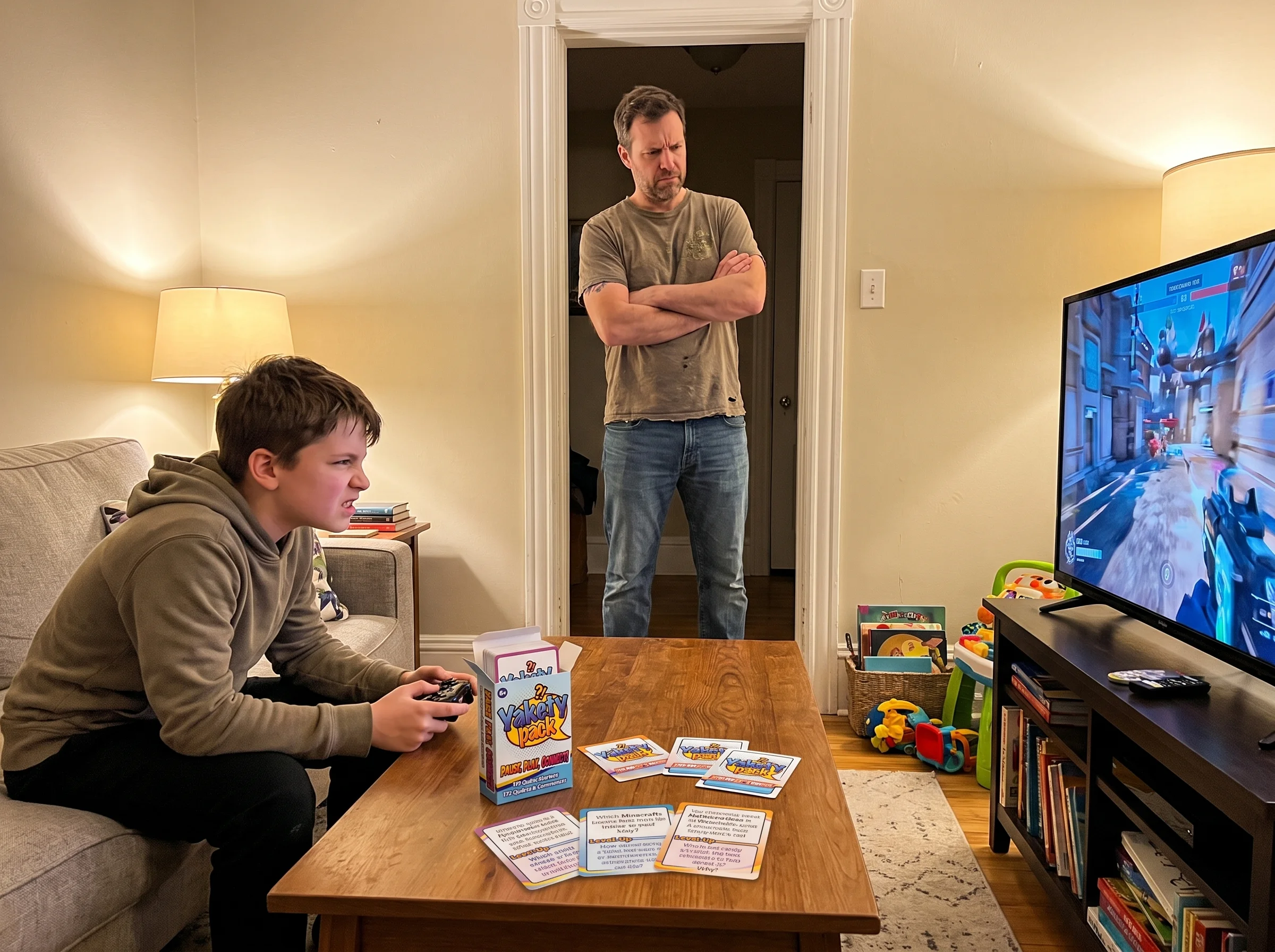
The disaster that finally got me to change happened on a Saturday afternoon. My son had been playing Fortnite with three friends. I told him "2 hours, that's it." At exactly 2 hours, I walked over and said time's up. His squad was one round from a Victory Royale. He melted down. I got mad that he melted down. We didn't talk for the rest of the day.
The problem wasn't the 2 hours. The problem was that I picked the unit of measurement (the clock) and the enforcement moment (whenever I felt like it) without ever asking him what he was actually doing.
That's when I started building this.
 Saturday starts on FridayPause, Play, Connect: Core Deck172 prompts that get a kid talking about their squad, their games, their whole weekend.$49 CAD • 90 cards • 18 reviewsShop the deck
Step 1: The Friday Night Pre-Negotiation
This is the whole thing. If you skip this, nothing else works.
Friday night, before dinner or after, you sit down for ten minutes. Not a family summit. Not a lecture. Ten minutes.
The questions I ask:
- What do you want to do this weekend?
- Who are you playing with, and when are they on?
- What matters most to you, the Saturday block or the Sunday block?
Then, and this is the part most parents skip, I tell him what I want from the weekend. Not rules. Wants.
"I want 45 minutes with you at the skate park Saturday morning. I want Saturday dinner with everyone at the table, phones away. Beyond that, let's figure the rest out."
That's it. You're not imposing. You're showing up with your own asks, same as him.

The Friday night thing is magic because nobody's emotionally invested yet. He hasn't started a game. I haven't gotten annoyed. We're both neutral. Try having the same conversation Saturday at 11am with him mid-match and you'll see what I mean.
Step 2: Trade, Don't Impose
This is the part I got wrong for years. I thought negotiation meant "I decide the rules and you agree to them." That's not negotiation. That's a hostage situation with a nicer tone.
Real negotiation means both sides bring asks and both sides give something up. Basic negotiation research from places like the Harvard Program on Negotiation has been saying this for decades, and it turns out it works with 12-year-olds too.
His asks might be:
- An uninterrupted three-hour block Saturday afternoon
- Sleepover Sunday, which means gaming late
- No random "come help me with this" interruptions during his squad time
Your asks might be:
- Skate park Saturday morning
- Family dinner, phone away
- One hour outside Sunday before the sleepover
Then you trade. "You get the three-hour block if dinner's phone-away and we do the skate park." Deal.
The first time I actually said out loud, "What do you need from me to make this work?" instead of "Here are the rules," my son's whole face changed. He looked at me like I was speaking a new language. Then he said, "I just need you to not walk up and tell me to stop when I'm in the middle of something." That was reasonable. I could work with that. And in exchange, I got what I actually wanted, which was a phone-away dinner with my kid who was actually happy to be there.
 Somewhere in the Saturday blockPause, Play, Connect: Core Deck$49 CAD • 172 promptsSee the deck
Step 3: Blocks, Not Hours
Kids don't experience time in hours. They experience it in matches, sessions, worlds, raids. When you say "two hours," they hear "some arbitrary number that will interrupt me at a bad moment."
Switch the unit. Negotiate blocks:
- Morning block (say, 9 to 11)
- After-lunch block (say, 1 to 4)
- Evening block (after dinner until whenever you agreed)
Blocks have natural start and stop points. Blocks let him plan. Blocks let his friends plan. And blocks respect the fact that Fortnite matches take 20 minutes and Minecraft builds take longer.
We also have a rule in our house called the 15-minute grace. If the block ends and he's mid-match, he gets 15 minutes to wrap up. In exchange, if he abuses the grace, he loses it the next weekend. He almost never abuses it. Because it's fair.
Step 4: Get Curious About Who He's Actually Playing With
Here's the thing I missed for way too long. Weekend gaming is basically hanging out. Those aren't just screens, those are his friends. Research from the Pew Research Center on teens and gaming shows most kids consider online gaming a core part of their friendships. If I don't know who he's playing with, I don't know who my kid is spending Saturday with. Would I do that with in-person friends? No. So why was I doing it with online ones?
I used to ask "how was gaming?" and get "fine." Useless.
Now I ask actual questions. "Who was on today?" "Who's the funniest in your squad?" "Anybody new?" "What did Marcus build this time?"

This is honestly why we built Yakety Pack. I kept trying to ask my kid better questions and coming up empty. One card in the deck asks "what game character would you want as a real-life friend?" That single question told me more about who my son was hanging around online than three months of "how was Fortnite?" ever did. If you're stuck on generic questions, that's the fix. Better questions, not more surveillance.
The point of the negotiation isn't to reduce his gaming. It's to understand what his gaming actually is.
Step 5: The Sunday Reset Protocol
Weekends are long. Deals fall apart. Someone gets grumpy, someone breaks the phone-away rule, someone plays 30 minutes over.
For a long time, one Saturday screwup meant the whole weekend was blown. I'd wake up Sunday still mad, come in hot, and turn a small thing into a two-day cold war.
Now we do a Sunday reset. It's literally one sentence: "Yesterday didn't go how we planned. Let's redo today."
That's the whole protocol. No re-litigating Saturday. No lecture about what went wrong. Just a fresh negotiation for Sunday, using the same trade framework.
The Sunday I almost blew up an entire weekend over 20 extra Saturday minutes taught me this. I was ready to cancel his gaming for all of Sunday out of principle. Instead I said "let's just restart" and by Sunday night we'd had a great day. The principle wasn't worth the day.
Step 6: Get on the Same Page with Your Partner Thursday Night
Real quick, because this is the hidden weekend killer.

If you and your co-parent haven't agreed on non-negotiables before the Friday night conversation, your kid will find the gap and drive a truck through it. Thursday night, five minutes:
- What are our two or three non-negotiables this weekend?
- Where are we flexible?
- If we disagree in front of the kid, what's our signal to pause?
That's it. Five minutes Thursday saves five hours Saturday.
The Counterintuitive Part
The goal of this weekend screen time negotiation framework for families isn't less screen time. Read that again.
The goal is protected time on both sides. If my son gets a three-hour Fortnite block uninterrupted and I get a phone-away family dinner and 45 minutes at the skate park, we both won. Even if his total screen time went up from last weekend. I stopped keeping score on hours and started keeping score on connection. That changed everything.

One Thing to Do This Friday
Sit down with your kid for ten minutes. Ask what they want from the weekend. Tell them what you want from the weekend. Trade. Don't argue, don't lecture, just trade.
You'll be shocked how differently Saturday morning feels.
Weekend negotiation is one piece of the bigger screen time conversation, and honestly, the questions you ask matter as much as the limits you set. Get curious first. The limits get a lot easier after that.
No clock on this onePause, Play, Connect: Core Deck172 prompts for a Saturday when you would rather hear about the squad than count minutes.$49 CAD • 90 cards • 18 reviewsShop the deck

