
For two years, I fought my son about screen time. Timers on the microwave. Warnings at the 10-minute mark. "Five more minutes" that turned into an hour. Doors slammed. One night I actually threatened to walk downstairs and unplug the router, and I saw him cry, but not for the reason I thought.
He wasn't crying because I was taking the game away. He was crying because his squad was mid-match and he'd just abandoned them. To him, I hadn't unplugged a game. I'd made him quit on his friends.
That was the night I realized I'd been arguing about the wrong thing for two years.
If you're reading this because screen time negotiation with kids feels like a losing battle every single night, I want to save you the two years I wasted. Here's what actually works, and more importantly, why the stuff you're doing now doesn't.
Why Your Current Screen Time Negotiations Aren't Working
You're negotiating about time. Your kid is defending something else entirely.
When I said "you've been on for 90 minutes, wrap it up," my son heard something like "your friendships don't matter, your progress doesn't matter, and I don't respect what you're doing." He wasn't fighting for 15 more minutes of dopamine. He was fighting because I clearly had no idea what I was interrupting.
Modern games are not TV. TV you can pause. TV has commercial breaks. TV doesn't have four other kids depending on you. When you tell a kid to "get off in 5 minutes," you're asking them to do something the game structurally doesn't allow. It's like telling an adult to hang up the phone in the middle of a work meeting because dinner's ready. Technically possible. Socially insane.
And here's the part nobody says out loud: kids read "I don't like your games" as "I don't like what you like." Which very quickly becomes "I don't like you." That's why the fight escalates so fast. You think you're setting a boundary. They think you're rejecting them.
The router incident I mentioned? After my son calmed down, he told me he'd been ranked up in Rocket League and his teammates were counting on him to hit a promotion match. I didn't even know Rocket League had ranks. I didn't know what a promotion match was. And I was making rules about it.
That's the gap. That's why we lose.
 The gap you just noticedPause, Play, Connect: Core Deck172 prompts that get a kid talking about the world you have been interrupting.$49 CAD • 90 cards • 18 reviewsShop the deck
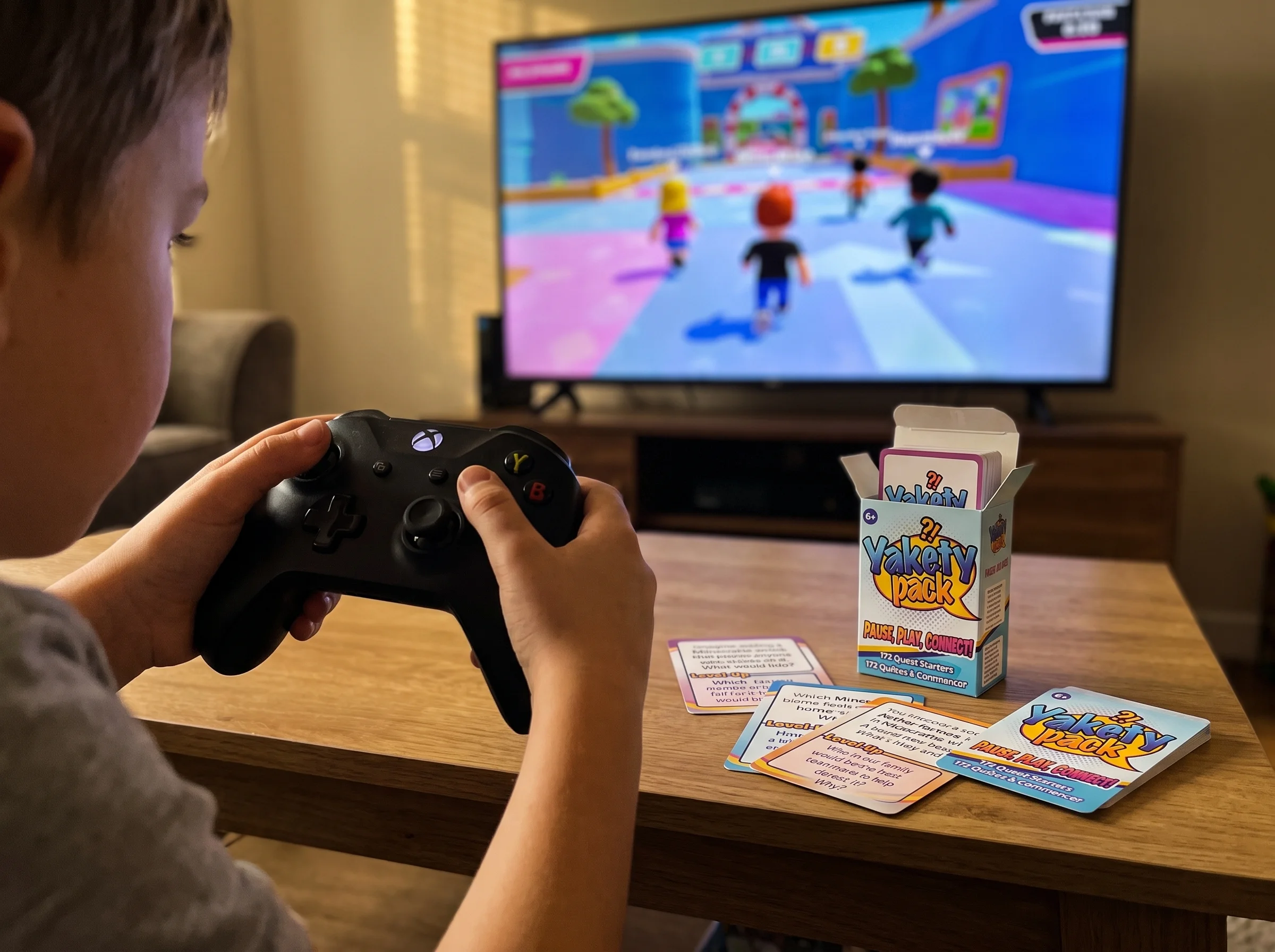
Learn the Game Before You Set the Limit
You can't negotiate what you don't understand. Full stop.
Before you set a single rule, do this: sit next to your kid while they play, for 20 minutes, and don't say anything. Don't ask questions yet. Don't judge. Just watch. You will learn more in those 20 minutes than in a year of reading parenting articles.
Here's what I didn't know before I started watching:
- Fortnite matches run about 20 to 25 minutes if you play well. If you die early, it's 3 minutes.
- Rocket League games are 5 minutes on the clock.
- Minecraft has no match. It's a project. Stopping is like telling a kid mid-Lego build to "just stop."
- Roblox isn't one game. It's a platform with thousands of games, some of which last 2 minutes and some of which run 45.
- Raids in games like Destiny or WoW can go 45 minutes to 2 hours, and you literally cannot leave without ruining it for five other people.
Once I knew this, my whole approach changed. "Wrap it up in 5 minutes" stopped being a rule and started being a threat, because I finally understood I was asking for something the game wouldn't give.
Ask your kid, genuinely: "How long is a match in this game?" "When's a natural stopping point?" "What happens to your teammates if you leave?" You will get real answers, because you're finally asking real questions. (Groups like the American Academy of Pediatrics have also shifted their guidance away from strict time limits toward focusing on the quality of what kids are doing on screens, which lines up with what I saw at home.)
The Pre-Game Agreement Is Everything
Here's the single biggest thing I got wrong for two years: I was negotiating during the game.
Nothing works during the game. Their brain is somewhere else. Their teammates are in their ears. You're an interruption, not a parent.
The negotiation has to happen BEFORE they turn it on. And it has to sound like this:
"How many matches do you want to get in today? Cool, three sounds good. When you finish match three, that's the stop. Deal?"
That's it. That's the whole thing. Trade time-limits for milestone-limits.
"One more match" beats "15 more minutes" every single time. It respects how the game works. It puts your kid in charge of hitting the goal. And crucially, it removes the fight because you're not interrupting them, you're just holding them to what THEY chose.
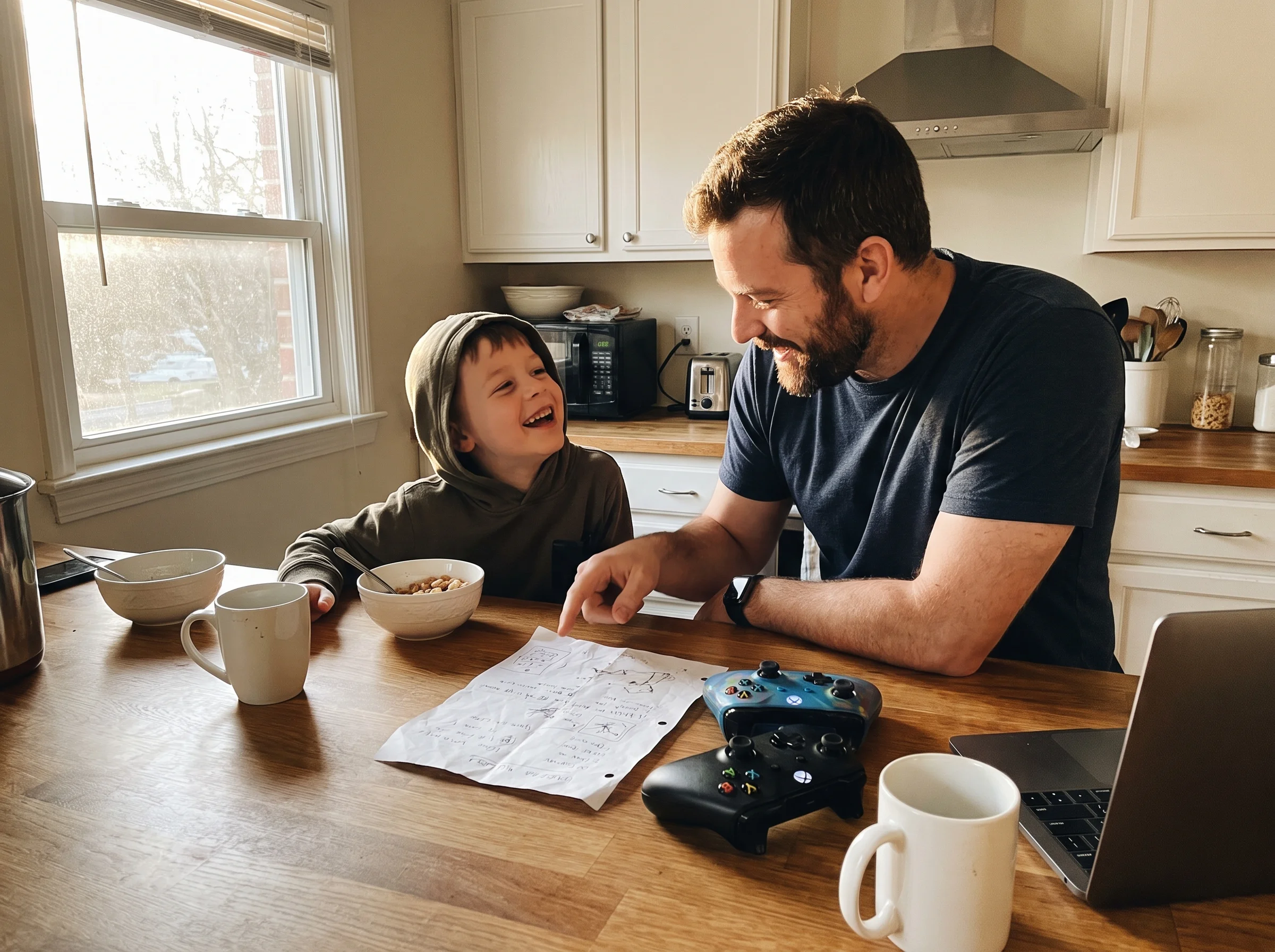
One Sunday I told my son he could pick: two Rocket League games or one Minecraft build session. He picked two Rocket League games. He hit both, then walked away from the console. No fight. No timer. No begging. Because he chose it and I honored his choice.
The word "chose" is doing a lot of work in that sentence. When kids are in charge of the stopping point, they self-enforce. When you're in charge of the stopping point, they resist. Same amount of screen time. Completely different dynamic.
What to Actually Say When It's Time to Stop
Everyone tells you to "set clear limits." Nobody tells you what to say. So here you go.
Phrases that work:
- "Finish the match, I'll wait." (This one is magic. It tells them you respect their world.)
- "What's a good stopping point in the next 10 minutes?"
- "Show me when you can save."
- "How much time do you need to wrap this up right?"
- "I know that was a good run."
Phrases that don't work:
- "You have 5 minutes." (5 minutes doesn't mean anything mid-game.)
- "Now." (Starts a war. Every time.)
- "Because I said so." (You've already lost.)
- "Just pause it." (You can't pause multiplayer. This tells them you don't get it.)
Notice the pattern. The working phrases all acknowledge that something is happening in there. The failing phrases treat the game like it's nothing, which is exactly how the kid learns that YOU'RE nothing to talk to about it.
Also: acknowledge the loss when you make them stop. "I know that was a good run" costs you nothing and buys you a ton of goodwill. Kids just want to be seen. If you've ever had to walk away from something you were deep in, you already know why.
 Past the five good phrasesPause, Play, Connect: Core Deck$49 CAD • 172 promptsSee the deck
When You Blow It (Because You Will)
I want to be really honest here, because nobody else is.
You are going to lose your cool. You're going to overreact. You're going to say something dumb like "that's it, I'm selling the Xbox" and then have to figure out how to walk that back tomorrow. It's fine. Welcome to parenting.
The repair conversation matters more than the rule.
The morning after the router incident, I sat down with my son and said: "Hey. Last night I got frustrated, and I made it about the wrong thing. I didn't understand you were in the middle of something that mattered to you and to your friends. I'm sorry."
He looked at me like I had three heads. Then he told me more about the game in the next 10 minutes than he had in the previous year.
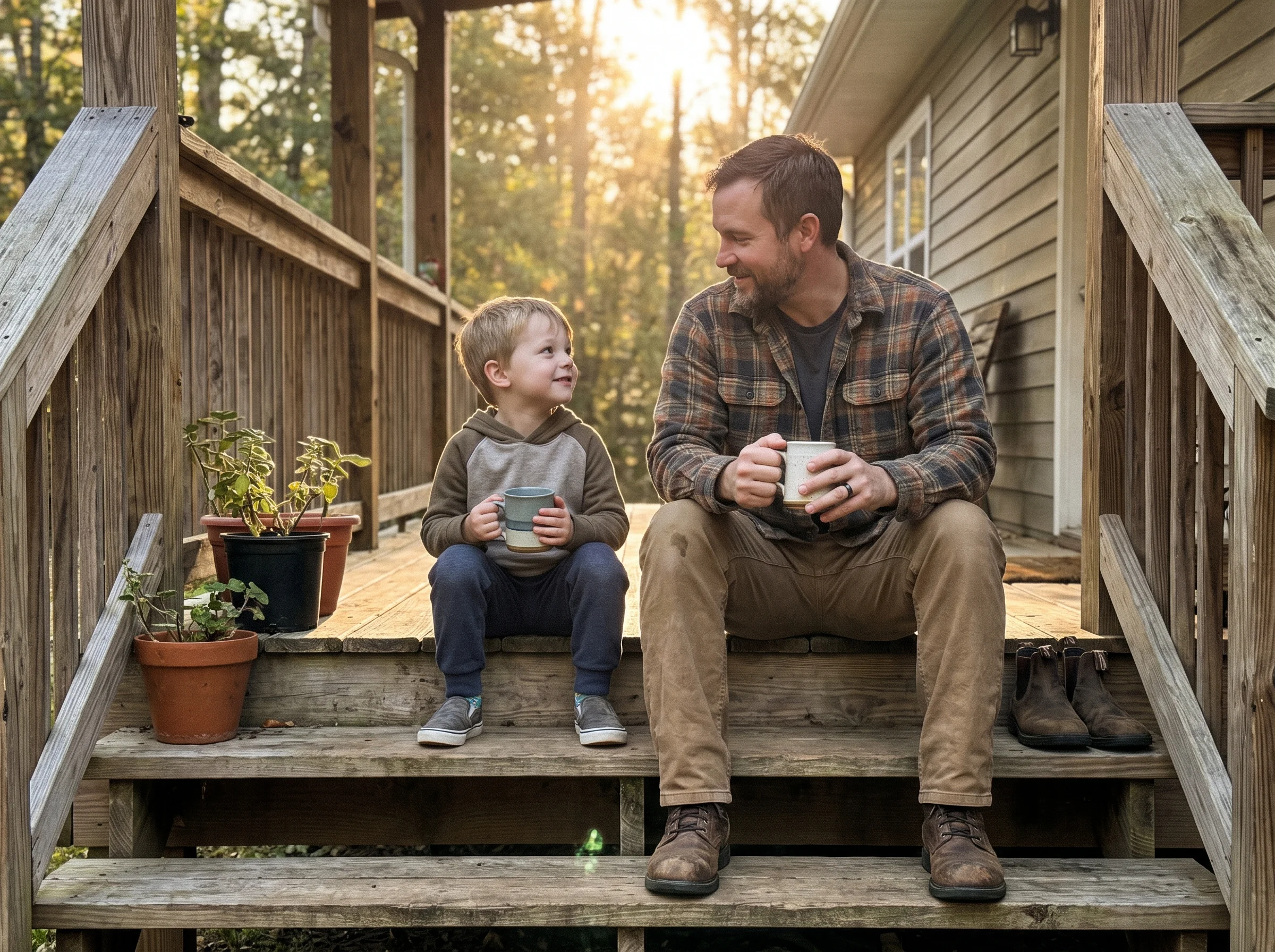
That one apology earned me more compliance than any rule I've ever set. Kids remember respect way longer than they remember rules. When you show them you can be wrong and admit it, they suddenly become willing to be wrong and admit it too. Modeling works, but not the way parenting blogs mean it. It works in the repair, not the routine.
If you blew up last night, don't double down. Repair it this morning. You'll be shocked what it unlocks.
Turn the Game Into a Conversation, Not a Fight
Here's the counterintuitive thing I learned: screen time gets shorter, naturally, when kids feel seen.
When my son started to feel like I actually understood what he was doing, he stopped fighting for every minute. He'd voluntarily tell me when he'd be done. "Hey Dad, two more games and I'm out." Because he wasn't trying to sneak minutes past a hostile adult anymore. We were on the same team.
The way you get there is questions. But not the questions you're currently asking.
Bad question: "How was gaming today?"
You will get a grunt. Every time. Because it's a lazy question and kids know it.
Good questions:
- "Did you get that skin you wanted?"
- "Is that kid you don't like still on your server?"
- "What's the craziest thing that happened in your world this week?"
- "Who's the best on your squad right now?"
- "What are you saving up for in the game?"
The difference is specificity. Specific questions prove you've been paying attention. Generic questions prove you haven't.
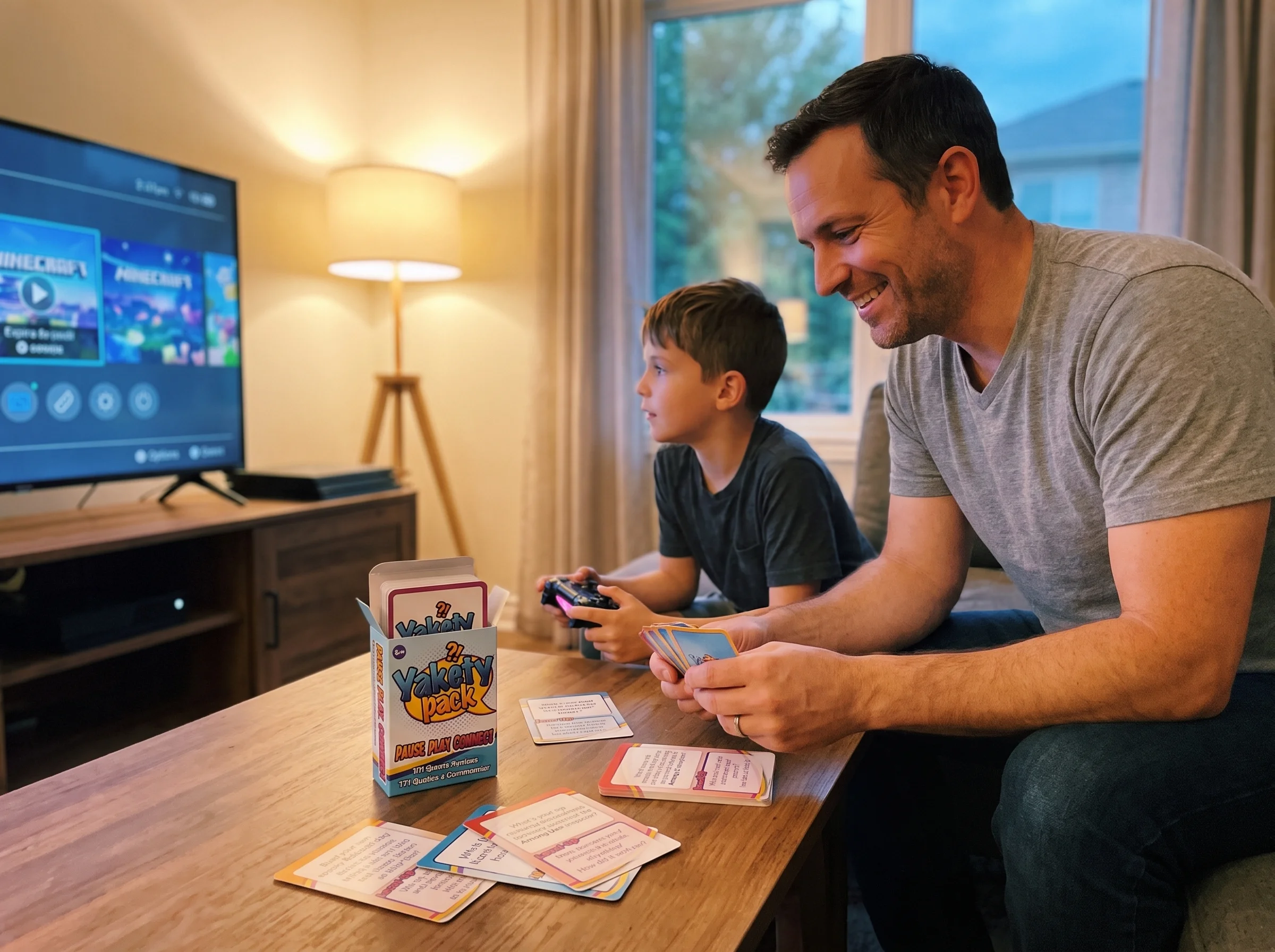
This is actually why we started building Yakety Pack. I realized my best conversations with my son started with questions about HIS world, not mine. One of our cards asks something like "What's a game character you'd want as a friend and why?" and the first time I asked my son that, he talked for 20 minutes straight about a character in a game I'd never heard of, and by the end of it I understood him better than I had in months.
You don't need a product to do this. You just need to get curious. But if you want a shortcut to better questions, that's what we built it for.
Weekends, Breaks, and When to Actually Loosen Up
The weekday/weekend distinction matters more than most parents let it.
On a school night, screen time is competing with sleep, homework, and family time. On a Saturday afternoon in February when it's raining? Different game. Long play sessions aren't inherently bad if what's happening in them is social and creative.
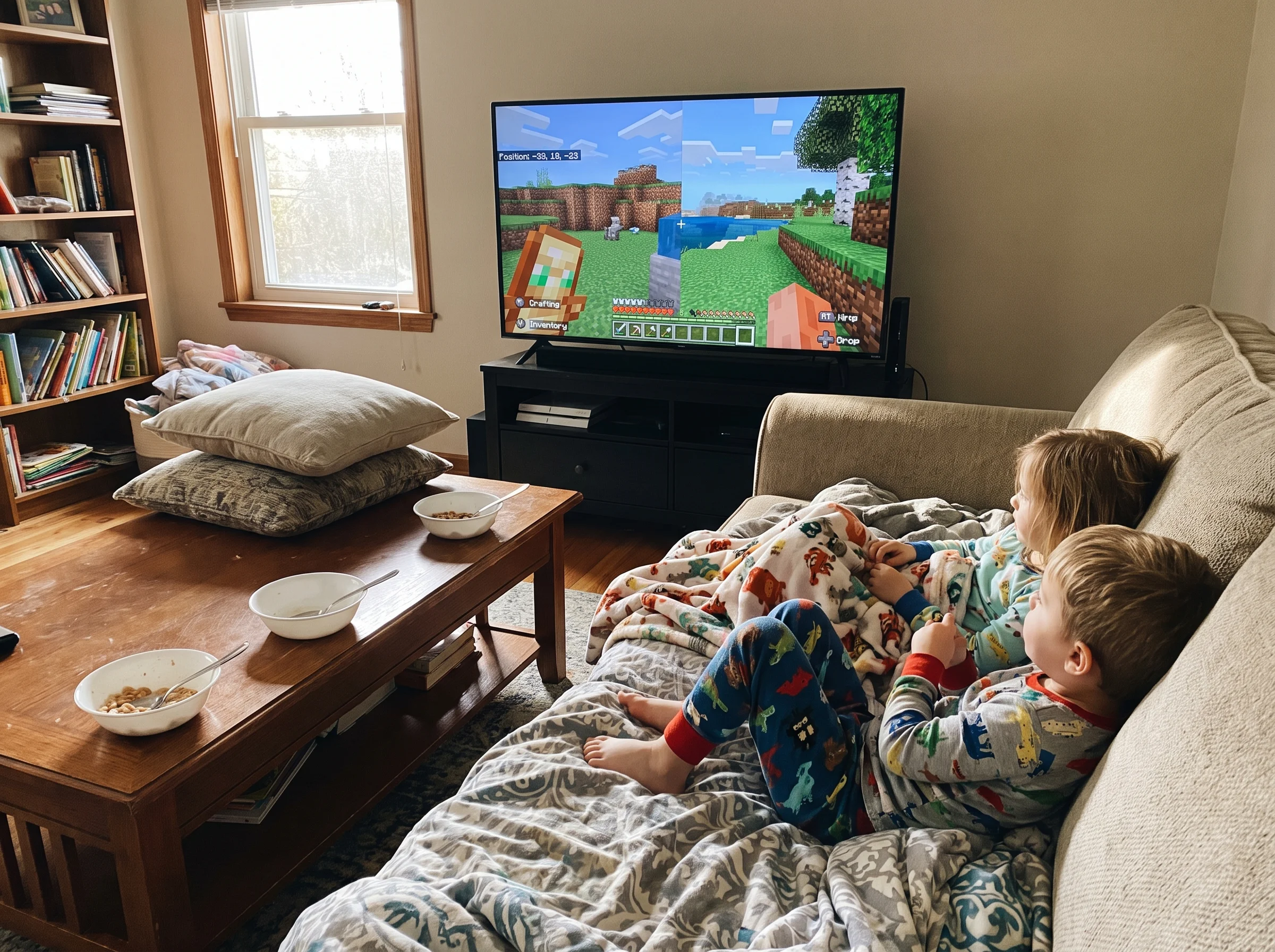
30 minutes of scrolling YouTube shorts alone is not the same thing as 3 hours of building a Minecraft world with your best friend who moved away last year. The timer treats them identically. You shouldn't.
The thing to watch is not the clock. It's what happens AFTER the game.
Green lights:
- They come off the game and talk about it
- They transition to dinner or family time without a fight
- They sleep fine
- They still care about their other hobbies, friends, sports
- Their mood is normal or even better
Red flags:
- They withdraw from things they used to love
- Sleep is getting wrecked
- The rage after gaming doesn't fade in 20 minutes
- They lie about how long they've played
- They can't imagine doing anything else
If you're seeing green lights, the amount of time matters way less than you think. If you're seeing red flags, no amount of "30 minute limits" is going to fix it, because time isn't the problem. You need a real conversation about what's actually going on. Researchers like Common Sense Media say roughly the same thing: the content and context matter more than the raw number of minutes.
Common Mistakes I Made (And See Everywhere)
Enforcing arbitrary cutoffs mid-match. You are punishing your kid for something they can't control. This one erodes trust faster than anything else.
Using screen time as a weapon. "If you don't clean your room, no Xbox." Now the game is a bargaining chip, and every negotiation is a hostage situation.
Assuming lying means they're bad. Kids lie about screen time because the rules feel unfair. Fix the rules, and half the lying disappears.
Different rules with the other parent. If your spouse has a different approach, you have to hash it out privately, not in front of the kid. Kids will exploit the gap. That's not a character flaw, that's just being a kid.
Making it about you. "I'm worried about your future." Your 10-year-old doesn't care about their future. They care about their squad tonight. Meet them where they are.
FAQ
"My kid says they can't quit mid-match. Is that true?"
Yes. In most multiplayer games, leaving mid-match penalizes their rank, hurts their teammates, or both. It's real. Ask them to show you where the "leave match" button is and what happens when they press it. You'll learn something.
"What's a fair amount of screen time for a 10-year-old?"
I'm not going to give you a number, because the number isn't the point. Look at the green lights and red flags I listed above. If your kid is sleeping, socializing, doing school, and still into other things, you're probably fine. If they're not, no magic number is going to solve it.
"Should screen time be a reward, a right, or a privilege?"
None of the above. It's an activity. Treat it like you'd treat any other activity your kid enjoys. You don't call soccer a "privilege" that you take away. You just talk about when it fits into the day.
"My kid gets angry after gaming. Should I ban it?"
Probably not, but you should investigate. Are they angry because they lost? Because teammates were mean? Because they were interrupted? Different problems, different solutions. Ask them.
"How do I set limits without ruining our relationship?"
You set them together. You explain your reasoning. You let them push back. You adjust when they make a good point. That's not weakness. That's how you raise a kid who can negotiate in the real world.
One Thing to Try Tonight
Sit next to your kid while they play. Don't say anything for 10 minutes. Then ask one specific question about what you saw.
Not "how was gaming." Something like "who's that guy in the blue skin?" or "why did you go to that spot on the map?" or "what were you and your friend laughing about?"
Watch what happens. I'm betting you get more real conversation in the next 20 minutes than you've had in the last month.
That's the whole thing. That's the entire strategy. Screen time negotiation with kids stops being a fight when you stop treating the game like an enemy and start treating it like a doorway. Walk through it with them. The rest gets a lot easier.
And if you want a hand starting those conversations, that's what we built Yakety Pack for. But even without it, tonight, try one question. See what opens up.
You've got this.
Bring one to the couchPause, Play, Connect: Core Deck172 prompts that make the one specific question easy to find on an ordinary Tuesday night.$49 CAD • 90 cards • 18 reviewsShop the deck

